8 Stages to Build A Marketplace Website

TL;DR

Online marketplaces have become a cornerstone of modern commerce, connecting buyers and sellers from all over the world. This guide explains what marketplace website development is, the main types of online marketplaces, their key benefits, and the fundamental features to build in. It then walks through 8 crucial steps to launch a marketplace website and covers the common challenges and costs.

Make a summary of this article with AI:

Where connectivity is king and convenience reigns supreme, the concept of online marketplaces has evolved from mere comfort to a cornerstone of modern commerce. Imagine this: a dynamic marketplace where buyers and sellers gather from all corners of the globe, exchanging goods, services, and ideas with just a few clicks. The charm of such a platform is definite, but the path to creating one is often complicated.

So, in this comprehensive article, we will reveal the secrets to creating a marketplace website that thrives and revolutionizes the way we buy and sell in the 21st century.

Let’s begin our development journey!

Definition of marketplace website development

Marketplace website development refers to creating an online platform where multiple third-party sellers or service providers can list their products or services for sale, and customers can browse, compare, and purchase them. It involves designing and building a digital space that facilitates transactions between buyers and sellers, offering product listings, search functionality, payment processing, messaging systems, and administrative tools. 

Marketplace website development covers various stages, from conceptualization and design to implementation, testing, and deployment.

The online marketplaces play a significant role in the e-commerce landscape. They drive substantial revenue growth, enable widespread consumer access to products and services, and empower businesses of all sizes to thrive in the digital economy.

Main types of online marketplaces

Online marketplaces serve diverse purposes and meet different needs. Understanding the main types of online marketplaces can provide insight into their functionalities, target audiences, and potential impact on various industries.

Products

Goods

These marketplaces focus on the sale of physical products. Examples include retail giants like Walmart, Amazon, and Alibaba. Consumers can browse a wide range of items, make purchases, and have them delivered to their doorstep.
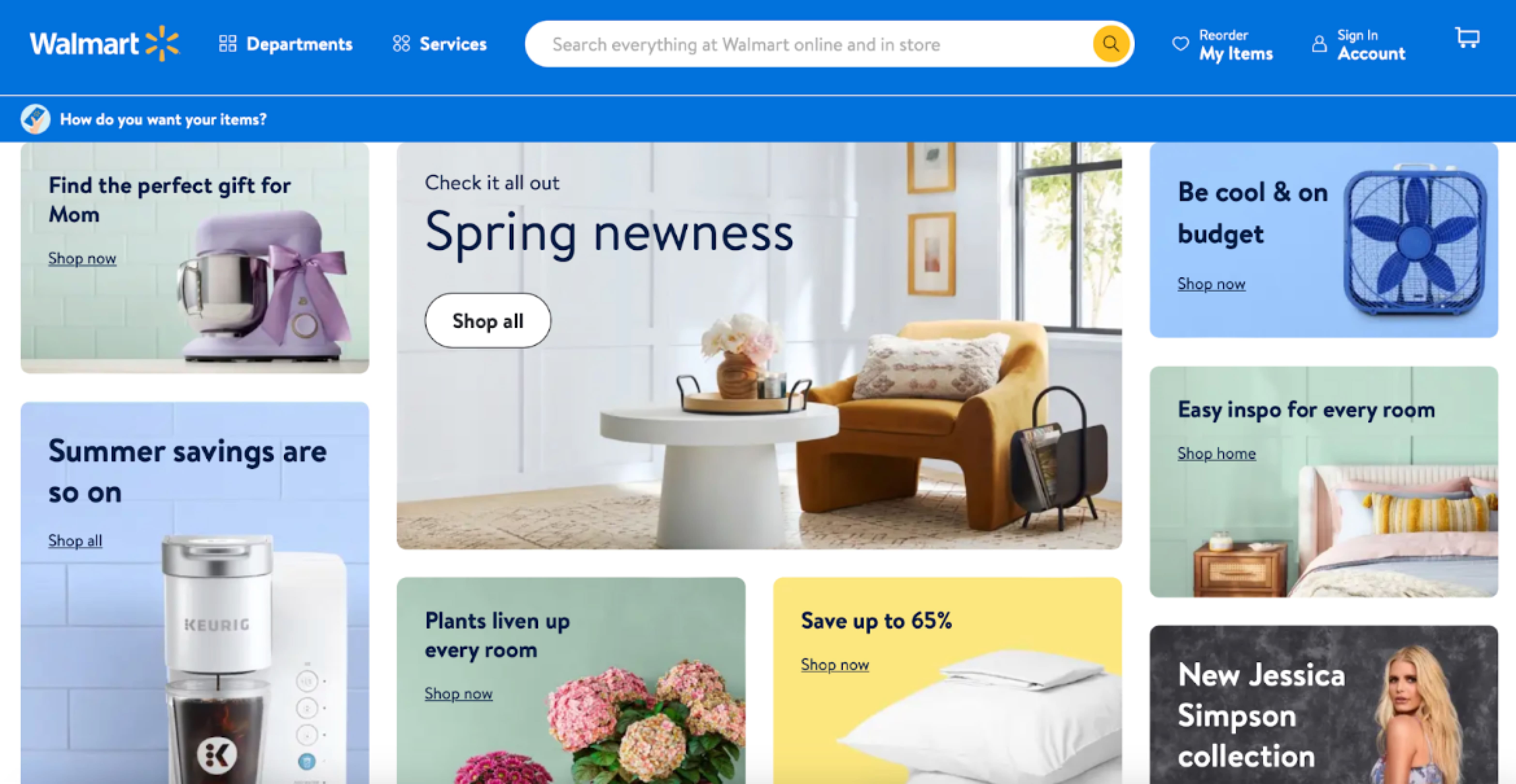
Walmart home page

Services

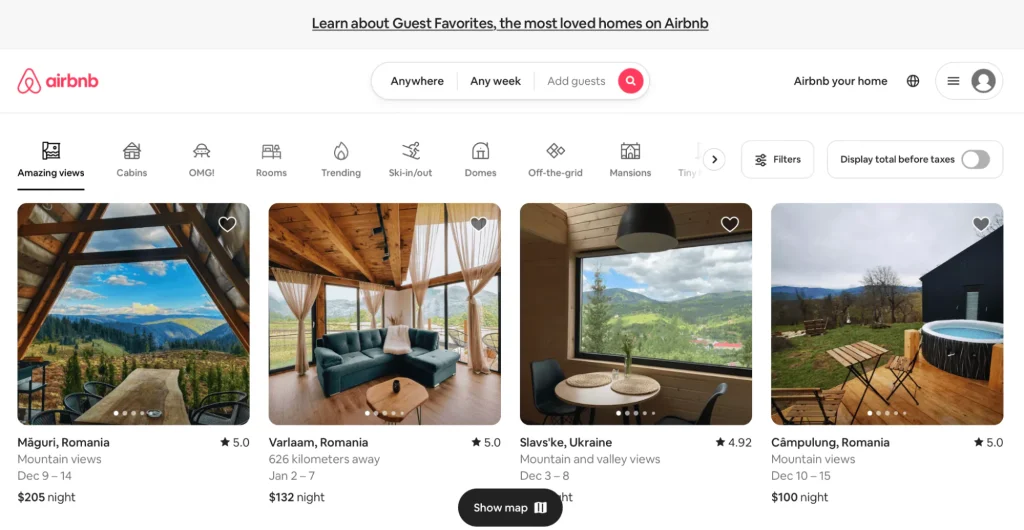
Unlike goods marketplaces, service-oriented platforms facilitate transactions for intangible offerings. Airbnb is a prime example of this, connecting travelers with hosts who offer accommodations and experiences. Other examples include TaskRabbit for odd jobs and Upwork for freelance services.
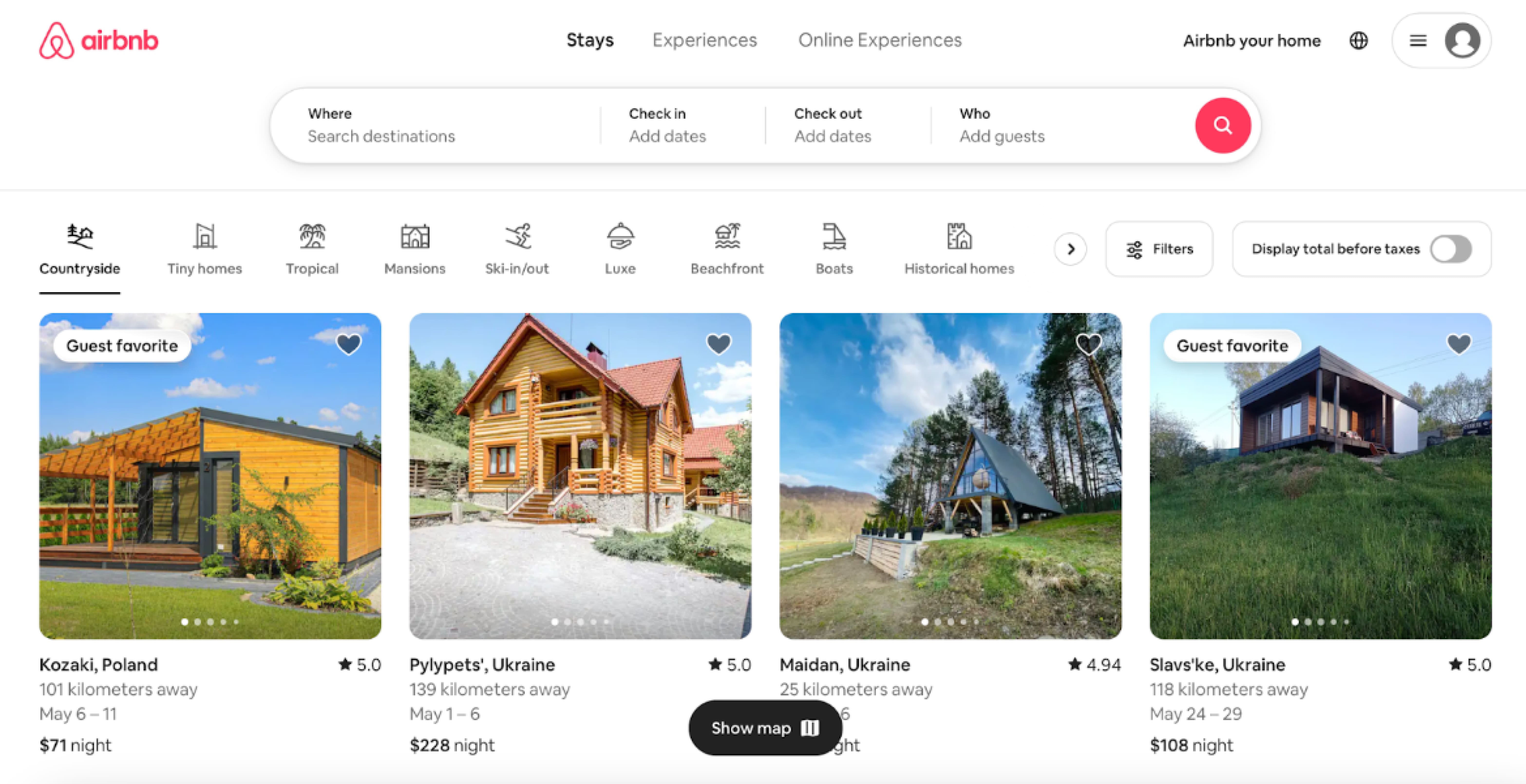
Airbnb home page

Participants

B2B (business-to-business)

These marketplaces cater to transactions between businesses. The world’s largest B2B platform, Alibaba, connects manufacturers with wholesalers and retailers globally. Companies can source products, negotiate deals, and manage supply chains efficiently.
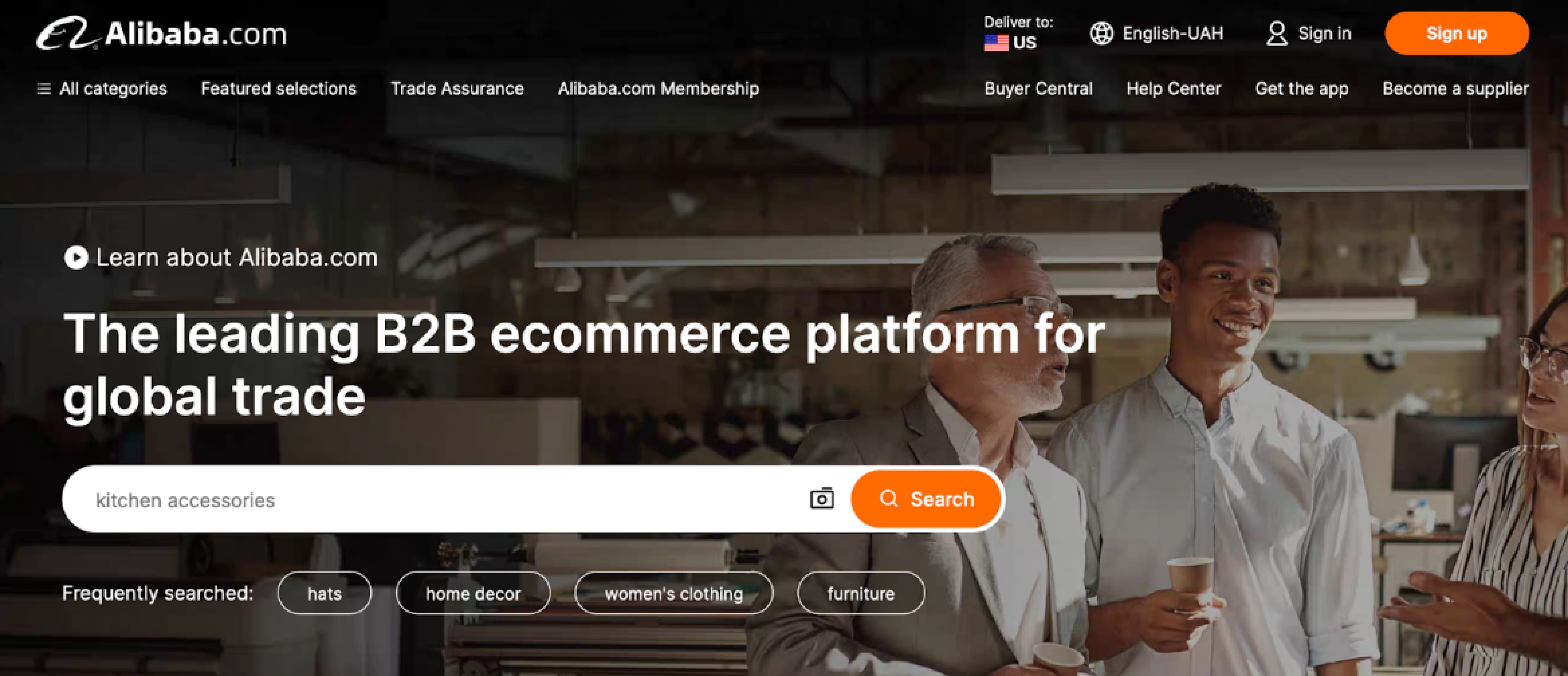
Alibaba home page

B2C (business-to-consumer)

B2C marketplaces enable businesses to sell directly to consumers. Platforms like Teachable allow individuals and companies to create and sell online courses, reaching a broad audience without the need for physical storefronts.
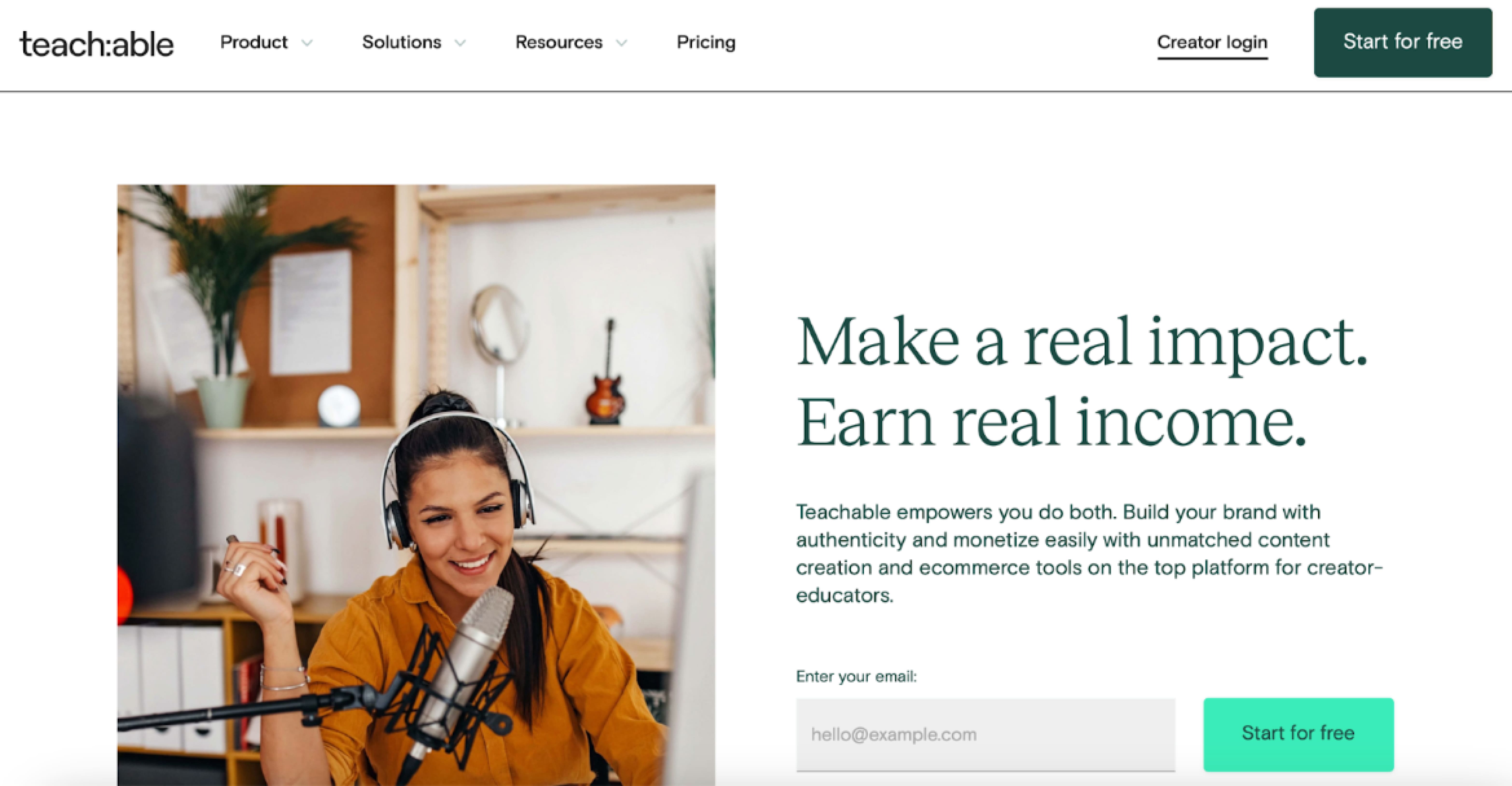
Teachable home page

C2C (consumer-to-consumer)

C2C marketplaces facilitate transactions between individual consumers. Craigslist, for instance, enables users to buy, sell, or trade various items locally. These platforms empower individuals to monetize unused items or find unique deals.
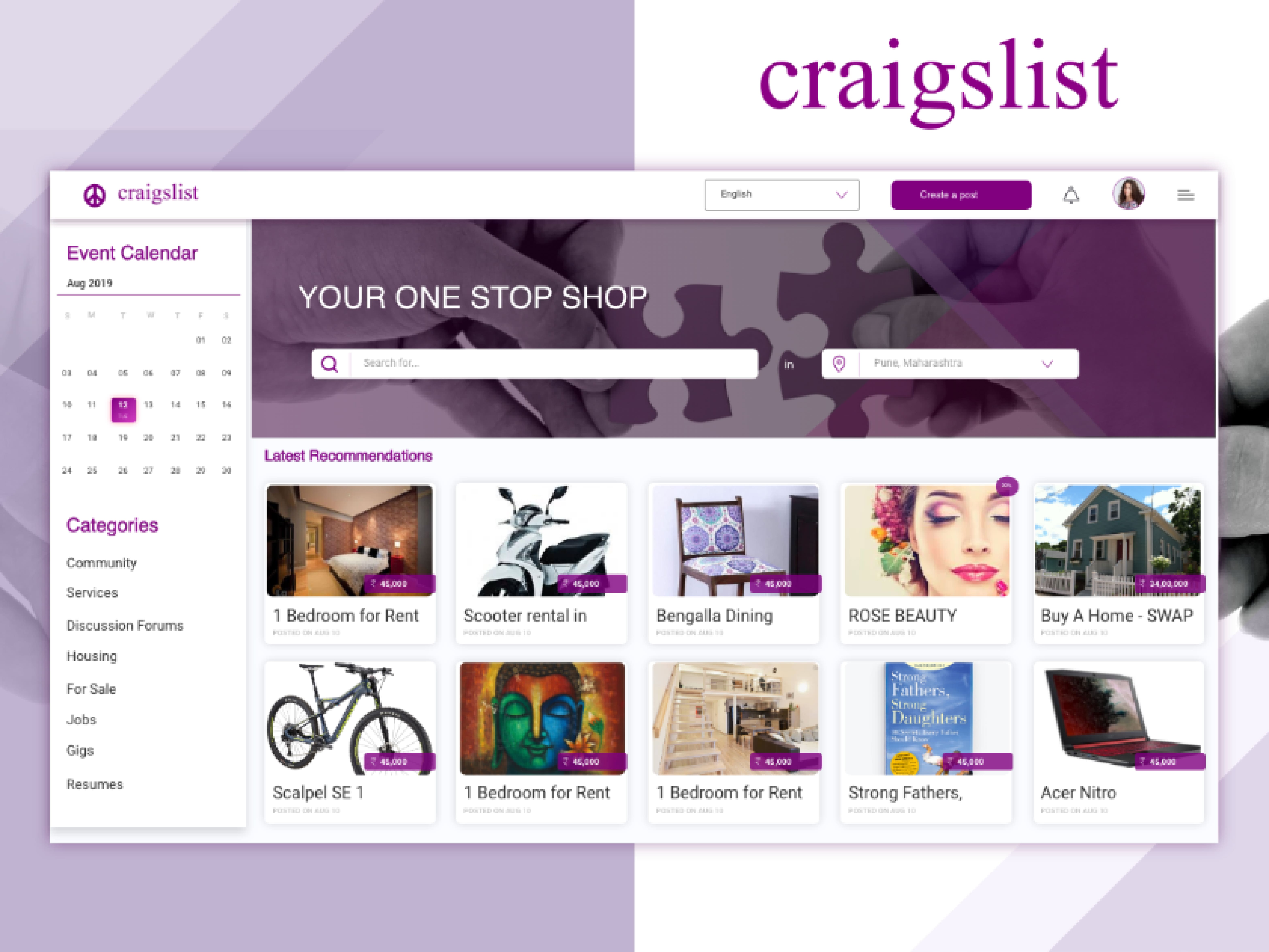
Craigslist home page

C2B (consumer-to-business)

In C2B marketplaces, consumers offer products or services to businesses. Upwork is a prominent example where freelancers offer their skills to businesses seeking specific services. This model provides flexibility for companies to access specialized talent on-demand.

Upwork home page

P2P (peer-to-peer)

P2P marketplaces connect individuals directly for transactions. Uber, for instance, connects drivers with passengers seeking rides. It eliminates the need for traditional taxi services by employing technology to facilitate peer-to-peer transportation.

Uber home page

Interaction

Online commerce

These marketplaces operate entirely online, from browsing products/services to making payments and receiving deliveries. Amazon presents this model, offering a seamless online shopping experience with various payment options and fast shipping.
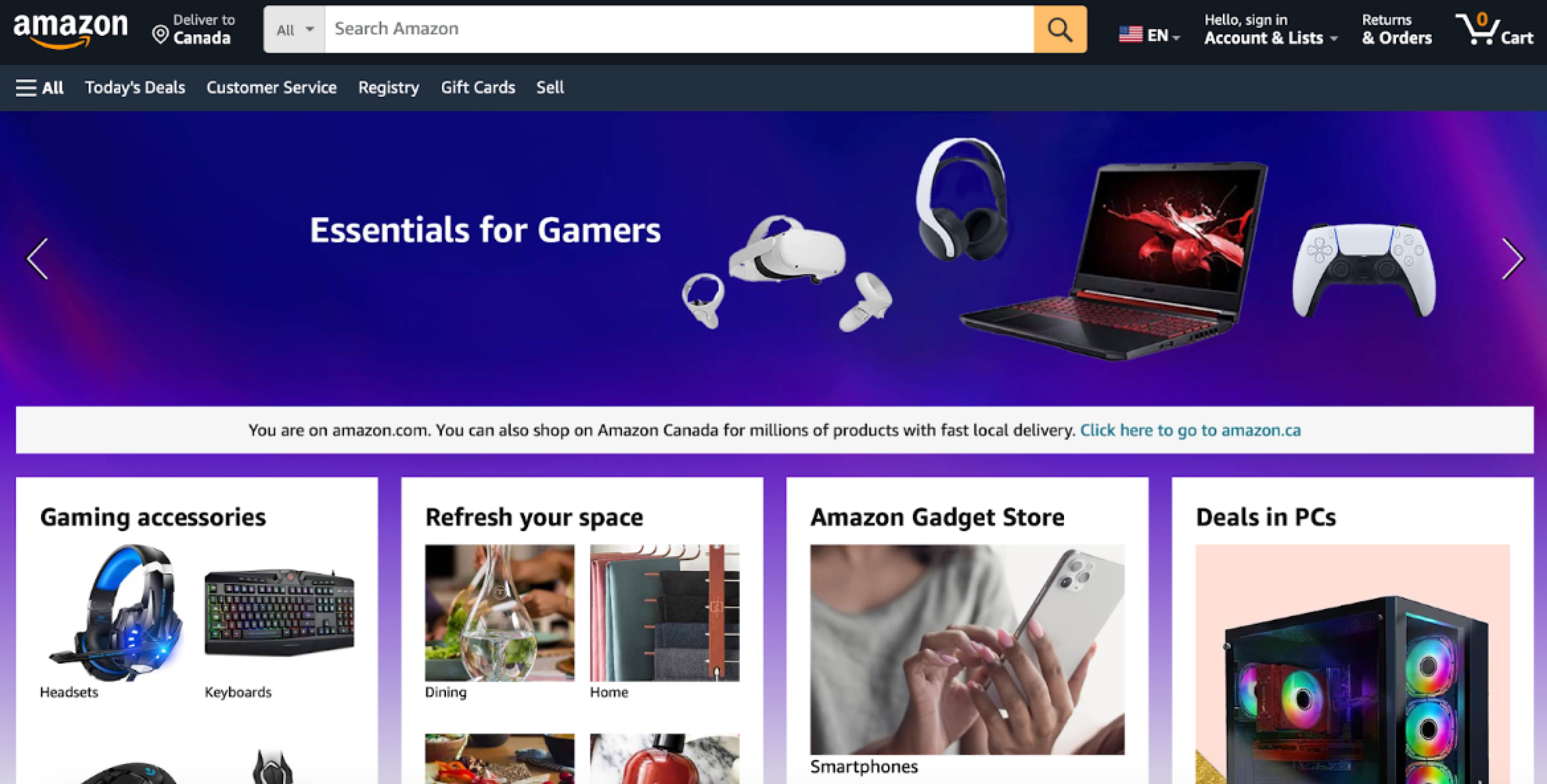
Amazon home page

 O2O (online-to-offline)

O2O marketplaces bridge the gap between online and offline experiences. eBay, for example, allows users to buy products online and pick them up in-store or vice versa. This model integrates digital and physical channels, offering consumers flexibility in interacting with the platform.
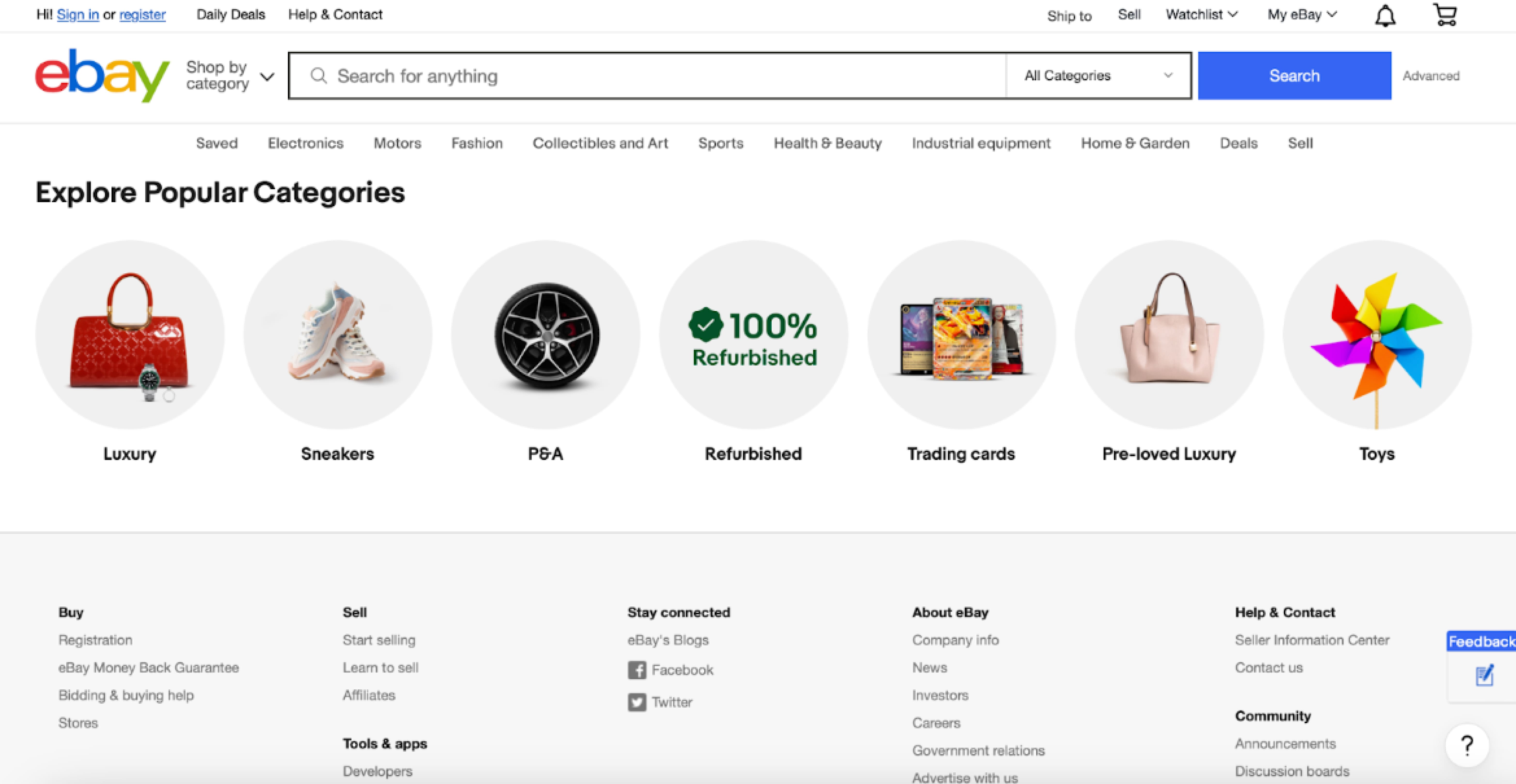
eBay home page

Focus

Horizontal

These marketplaces offer a wide range of products or services across multiple categories. Flipkart, one of India’s largest e-commerce platforms, sells everything from electronics to fashion to home appliances. These marketplaces satisfy broad consumer needs, aiming for mass appeal.
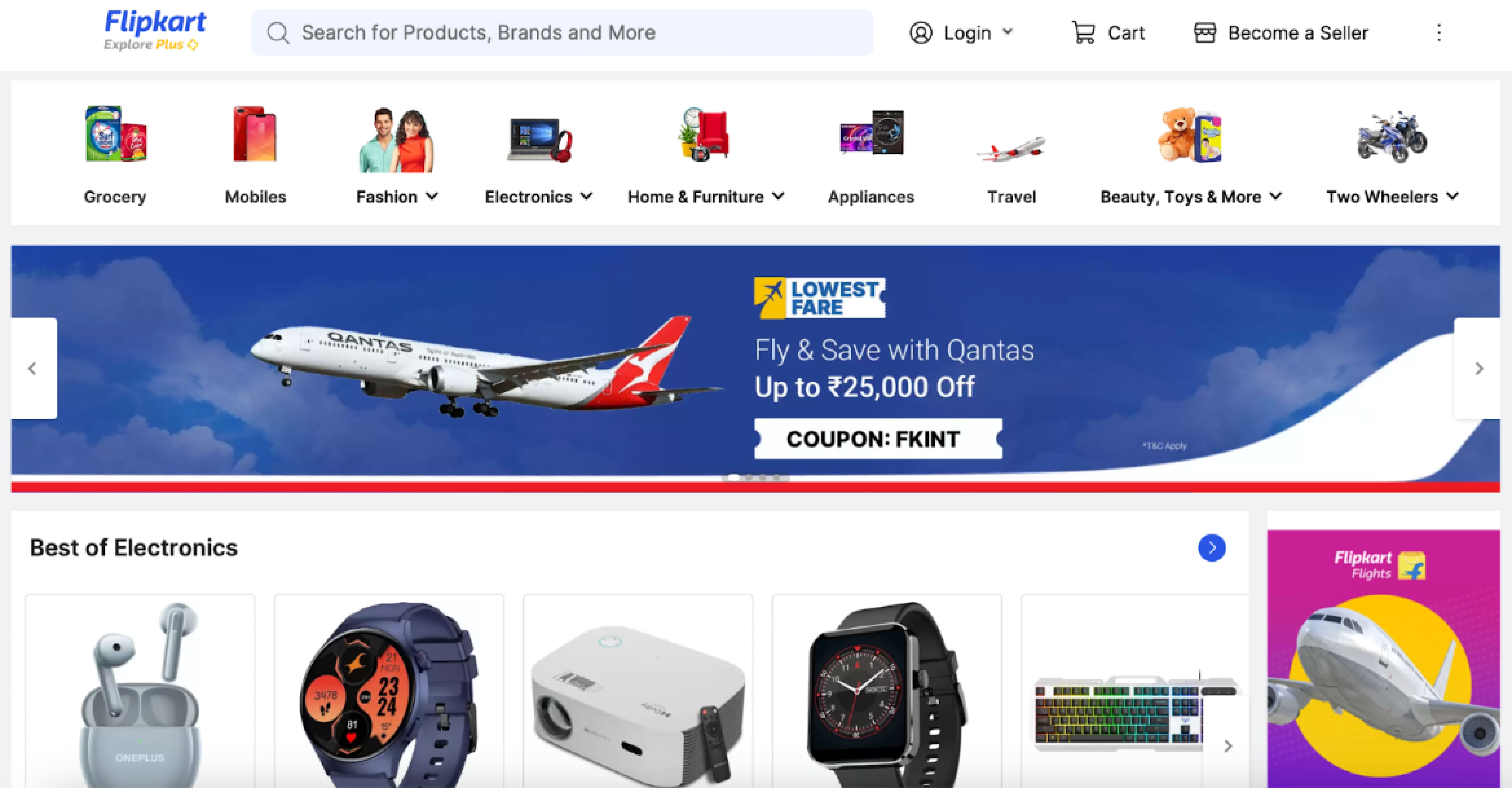
Flipkart home page

Vertical

These marketplaces focus on a specific niche or industry vertical. Etsy, for instance, specializes in handmade or vintage items and craft supplies.

Interesting

By catering to a specific audience or product category, vertical marketplaces provide curated experiences and effectively serve niche markets.
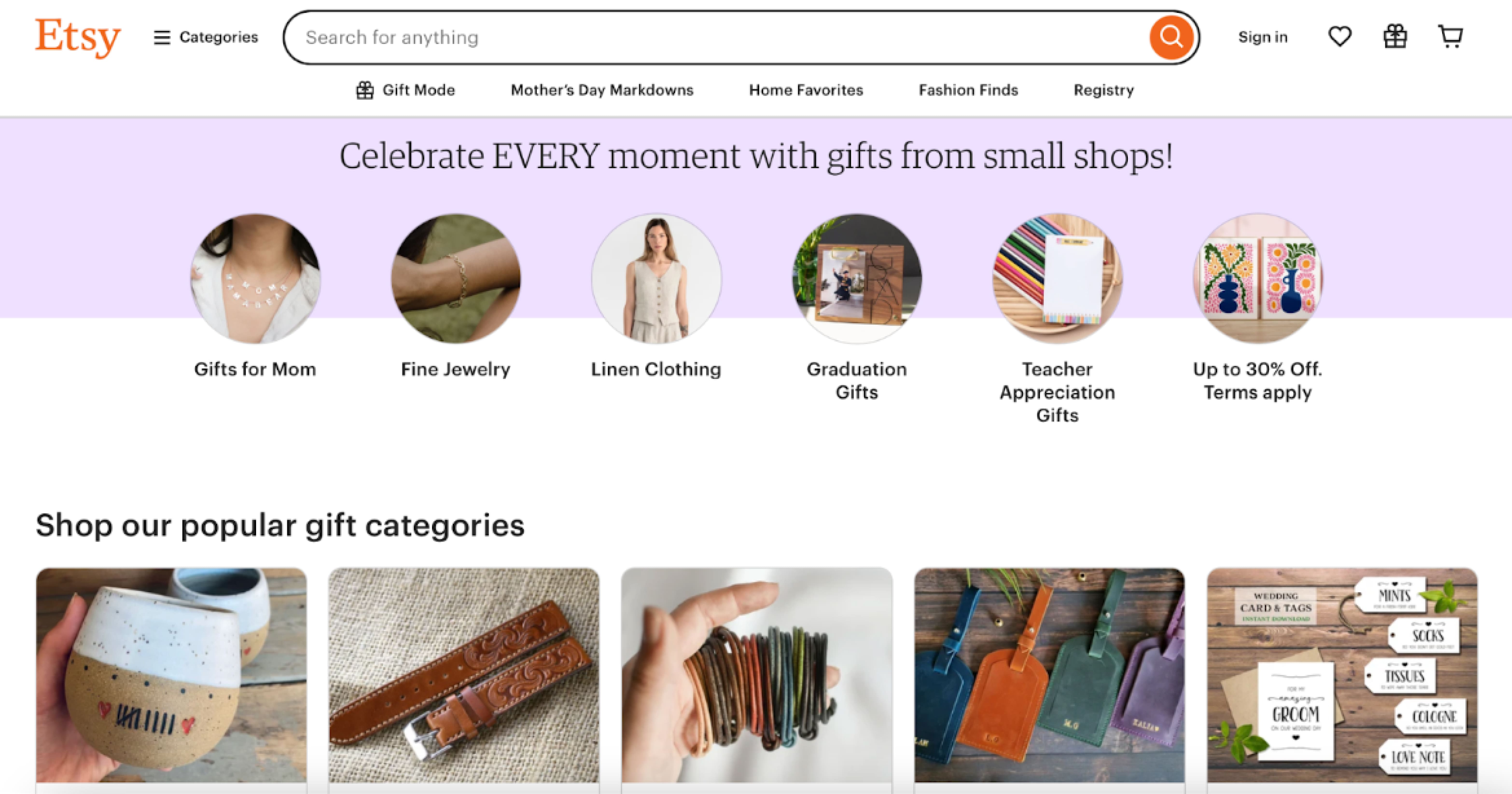
Etsy home page

Essential benefits of online marketplace development

The development of online marketplaces brings forth many benefits for businesses, consumers, and the economy at large. Let’s check the crucial advantages of online marketplace development.
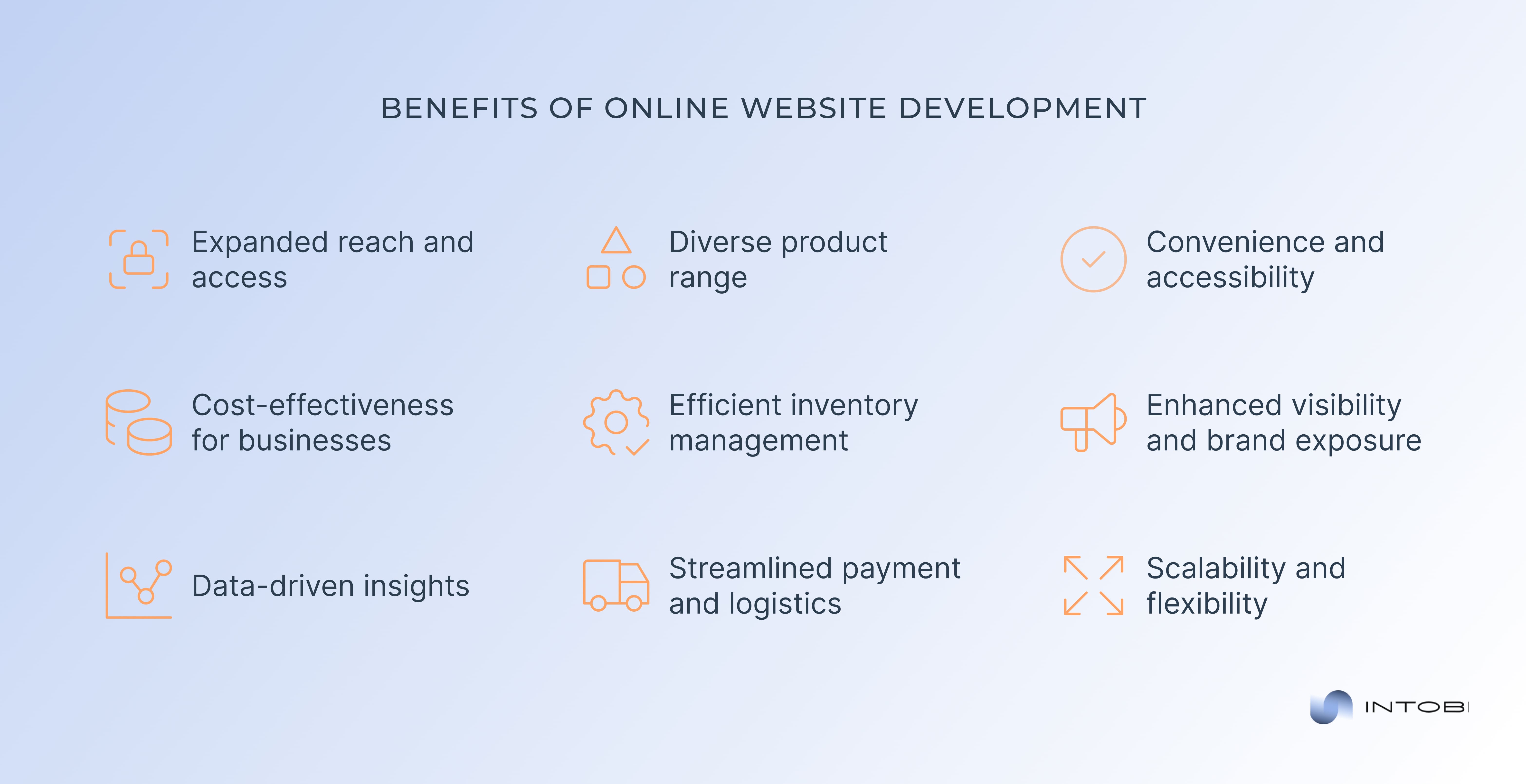
Online marketplace development advantages
  • Expanded reach and access: One of the primary benefits of online marketplace development is the ability to reach a broader audience. With the Internet breaking down geographical barriers, businesses can tap into global markets without needing physical presence in each location. This expanded reach opens up new growth and revenue generation opportunities, allowing businesses to connect with customers beyond their local vicinity.
  • Diverse product range: Online marketplaces offer consumers a vast array of products and services from various vendors all in one place. This diversity gives consumers more choice and flexibility, enabling them to easily compare prices, features, and quality. From niche products to mainstream items, online marketplaces satisfy various consumer preferences, enhancing the overall shopping experience.
  • Convenience and accessibility: The convenience of online shopping is a significant driver of its popularity. Online marketplaces allow consumers to browse, select, and purchase products from the comfort of their homes or on the go using mobile devices. This accessibility eliminates the need for physical store visits, saving time and effort for busy consumers who value convenience in their shopping experience.
  • Cost-effectiveness for businesses: Online marketplaces offer a cost-effective way to reach customers and sell products. Instead of investing in autonomous e-commerce platforms or brick-and-mortar stores, businesses can use existing marketplace infrastructures, reducing upfront costs and operational overhead. Additionally, online marketplaces often operate on a commission-based model, where companies pay fees only for successful transactions, making it a financially attractive option.
  • Efficient inventory management: Online marketplace platforms typically provide tools and functionalities for efficient inventory management. Through centralized dashboards, vendors can track their inventory levels, update product listings, and manage orders in real time. This streamlines operations and reduces the possibility of stockouts or overstocking, optimizing inventory turnover and minimizing associated costs.
  • Enhanced visibility and brand exposure: Creating an online marketplace can significantly boost a brand’s visibility and exposure to potential customers. By employing the marketplace’s existing customer base and marketing channels, businesses can increase brand awareness and attract new customers more effectively. Also, positive reviews and ratings on marketplace platforms can further enhance a brand’s reputation and credibility, fostering consumer trust.
  • Data-driven insights: With online marketplace development, platforms generate a wealth of data regarding consumer behavior, preferences, and purchasing patterns. Businesses can use this data to gain valuable insights into market trends, customer demographics, and product performance. By analyzing this information, companies can make informed decisions regarding pricing strategies, product offerings, and marketing campaigns, driving growth and profitability.
  • Streamlined payment and logistics: Online marketplaces often integrate secure payment gateways and logistics solutions to facilitate seamless transactions and order fulfillment. This simplifies the purchasing process for consumers and provides peace of mind regarding payment security and product delivery. Moreover, centralized payment processing and logistics management reduce the administrative limitation on vendors, allowing them to focus on core business activities.
  • Scalability and flexibility: Online marketplace development offers scalability and flexibility to accommodate the evolving needs of businesses and consumers. As companies grow, they can quickly scale their operations within the marketplace environment, adding new products, expanding into new markets, or integrating additional features and functionalities. This scalability ensures that businesses can adapt to changing market dynamics and stay competitive in the long run.

In general, businesses can unlock new opportunities for revenue generation, customer engagement, and market expansion in the digital age by using the power of online marketplace development.

Want to build your marketplace website?

Let’s chat

Fundamental features to build a marketplace website

Creating a marketplace website requires careful planning and integrating essential features that satisfy the needs of both sellers and buyers. When launching a niche platform for handmade crafts or a comprehensive marketplace for various goods and services, certain features are necessary for driving engagement, facilitating transactions, and ensuring a seamless user experience.

Let’s explore the top features to consider when building a marketplace website.

User-friendly interface and navigation

A user-friendly interface is important for engaging visitors and guiding them through the marketplace seamlessly. Implement intuitive navigation with precise categorization and search functionality, allowing users to find products or services efficiently. Ensure a responsive design that adapts to various devices, providing a consistent experience across desktops, tablets, and smartphones.

Robust user profiles and authentication

Enable users to create comprehensive profiles that showcase their identity, preferences, and past transactions. Implement secure authentication mechanisms, such as email verification or social media log-in, to ensure the integrity of user accounts and foster trust within the marketplace community. Offer options for individual and business profiles, catering to diverse seller and buyer demographics.

eBay account registration

Advanced search and filtering options

Integrate advanced search and filtering options to empower users to effectively narrow their search results. Allows users to filter by categories, price range, location, ratings, and other relevant criteria, enabling them to find precisely what they’re looking for amidst a vast array of offerings. Implement autocomplete and suggestion features to enhance the search experience further.

Comprehensive product listings

Provide sellers with robust tools for creating detailed product listings that captivate potential buyers. Include options for high-quality images, descriptive titles, detailed descriptions, pricing, shipping information, and customizable attributes. These listings also enable sellers to manage their inventory, update product availability, and communicate with buyers directly through the platform.

Secure payment gateway integration

Ensure seamless and secure transactions by integrating trusted payment gateways that support various payment methods, including credit/debit cards, digital wallets, and bank transfers. Implement SSL encryption to safeguard sensitive financial information and instill confidence in buyers. Offer transparent pricing structures and communicate any applicable fees or charges.

Rating and review system

Foster transparency and accountability within the marketplace by implementing a robust rating and review system. Allow buyers to rate sellers and leave feedback based on their purchasing experience, product quality, and overall satisfaction. Display ratings and reviews prominently on product pages to guide future purchasing decisions and cultivate trust among users.

Messaging and communication tools

Facilitate seamless communication between buyers and sellers through integrated messaging tools or chat systems. Enable users to inquire about products, negotiate prices, and address concerns directly within the platform. Implement notifications and alerts to inform users about new messages, order updates, and important announcements.

Order management and tracking

Provide comprehensive order management tools that allow sellers to track orders, manage shipments, and update the order status in real-time. Enable buyers to track the progress of their orders, view shipping details, and receive notifications at critical milestones, such as order confirmation, shipment, and delivery. Offer options for returns, refunds, and dispute resolution to ensure a fair and satisfactory transaction process.

Analytics and reporting dashboard

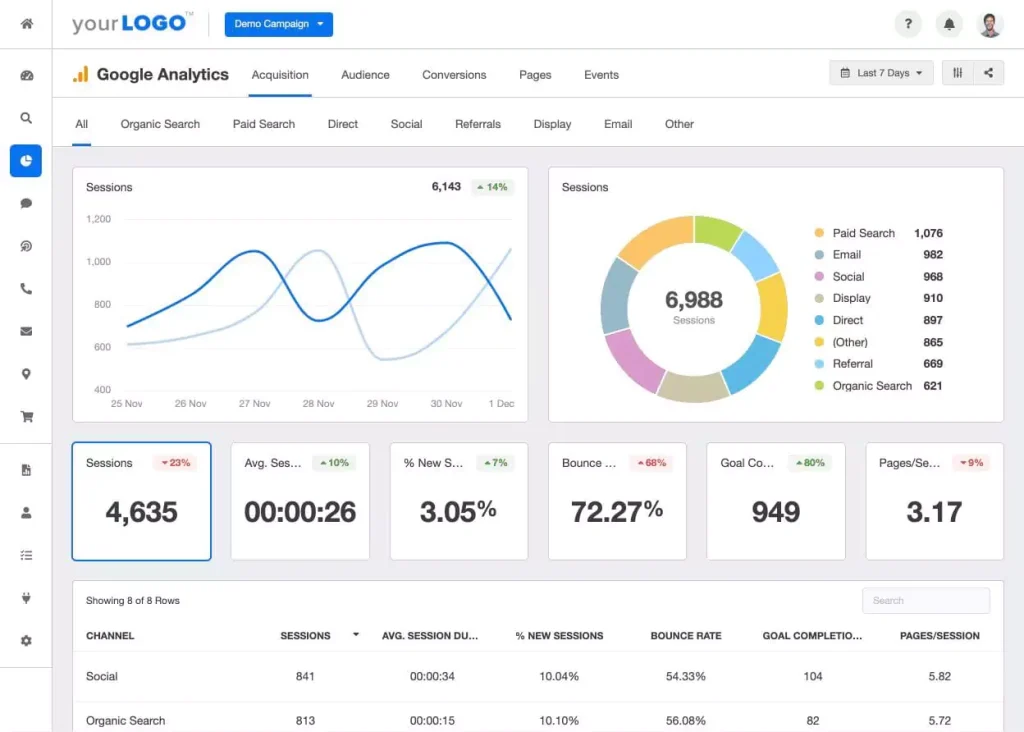
An analytics and reporting dashboard empowers sellers with insights into their performance and sales metrics. It provides visualizations of key metrics, such as sales volume, revenue, conversion rates, and customer demographics. The dashboard offers actionable insights and recommendations to help sellers optimize their listings, pricing strategies, and marketing efforts.

Multi-language and multi-currency supportProvide a global audience with multi-language and multi-currency support within the online marketplace development platform. Allow users to switch between languages and currencies seamlessly, ensuring accessibility and inclusivity for international buyers and sellers. You can implement localized content and pricing to enhance the user experience for users from different regions.

Сhoice of languages/currencies on the Alibaba platform

Social media integration and marketing tools

Use social media integration to boost your marketplace’s reach and facilitate user engagement. Allow users to share products or listings effortlessly on social media platforms, extending your marketplace’s visibility and driving organic traffic. Provide marketing tools, such as promotional banners, discount codes, and affiliate programs, to stimulate user participation and expand sales.

Customization options

Design your marketplace website with scalability and flexibility, allowing for future growth and expansion. Choose a robust e-commerce platform or build a custom solution that can accommodate increasing traffic, transactions, and user interactions. Offer customization options for branding, layout, and functionality to meet the unique needs of your marketplace niche.

Thus, incorporating these top features into your marketplace website lays the foundation for a successful online platform. By prioritizing user experience, security, transparency, and functionality, you can create a marketplace website that attracts users, fosters trust, and drives sustainable growth in the competitive e-commerce field.

8 crucial steps to build a marketplace website

Online marketplaces have become integral parts of the modern economy, facilitating transactions across a wide range of industries and verticals. From retail and hospitality to services and rentals, marketplaces provide a centralized platform where buyers and sellers can connect, transact, and exchange value. The rise of mobile technology and the Internet has further accelerated the growth of online marketplaces, enabling seamless transactions and global reach. Let’s check the main phases when creating an online marketplace:
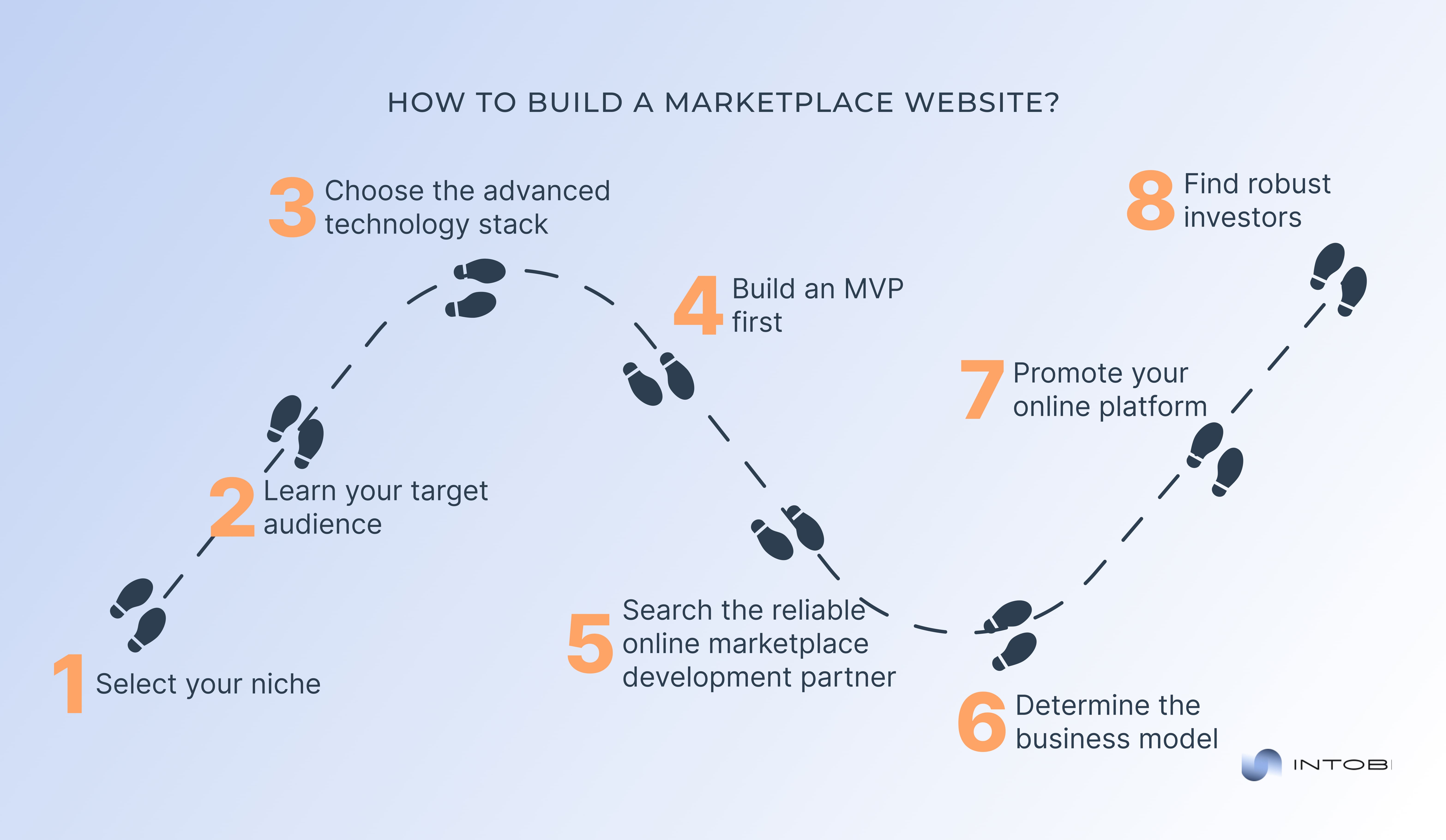
Main steps to create a marketplace website

1. Select your niche 

The first step in building a marketplace website is to choose your niche. Selecting a niche allows you to focus on a specific market segment or industry with a demand for your products or services.

This targeted approach helps you differentiate your marketplace from competitors and attract a loyal customer base. When selecting your niche, consider factors such as market size, competition, profitability, and your own interests and expertise.

2. Learn your target audience

Understanding your target audience is crucial for the success of your marketplace website development. By conducting thorough market research, you can gain insights into your potential customers’ demographics, preferences, behavior patterns, and pain points. This knowledge allows you to tailor your marketplace offerings, user experience, and marketing strategies to better meet your audience’s needs and drive engagement and conversions.

To effectively learn about your target audience, employ a variety of research methods, including surveys, interviews, focus groups, and data analysis. Utilize qualitative and quantitative data to comprehensively understand your audience’s needs, preferences, and behaviors. Identify critical demographics like age, gender, location, income level, and interests, and segment your audience based on common characteristics or behaviors. 

It is vital to analyze trends and patterns in consumer behavior, such as purchase habits, product preferences, and decision-making processes. Try identify opportunities and challenges in your target market.

In addition to understanding your audience’s demographics and behaviors, delve into their psychographics to uncover more profound insights into their motivations, values, and aspirations. Explore factors such as lifestyle choices, personality traits, and cultural influences that shape your audience’s purchasing decisions and preferences. 

By understanding the underlying motivations and emotions driving consumer behavior, you can create more targeted and compelling marketing messages, product offerings, and user experiences that resonate with your audience on a deeper level.

3. Choose the advanced technology stack

Selecting the right technology stack is essential for robust and scalable marketplace website development. Your choice of back-end, front-end, and mobile development technologies will impact performance, scalability, security, and developer productivity. Consider factors such as your project requirements, budget, timeline, and team expertise when choosing your technology stack.

Here’s an overview of some popular technologies used in marketplace website development:

  • Back-end technologies: Node.js/NestJS, C#/.NET, PHP (Laravel, Symfony), Python (Django, FastAPI, Flask).
  • Front-end technologies: React.js/Next.js, Vue.js/Nuxt, Angular.
  • Mobile app development: Swift, Kotlin, Flutter, Kotlin Multiplatform.

When choosing your technology stack, prioritize compatibility, flexibility, and scalability to accommodate future growth and evolution of your marketplace platform.

For businesses planning a scalable marketplace platform, web development services can help turn core features, integrations, and user flows into a reliable online product.

Consider factors such as integration capabilities, community support, documentation, and developer tools and resources available for each technology stack. 

Collaborate with your development team to assess the pros and cons of each technology option and make informed decisions based on your project requirements and objectives.

4.  Build an MVP first

Instead of developing a fully-featured platform from the get-go, start with a minimum viable product (MVP). An MVP allows you to validate your marketplace idea with minimal resources and gather feedback from early users. By focusing on core features that address the primary needs of your target audience, you can iterate quickly, minimize development costs, and reduce the time to market. Common features in your MVP may include user registration, product listings, search functionality, and basic transaction capabilities.

When building your MVP, prioritize features that provide the most value to your users and differentiate your marketplace from competitors. Focus on solving a specific problem or addressing a particular pain point in your target market to attract early adopters and build momentum.

Incorporate feedback loops and mechanisms for collecting user feedback and data analytics to track user behavior, preferences, and engagement with your MVP. Use this feedback to iteratively refine and enhance your marketplace platform, adding new features and functionalities based on user needs and market demand.
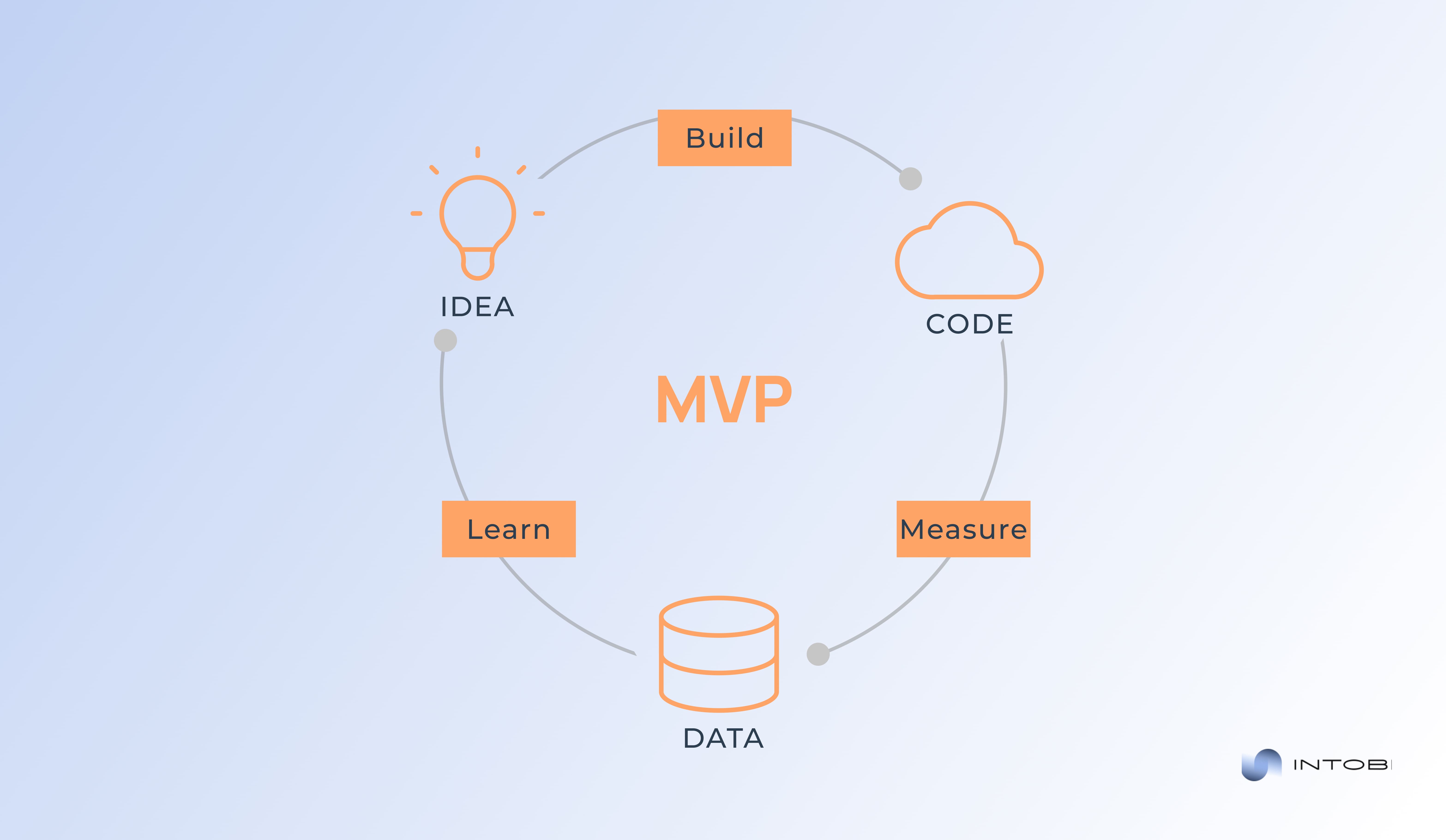
MVP feedback loop

5. Search the reliable online marketplace development partner

Collaborating with an experienced and reputable development partner can streamline the process of building a marketplace website. Look for a company or team with a proven track record in developing similar projects, industry expertise, and a collaborative approach to work. A reliable development partner can offer valuable insights, technical expertise, and project management support throughout development, helping you bring your marketplace vision to life effectively and efficiently.

When searching for a development partner, consider their portfolio of past projects, client testimonials and references, expertise in relevant technologies and industries, and communication and collaboration processes. Schedule initial consultations or discovery sessions to discuss your project requirements, goals, and expectations with potential development partners. Evaluate their perception of your vision and objectives, as well as their proposed approach and timeline for the project.

So, choose a development partner who understands your marketplace concept deeply, shares your vision and values, and is committed to delivering high-quality results within your budget and timeline constraints.

6. Determine the business model

Your marketplace’s business model will define how you generate revenue from your platform. There are various monetization strategies to consider, each with its own advantages and challenges. Here are some standard business models used in online marketplace development:

  • Commission. Charge a percentage of each transaction facilitated through your platform.
  • Listing fee. Charge sellers a fee to list their products or services on your marketplace.
  • Advertisement. Display targeted ads to users and charge advertisers for placement.
  • Freemium. Offer basic features for free and charge for premium features or services.
  • Membership. Charge users a subscription fee for exclusive benefits or features.

For marketplaces built around freemium, membership, or subscription models, SaaS development services can help implement scalable user management, billing, and feature access.

Choosing a suitable business model depends on factors such as your target market, competitive landscape, value proposition, and long-term growth strategy. Experimentation and iteration may be necessary to find your marketplace’s most effective monetization approach.

When picking your marketplace’s business model, consider factors such as the nature of your marketplace, the needs and preferences of your target audience, and the competitive dynamics in your industry. Evaluate the strengths and weaknesses of each monetization strategy for your marketplace concept, user experience, and revenue potential.

On the other hand, conduct market research and competitor analysis to identify successful examples of similar business models in your industry and learn from their strategies and best practices. Test different monetization approaches through pilot programs or A/B testing to gauge user response and optimize your revenue model based on real-world feedback and data.

7. Promote your online platform

Marketing and promotion are essential for attracting users to your marketplace website and driving engagement and transactions. Develop a comprehensive marketing strategy that uses a mix of digital marketing channels, such as social media, content marketing, email marketing, search engine optimization (SEO), and influencer partnerships. 

Tailor your messaging and tactics to resonate with your target audience and communicate your marketplace’s unique value proposition. Continuously monitor and analyze your marketing efforts to optimize performance and maximize ROI (return on investment).

To promote your online platform effectively:

  1. Develop a multi-channel marketing strategy that reaches your target audience across various touchpoints and platforms. Based on factors such as your target audience demographics, behavior patterns, and media consumption habits, identify the most relevant and impactful marketing channels for your marketplace. Allocate your marketing budget and resources strategically to maximize reach and impact while minimizing waste and inefficiency.
  2. Use the power of content marketing to educate, inspire, and engage your target audience and build brand awareness and credibility for your marketplace website development. Create high-quality, informative, and relevant content that addresses your audience’s needs, interests, and pain points and showcases your marketplace’s value proposition. Distribute your content across various channels, such as your website, blog, social media profiles, email newsletters, and industry publications, to reach a wider audience and drive traffic to your platform.
  3. Utilize social media marketing to connect with your audience, foster community engagement, and build relationships with potential users and stakeholders. Develop a cohesive social media strategy that aligns with your brand identity, messaging, and objectives and utilizes various social media platforms to reach different segments of your target audience. Create engaging and shareable content that encourages likes, comments, shares, and other forms of interaction and enables users to visit your marketplace website and explore your offerings.
  4. Invest in SEO to improve your marketplace’s visibility and rankings in search engine results pages (SERPs) and drive organic traffic to your website. Conduct keyword research to identify relevant and high-volume search terms for your marketplace niche and target audience. Optimize your website’s on-page elements, such as meta tags, headings, and content, to include target keywords and improve search engine crawlability and indexing. Build high-quality backlinks from reputable and relevant websites to increase your website’s authority and credibility in the eyes of search engines.

8. Find robust investors

Securing funding from investors can provide the capital needed to scale your marketplace business and fuel growth. Prepare a compelling business plan and pitch deck that clearly articulates your marketplace’s value proposition, market opportunity, revenue model, and growth strategy. Identify potential investors with a track record of investing in marketplace businesses or aligning with your industry or vision. 

Build relationships with investors through networking events, pitch competitions, and introductions from mutual connections. Be ready  to demonstrate traction, validate your business model, and showcase your team’s expertise and capabilities to attract investor interest and support.

When seeking investment for your marketplace website development, consider different funding sources, such as venture capital, angel investors, crowdfunding, or strategic partnerships. Evaluate the pros and cons of each funding option based on factors such as investment size, dilution, control, and strategic alignment. 

Tailor your pitch and investment proposal to each investor’s preferences, interests, and investment criteria to increase your chances of securing funding. Highlight your marketplace’s key milestones, achievements, and traction to date and outline your plans for future growth and expansion.

Prepare a detailed financial model and projections demonstrating your marketplace business’s revenue potential, profitability, and scalability. Include key metrics and performance indicators, such as customer acquisition cost (CAC), customer lifetime value (CLV), churn rate, and gross margin, to provide investors with a clear understanding of your marketplace’s financial health and growth trajectory. 

Address potential risks and challenges facing your marketplace business and outline contingency plans and mitigation strategies to reassure investors and build confidence in your ability to execute your business plan successfully.

Engage with investors in a transparent, professional, and responsive manner throughout the fundraising process. Be open to feedback and constructive criticism, and be prepared to address any concerns or objections investors raise. Build rapport and trust with investors by demonstrating integrity, honesty, and accountability in your interactions and decision-making. Negotiate investment terms and agreements that align with your marketplace’s goals and values while also meeting the expectations and requirements of your investors. 

Close the deal with clear communication, documentation, and legal agreements to formalize the investment and set the stage for future collaboration and partnership.In general, by following the steps outlined in this guide and staying adaptable to market dynamics and user feedback, you can create an online marketplace that connects buyers and sellers, drives value, and fosters growth in your chosen niche. Remember to prioritize user experience, build trust and credibility, and continuously innovate to stay ahead of the competition in the dynamic online marketplace development industry.

Searching for a reliable development partner?

Contact us

Common challenges of building an online marketplace

Building an online marketplace can be an exciting initiative, offering vast opportunities for entrepreneurs to connect buyers and sellers in a digital space. However, among the allure of success lie numerous challenges that must be navigated effectively. From technological hurdles to trust and scalability issues, the path to creating a thriving online marketplace is fraught with obstacles.

Here are some of the key challenges:

  • User acquisition: Attracting users, both buyers and sellers, to the platform is a significant hurdle. Initially, there may be a chicken-and-egg problem—sellers won’t join without buyers, and buyers won’t visit without a diverse range of products or services. Effective marketing strategies, such as targeted advertising, social media campaigns, and referral programs, are essential to kickstart user acquisition.
  • Building trust: It is essential in any marketplace, particularly in an online environment where transactions occur remotely. Establishing credibility and fostering trust among users is a formidable challenge. Implementing robust verification processes, facilitating transparent communication channels, and incorporating user reviews and ratings can help build trust over time.
  • Managing supply and demand: Balancing supply and demand dynamics is crucial for the sustainability of an online marketplace. Ensuring an adequate number of sellers to meet buyer demand without oversaturating the market requires careful monitoring and management. Dynamic pricing mechanisms, inventory management tools, and seller motivations can help address supply and demand fluctuations.
  • Logistics and fulfillment: Efficient logistics and fulfillment processes are essential for a seamless customer experience. Coordinating shipping, tracking orders, and managing returns can be complex, particularly for marketplaces with diverse products and sellers. Integrating with reliable logistics partners and implementing streamlined fulfillment solutions are critical to overcoming this challenge.
  • Regulatory compliance: Guiding regulatory requirements and compliance standards can be a significant hurdle, especially in highly regulated industries such as finance, healthcare, or e-commerce. Ensuring adherence to data protection laws, consumer rights regulations, and tax obligations adds another layer of complexity to the marketplace operation. Collaborating with legal experts and staying abreast of regulatory changes is essential to reduce legal risks.
  • Monetization strategy: Developing a sustainable monetization strategy is vital for the long-term viability of the marketplace. Determining the most effective revenue model—whether through transaction fees, subscription plans, advertising, or premium features—requires careful consideration of the market dynamics and user behavior. Balancing revenue generation with providing value to users is a delicate balancing act.
  • Competition and differentiation: The online marketplace landscape is highly competitive, with established players dominating many sectors. Differentiating your platform from competitors and creating a unique value proposition is a significant challenge. Innovating with features, offering superior customer service, and targeting niche markets can help distinguish your marketplace in a crowded field.
  • Cybersecurity and fraud prevention: Protecting the platform and its users from cyber threats, fraud, and data breaches is a constant battle. Implementing robust security measures, including encryption, authentication protocols, and fraud detection algorithms, safeguards sensitive information and maintains trust. Regular security audits and proactive risk management are critical for mitigating cybersecurity risks.

In fact, with careful planning, innovative solutions, and relentless perseverance, these challenges can be overcome, paving the way for a successful and sustainable online marketplace development.

Cost of creating a marketplace website

The cost of creating a marketplace website can vary significantly depending on various factors, including the complexity of the platform, features required, technology stack, design requirements, and development resources. Here’s a breakdown of the critical cost considerations:

How much does it cost to create an online marketplace website?
FeaturesTime, hoursCost ($50/h)
Design
UX development42$2,100
UI development56$2,800
Architecture
Project setup16$800
DB structure32$1,600
Integrations
Payment32$1,600
Shipment32$1,600
Main functionality
Authorization and security72$3,600
User profiles42$2,100
Homepage84$4,200
Search and filters96$4,800
Product page42$2,100
Reviews and ratings48$2,400
Shopping cart64$3,200
Payments42$2,100
Notifications32$1,600
Buyer panel120$6,000
Vendor panel164$8,200
Admin panel192$9,600
Non development activity
Project management48$2,400
Quality assurance64$3,200
Code review48$2,400
Total1368$68,400

Insights and innovations in online marketplace building at Intobi 

At Intobi, we deliver advanced online marketplace development services. Our focus is on creating a platform that seamlessly connects buyers and sellers, fostering a dynamic commerce ecosystem. We use the latest technologies to ensure a user-friendly experience, with intuitive navigation and robust security measures in place.

Our specialists understand the importance of customization and scalability. We’re creating a marketplace that can adapt to various industries and businesses’ unique needs, allowing for flexible integration of features and functionalities. From product listings to payment processing, we’re committed to delivering a comprehensive marketplace solution that empowers businesses to thrive in the digital economy.

Now, let’s check our exciting case study.

Chaumet

It is an exclusive ecommerce solution specializing in jewelry that mixes technology, emotion, and passion. We aimed to develop a user-friendly platform for seamless online shopping, prioritizing ease and accuracy. Through user-centric thinking, we build a solution offering functionality, superb user experience, and visually stunning design.

Our process covered:

  1. Research: Conducted competitor analysis and interviews.
  2. Analysis: Structured research data, summarized in wireframes.

UI design: Developed a high-fidelity prototype for intuitive user interaction.

Intobi's ecommerce case study

Final thoughts

Now, it is clear that the online marketplace development journey doesn’t end here; instead, it marks the beginning of an exciting new chapter in digital entrepreneurship. Armed with the insights gathered from our exploration, you have the tools to launch your way of creating a marketplace. Remember, Rome wasn’t built in a day, nor is it a thriving online marketplace. It requires patience, persistence, and a tendency to innovate.

So, keep your vision clear, your users at the forefront, and your commitment determined. With dedication and creativity, your online marketplace has the potential to succeed and redefine the landscape of e-commerce as we know it.

Contact us today to discuss how we can collaborate to bring your online marketplace dreams to life. With Intobi, you will get a platform that meets and exceeds your expectations, driving success and innovation in the e-commerce industry. Don’t just dream it—let’s make it together!

FAQ

How to create a marketplace website?

To launch your marketplace journey, start by defining your niche and audience. Then, choose a robust platform or enlist a skilled developer to bring your vision to life. Focus on user experience, security, and scalability for sustained success.

Which of the following have marketplaces where an entrepreneur might sell goods?

Marketplaces abound across various platforms, including e-commerce giants like Amazon and eBay, specialized platforms like Etsy for crafts, and service-oriented hubs like TaskRabbit or Upwork.

How much does it cost to build a marketplace website?

The cost of crafting a marketplace website varies widely based on factors like complexity, features, and development approach. It could range from a few thousand to several hundred thousand dollars. Consulting with experts can provide a more precise estimate tailored to your needs.

How to build a B2B marketplace?

Constructing a B2B marketplace necessitates a deep understanding of your industry’s dynamics and businesses’ unique requirements. Employ strategies like thorough market research, robust supplier vetting, and tailored features to facilitate seamless business transactions.

What is a marketplace?

A marketplace is an online platform where buyers and sellers assemble to exchange goods, services, or information. It is a digital bazaar that facilitates transactions and fosters connections between diverse parties.

How do marketplaces make money?

Marketplaces generate revenue through various channels, including transaction fees, subscription models, listing fees, advertising, and premium features. By using their user base and providing value-added services, marketplaces can sustainably monetize their platforms.

What is SaaS Business Model: A Comprehensive Guide

TL;DR

SaaS delivers software over the Internet on a subscription basis and has become a cornerstone of modern business. This guide explains what a SaaS business model is, the common model types – freemium, flat, usage-based, per-user, tiered, and hybrid pricing – and the benefits for users and businesses. It also covers the growth stages of a SaaS business, the key metrics to track, such as LTV, CAC, MRR, and churn, and real examples.

Make a summary of this article with AI:

It is well-known that software as a service (SaaS) is a cornerstone of modern business operations. This innovative business model revolutionizes the traditional approach to software delivery, offering exceptional flexibility, scalability, and accessibility.

At its heart, SaaS revolutionizes software delivery by providing applications via the Internet, eliminating the need for complex installations and constant updates. Users can seamlessly access these applications through a web browser, paying for the services on a subscription basis. This shift from ownership to access democratizes software usage, enabling businesses of all sizes to use cutting-edge technology without prohibitive upfront costs.

As businesses increasingly prioritize agility and efficiency, understanding the complexities of the SaaS business model becomes crucial for staying competitive in the digital era. So, we have prepared a unique guide to help you understand a SaaS business model, its types, advantages, vivid examples, and more.

Let’s start our research together!

Unlocking the basics: what is a SaaS business model?

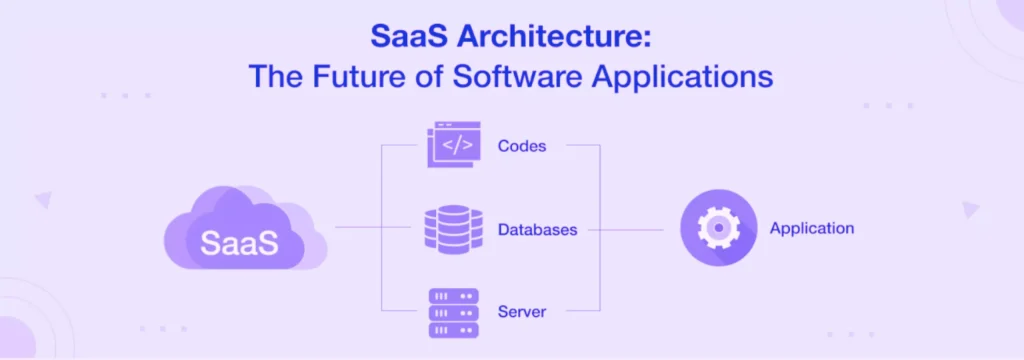
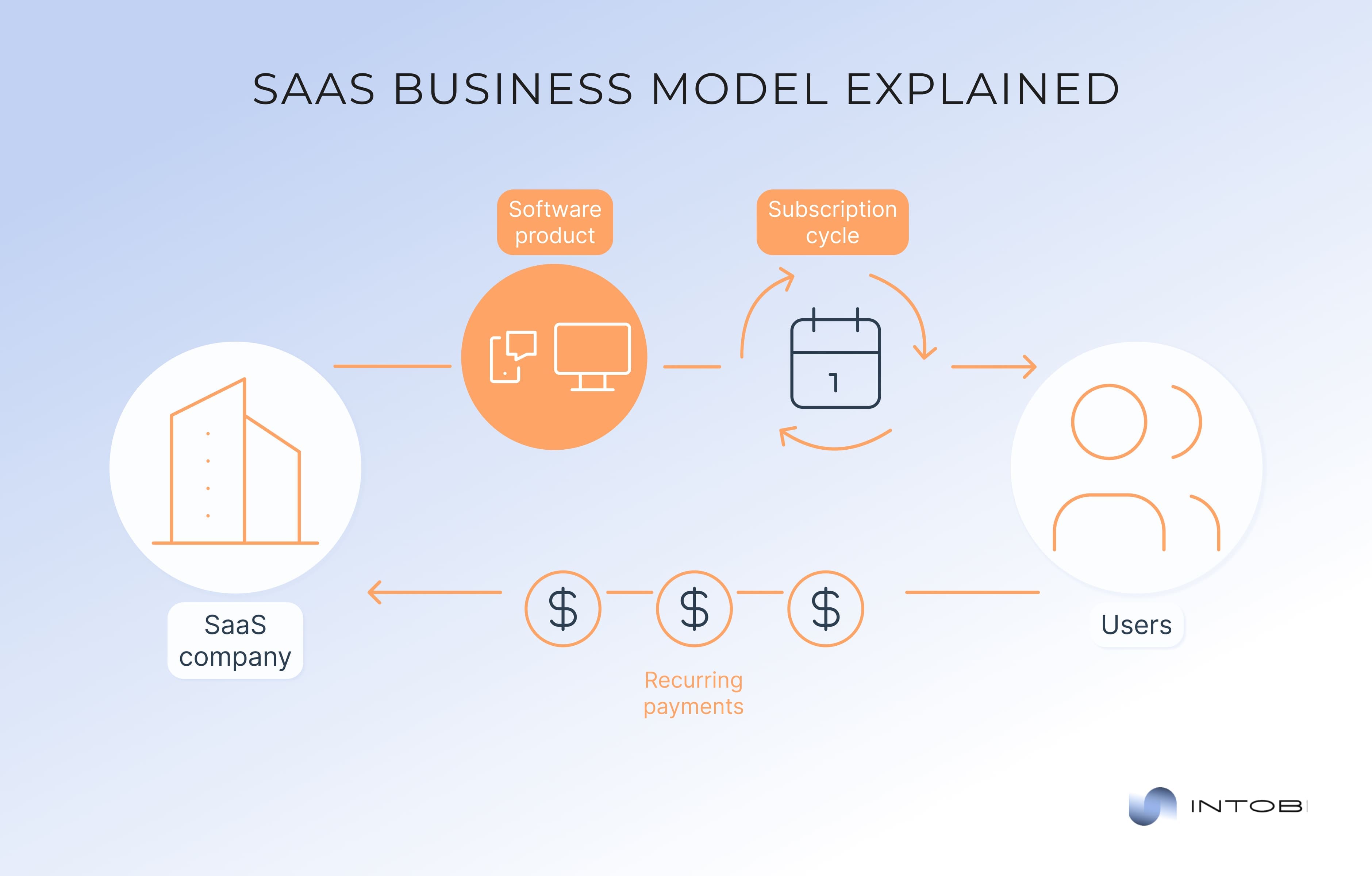
In a nutshell, the software as a service business model is a prominent player. SaaS fundamentally represents a method of delivering software applications over the Internet on a subscription basis.

Unlike traditional software models where users purchase and install software on their devices, SaaS provides access to applications hosted in the cloud. This approach offers convenience and revolutionizes how businesses utilize and pay for software solutions.

SaaS business model

The unique characteristics of the SaaS business model

One of the primary differentiators of the SaaS model is its subscription-based pricing structure. Instead of weighty upfront costs associated with purchasing software licenses, SaaS allows users to pay a recurring fee, typically monthly or annual. This pricing model democratizes access to software, making it more affordable and scalable for businesses of all sizes.

Another distinguishing feature is the cloud-based delivery of services. SaaS applications are hosted on remote servers maintained by the service provider, eliminating the need for users to install, maintain, or update software on their hardware. This reduces IT infrastructure costs and ensures seamless access to the latest features and updates without any manual intervention.

For companies building scalable SaaS products, cloud app development can help create secure cloud-based applications with reliable access, updates, and performance.

Furthermore, the SaaS model fosters a culture of flexibility and customization. Most SaaS applications offer configurable settings and integrations, allowing users to tailor the software to their needs and workflows. This adaptability is particularly beneficial for businesses operating in dynamic environments where agility and responsiveness are paramount.

Moreover, SaaS providers prioritize customer satisfaction and retention. Since subscribers can easily switch between providers, SaaS companies are stimulated to deliver exceptional customer support, regular updates, and continuous product improvements. This customer-centric approach is designed to make you feel valued and essential, fostering long-term relationships and promoting loyalty within the user base.

Common SaaS business model types

Developing the right pricing strategy is a crucial determinant of success for SaaS businesses. From attracting new users to retaining loyal customers, the pricing model is essential in shaping a SaaS company’s growth course. Understanding the nuances of different pricing approaches empowers businesses to tailor their strategies to meet the diverse needs of their target audience.

Now, let’s delve into the different SaaS business model types:

Freemium

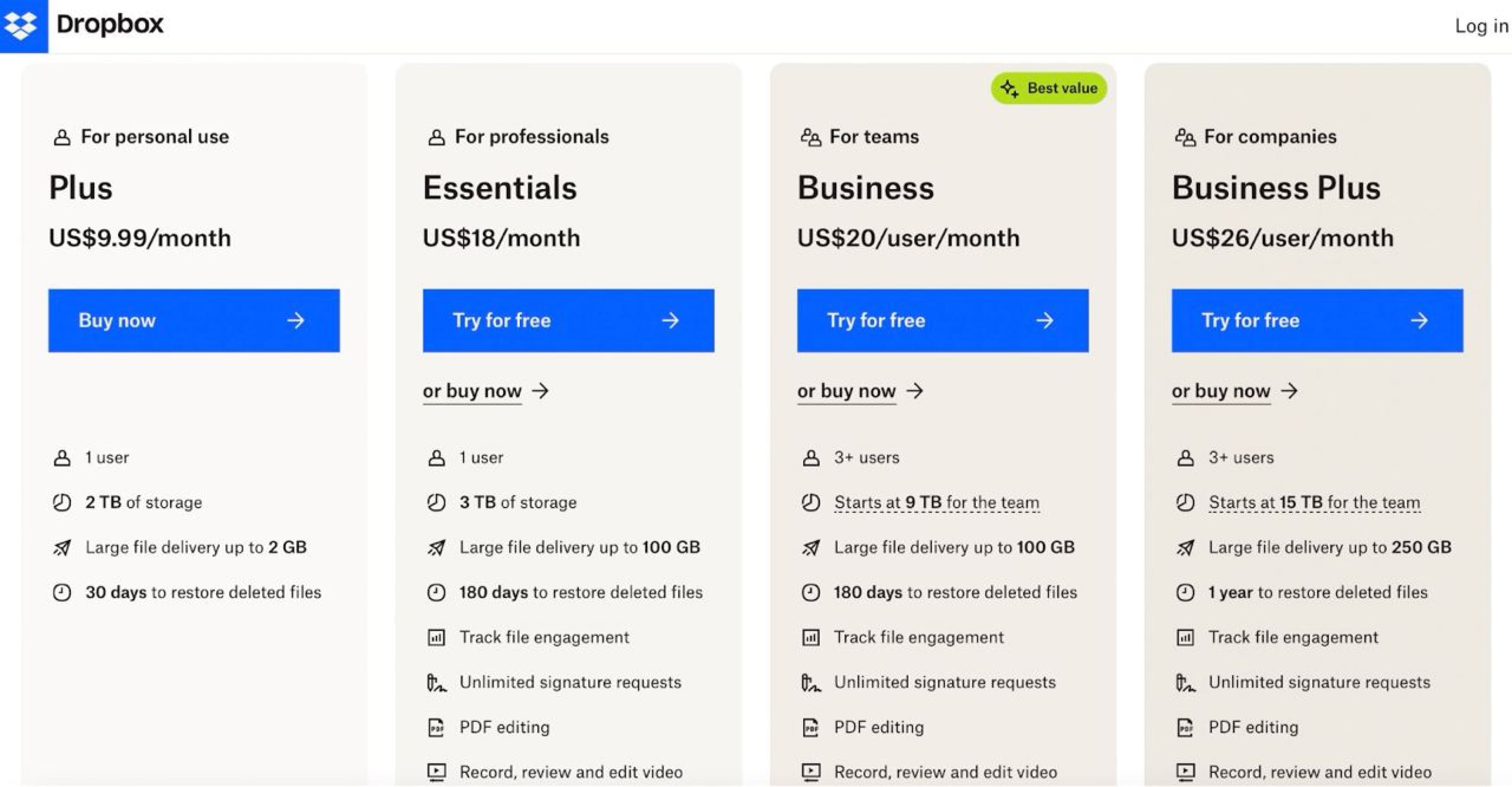
This model is a popular choice among SaaS businesses. It offers a basic version of the product for free while charging for premium features or functionality. This approach allows users to experience the product before committing to a paid plan, fostering trust and potentially leading to upsells as users discover the value in additional features.

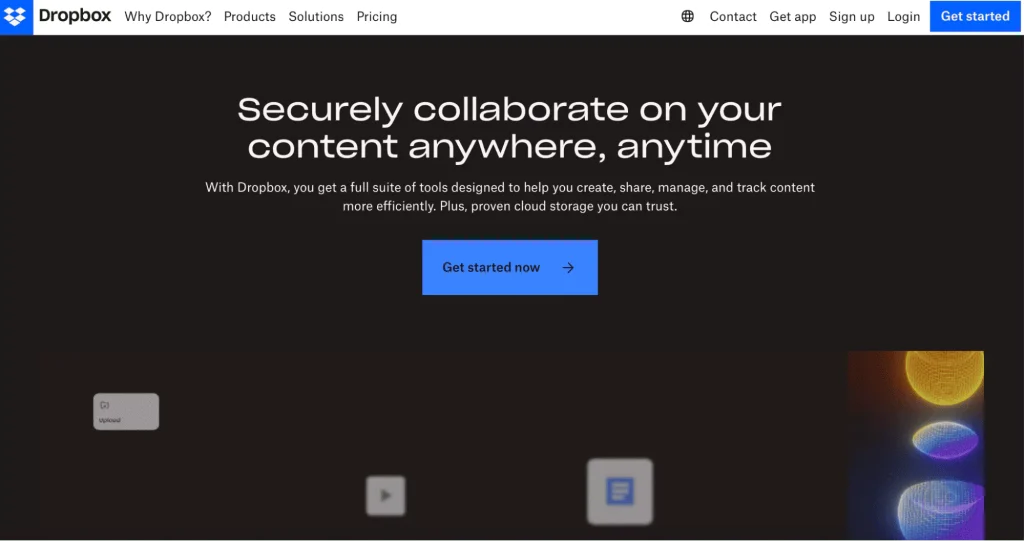
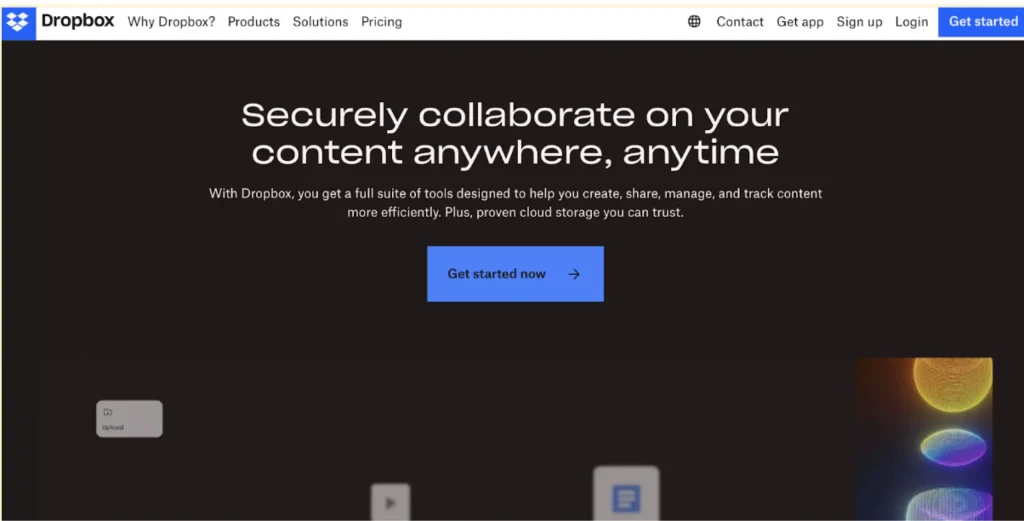
A prime example of this model is Dropbox, which provides free storage space with the option to upgrade for enhanced features and extra storage

Dropbox pricing model template

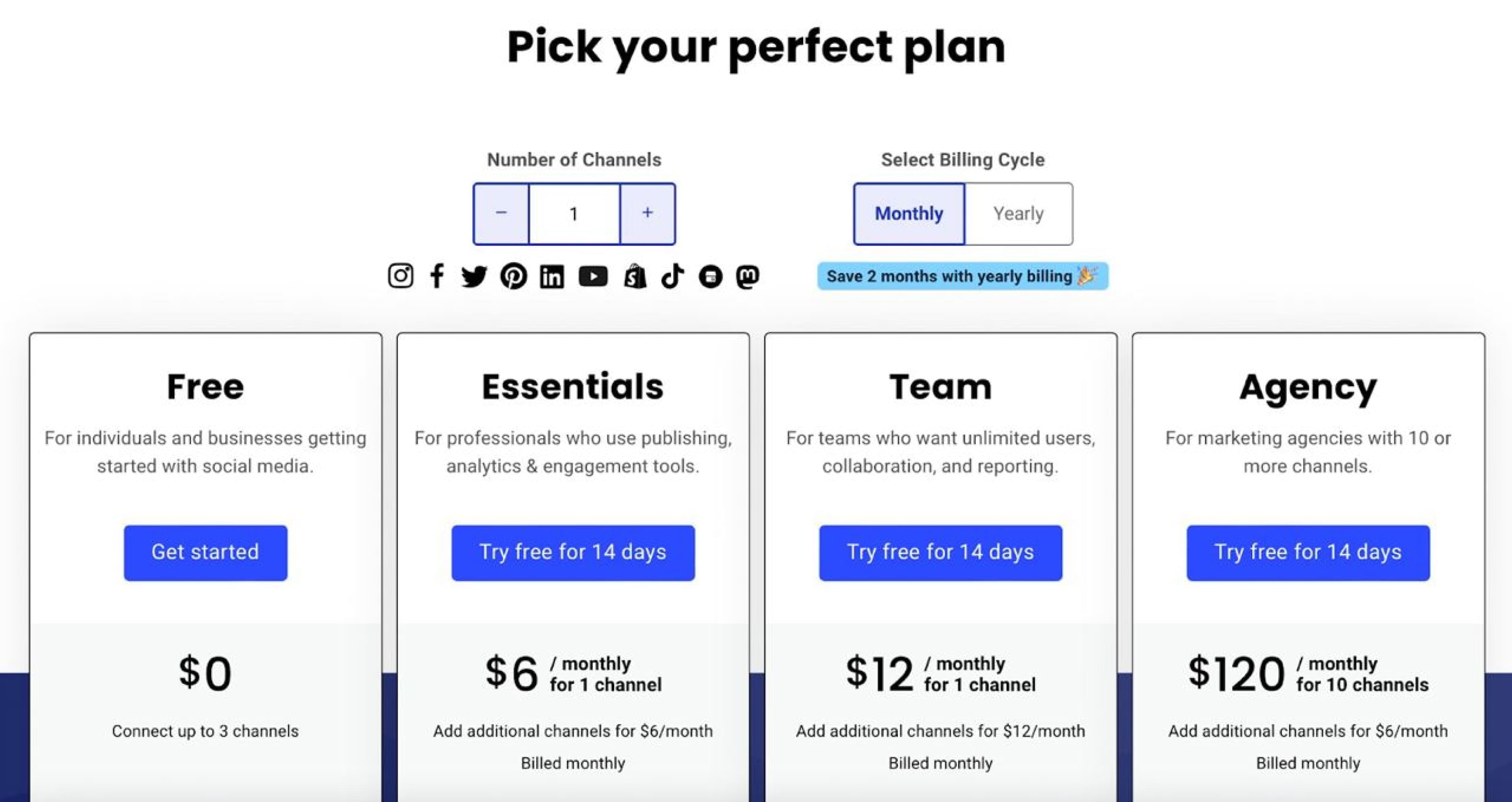
Flat pricing

With flat pricing, SaaS companies offer a single pricing tier with a fixed price, regardless of the features used or the volume of usage. This simplicity appeals to users who prefer straightforward pricing structures and want to avoid dealing with the complexity of usage-based or tiered models. Flat pricing often targets small businesses or individuals looking for affordability and ease of use.

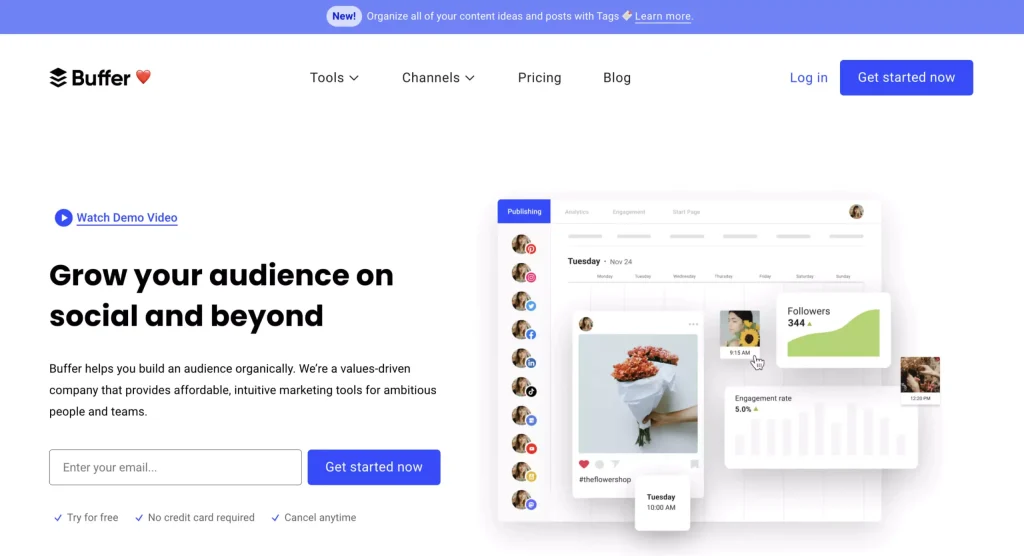
Buffer, a social media management platform, offers a single pricing tier with a fixed monthly fee, regardless of the number of posts or social media accounts managed.

Buffer pricing model template

Usage-based pricing

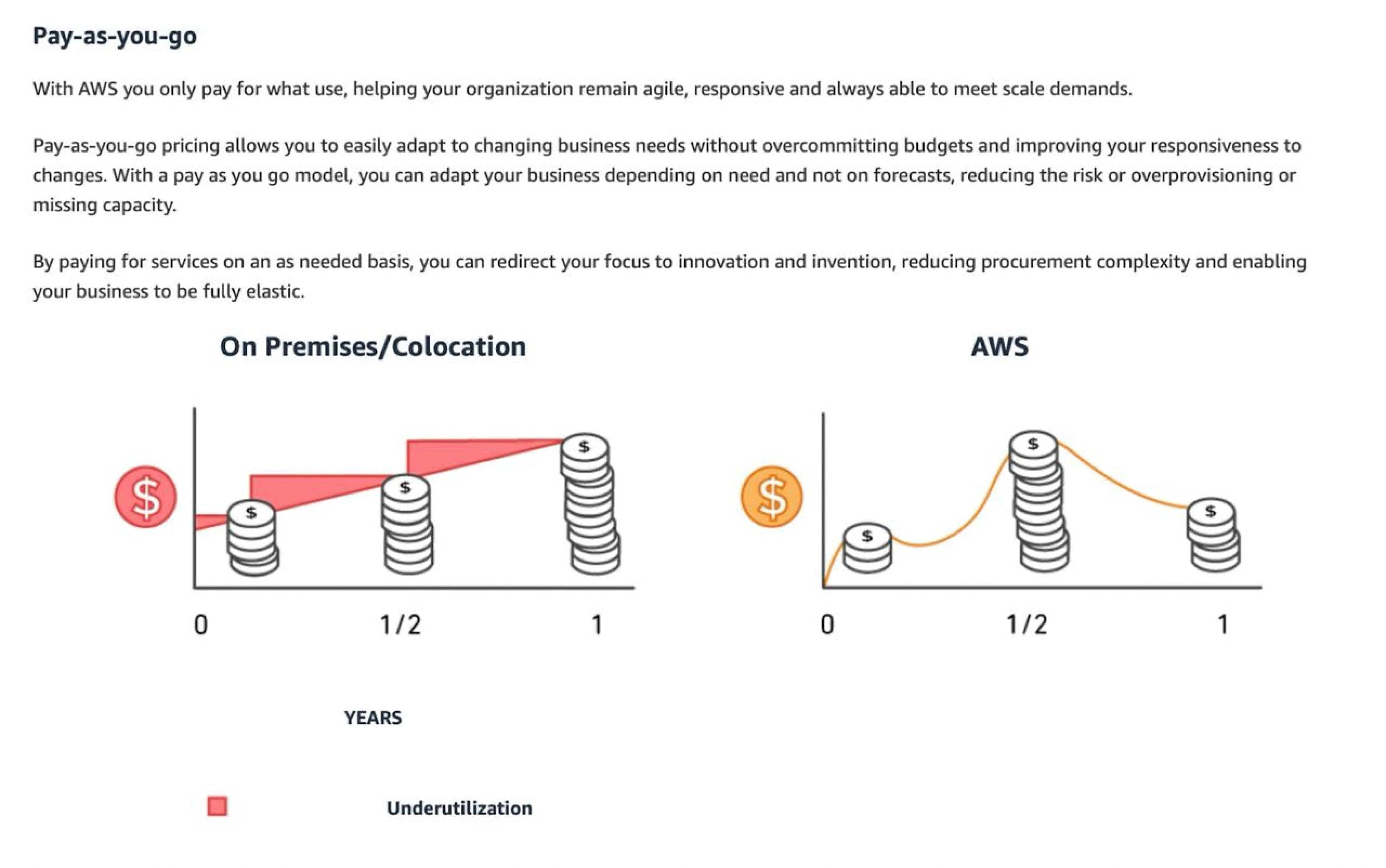
These models charge customers based on their usage of the SaaS product, such as the number of API (application programming interface) calls, storage space used, or active users. This model scales with usage, making it attractive to businesses with fluctuating needs or those seeking a more cost-effective solution that aligns with their usage patterns.

Amazon Web Services (AWS), a leading cloud computing platform, adopts this model by billing customers according to the compute power, storage, and data transfer they utilize. This provides flexibility and cost-effectiveness based on actual usage.

Amazon Web Services pricing model template

Per-user pricing

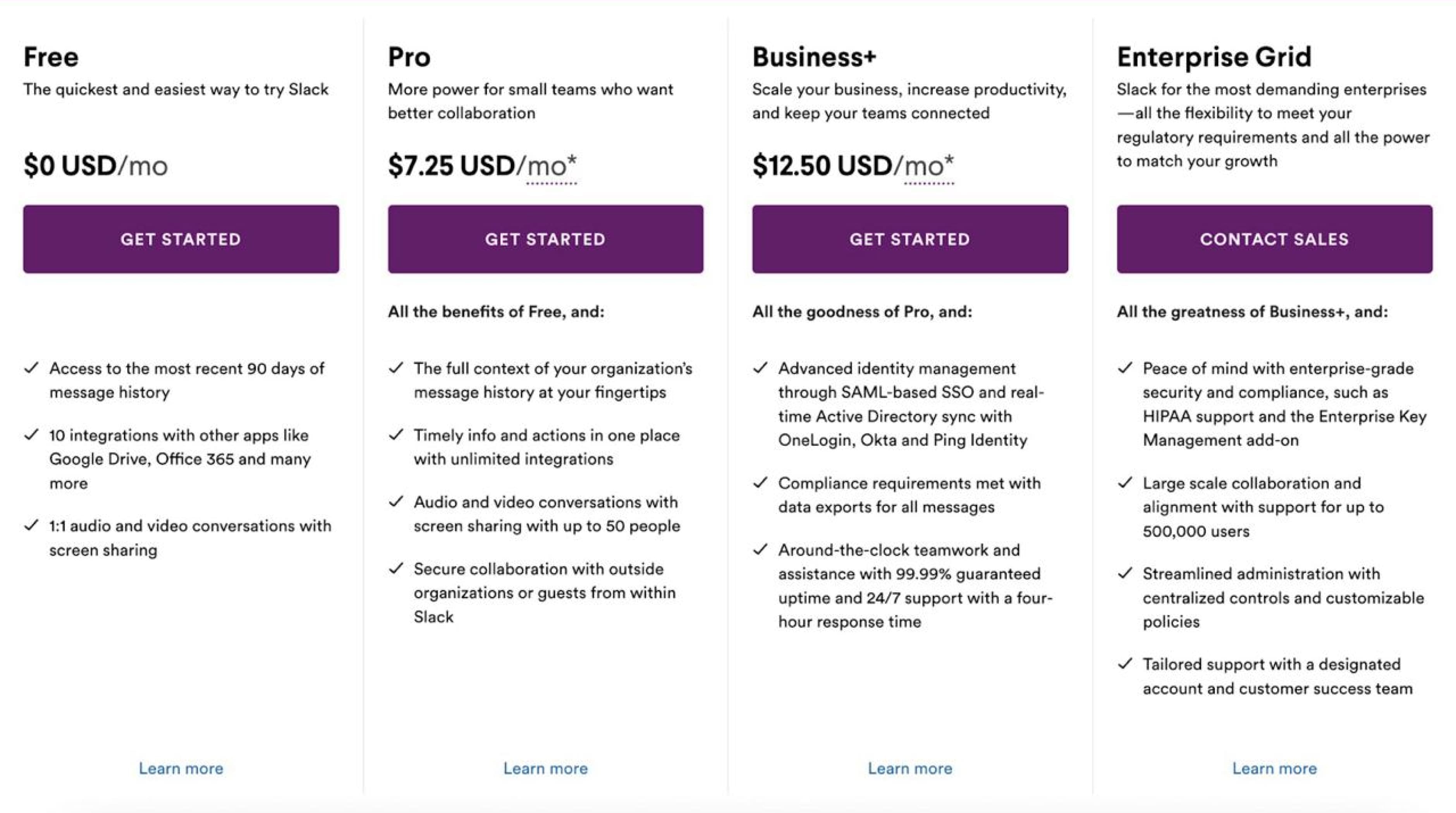
This SaaS business financial model charges customers based on the number of users accessing the platform. Each user typically pays a fixed monthly or annual fee, regardless of their activity level within the platform. This model is advantageous for businesses that require user-specific accounts and allows for easy scalability as the organization grows.

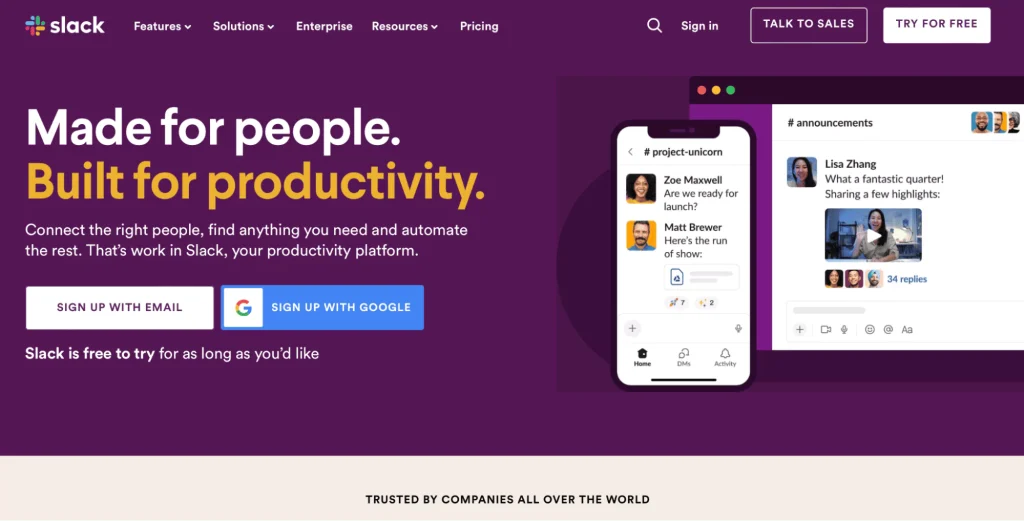
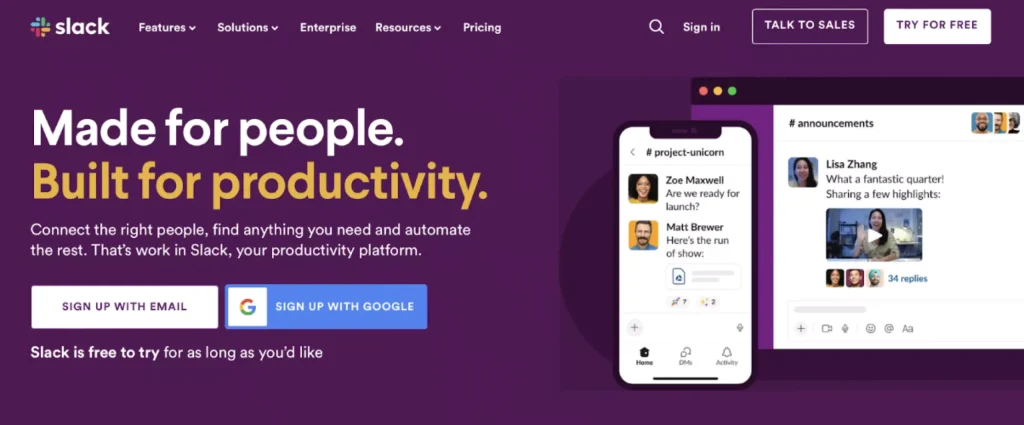
Slack, a famous team collaboration tool, follows this model, where companies pay a fixed fee for each team member using the platform. This ensures scalability and aligns costs with organizational growth.

Slack pricing model template

Tiered pricing

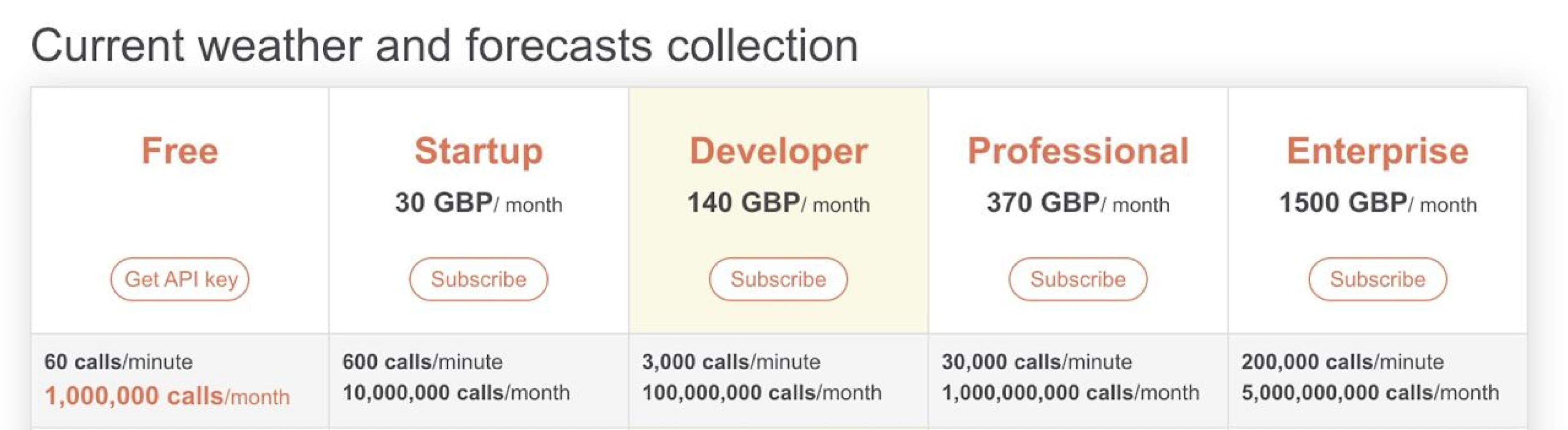
This pricing model offers multiple subscription tiers with varying features and functionality at different price points. Customers can choose the tier that best suits their needs and budget, with the option to upgrade or downgrade as their requirements change.

Interesting

Tiered pricing provides flexibility and satisfies a broader range of diverse customer needs.

OpenWeather, a weather data provider, implements this model by offering different tiers of access to weather data APIs based on the volume of requests and features required by users.

OpenWeather pricing model template

Hybrid pricing

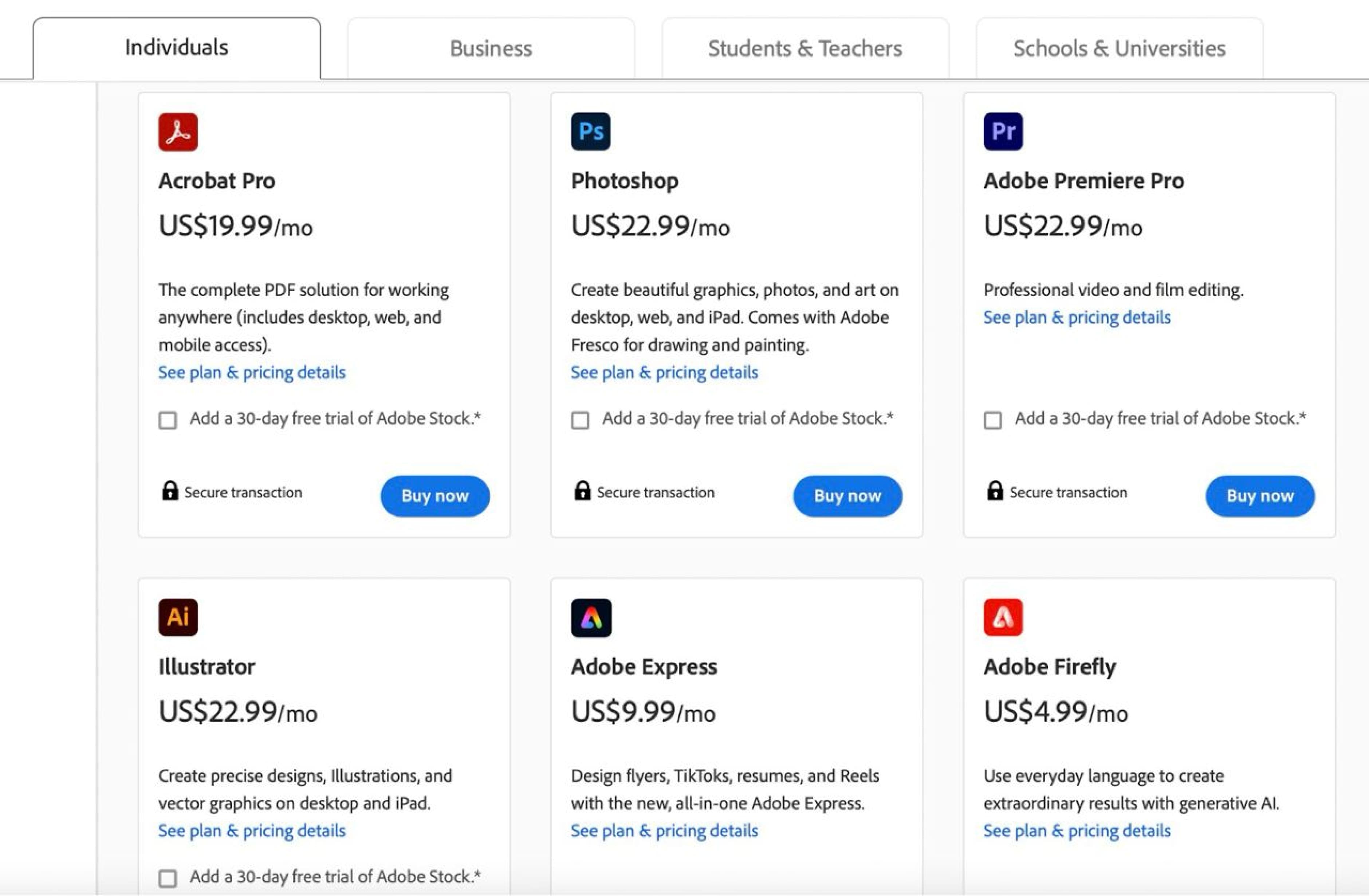
This SaaS business model pricing combines elements of different pricing models to offer a customized approach that fits the unique needs of the target market. This could involve a combination of flat pricing for basic features, usage-based charges for additional resources, and per-user fees for access to premium functionality. Hybrid pricing maximizes flexibility and can appeal to a wide range of customers with varying usage patterns and budgets.

Adobe Creative Cloud, a suite of creative software tools, employs this model by offering subscription plans with a combination of flat fees for primary access and usage-based charges for additional services or premium features.

Adobe Creative Cloud pricing model template

Thus, each of these SaaS business model types has its advantages and considerations, and the choice often depends on factors such as the target market, the nature of the product or service offered, and the competitive landscape. By selecting the most suitable model and continually iterating based on customer feedback and market dynamics, SaaS companies can optimize their pricing strategy for sustainable growth and profitability.

Looking for flexible software solutions?

Let’s chat

Essential benefits of SaaS business model

The SaaS business model has transformed the technology consumption landscape, offering many advantages for both users and companies. From enhanced flexibility to cost-effectiveness, SaaS has become the preferred choice for software delivery and utilization.

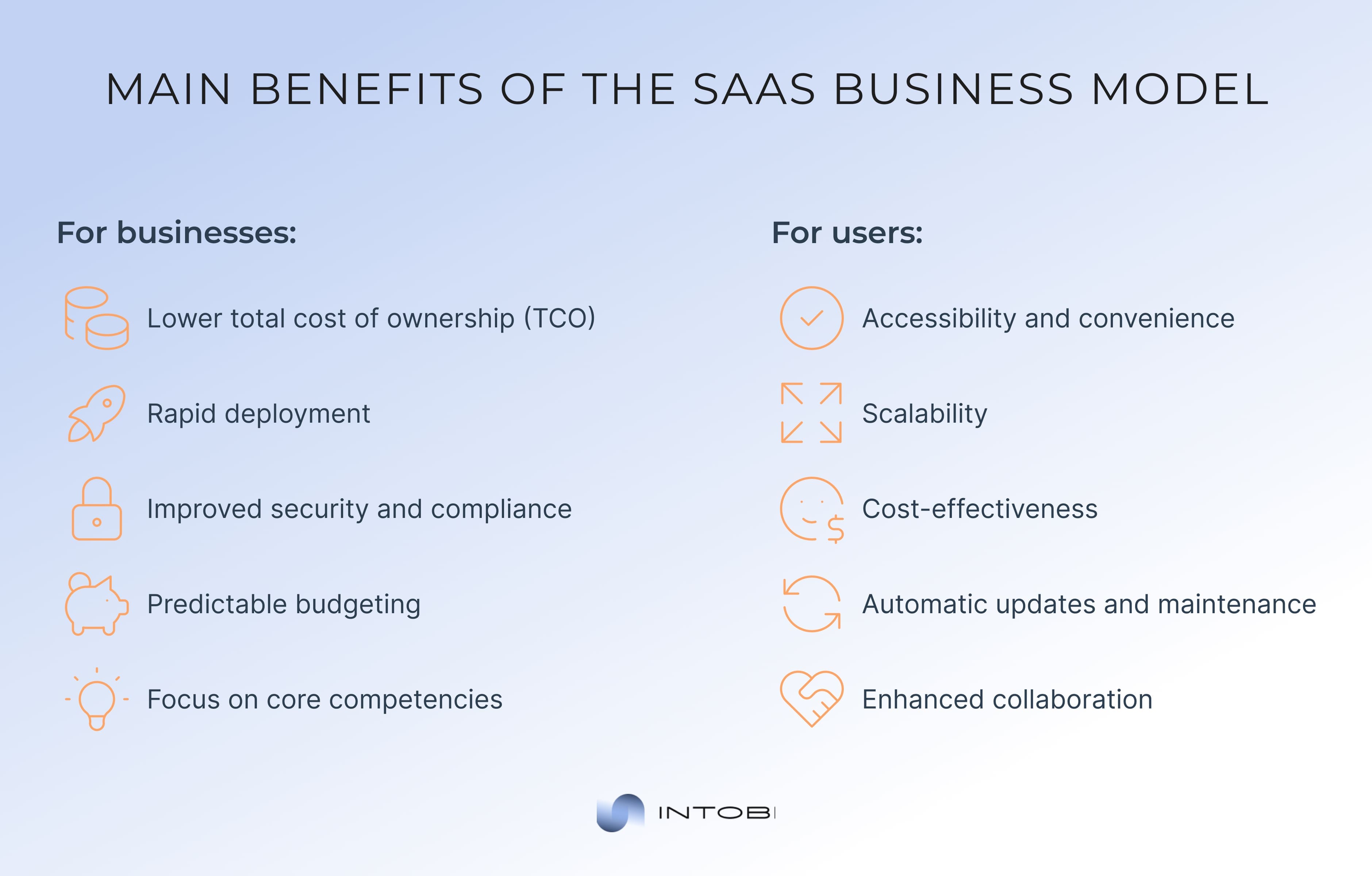
Top benefits of the SaaS business model

Let’s check the fundamental benefits of SaaS business model.

For users:

  • Accessibility and convenience. One of the most significant advantages of SaaS for users is its accessibility. Users can access SaaS applications from any Internet-enabled device, eliminating the need for specific hardware or software installations. This accessibility enhances convenience, allowing users to work seamlessly anywhere and anytime.
  • Scalability. SaaS applications offer scalable solutions that can adapt to users’ changing needs. These platforms can quickly scale up or down based on demand, whether an individual user or a large enterprise. Users can effortlessly add or remove features, adjust subscription levels, or increase user licenses as their requirements evolve.
  • Cost-effectiveness. Traditional software often involves significant upfront costs for licenses, installations, and maintenance. However, SaaS follows a subscription-based model, allowing users to pay only for the services they use regularly. This pay-as-you-go approach eliminates bulky upfront expenses, making SaaS solutions more cost-effective for users of all scales.
  • Automatic updates and maintenance. SaaS providers handle all software updates and maintenance tasks, ensuring that users always have access to the latest features and security patches without any effort. This relieves users from managing updates manually, allowing them to focus on their core tasks while enjoying a seamlessly updated software environment.
  • Enhanced collaboration. Many SaaS applications are designed to facilitate seamless communication and cooperation among users regardless of their geographical location. Features such as real-time editing, shared document access, and integrated communication tools foster collaboration, boosting productivity and efficiency for team users.

For businesses:

  • Lower total cost of ownership (TCO). Adopting SaaS solutions can significantly reduce businesses’ total cost of ownership. By eliminating the need for expensive infrastructure, hardware upgrades, and dedicated IT staff for software maintenance, businesses can allocate their resources more efficiently, investing in areas that directly contribute to their growth and innovation.
  • Rapid deployment. SaaS applications can be deployed much faster than traditional software solutions. With no need for complex installations or configurations, businesses can start using SaaS applications immediately after subscribing. This agility enables companies to respond swiftly to changing market demands and capitalize on new opportunities without being hindered by lengthy implementation processes.
  • Improved security and compliance. SaaS providers prioritize security and compliance measures to safeguard user data and ensure regulatory adherence. By using progressive encryption technologies, access controls, and regular security audits, SaaS solutions offer businesses more data protection than on-premises software deployments. This enhanced security posture protects sensitive information and helps companies to build trust with their customers and partners.
  • Predictable budgeting. SaaS subscription models provide businesses with predictable and transparent pricing, making it easier to budget and forecast expenses accurately. Unlike traditional software licenses, which may involve unpredictable upgrade costs or unexpected maintenance fees, SaaS subscriptions offer fixed monthly or annual rates, enabling businesses to plan their expenditures more effectively.
  • Focus on core competencies. Outsourcing software management to SaaS providers allows businesses to focus their internal resources on core competencies rather than IT infrastructure management. By offloading routine tasks such as software updates, maintenance, and support to SaaS vendors, businesses can redirect their efforts towards innovation, product development, and customer satisfaction, driving competitive advantage and business growth.

In conclusion, the SaaS business model offers myriad benefits for both users and businesses alike. These solutions empower users to work more efficiently while enabling companies to streamline operations, reduce costs, and accelerate growth. As technology develops, SaaS is poised to remain a cornerstone of modern software delivery, driving innovation and transforming how we work and do business.

Crucial stages of SaaS business model

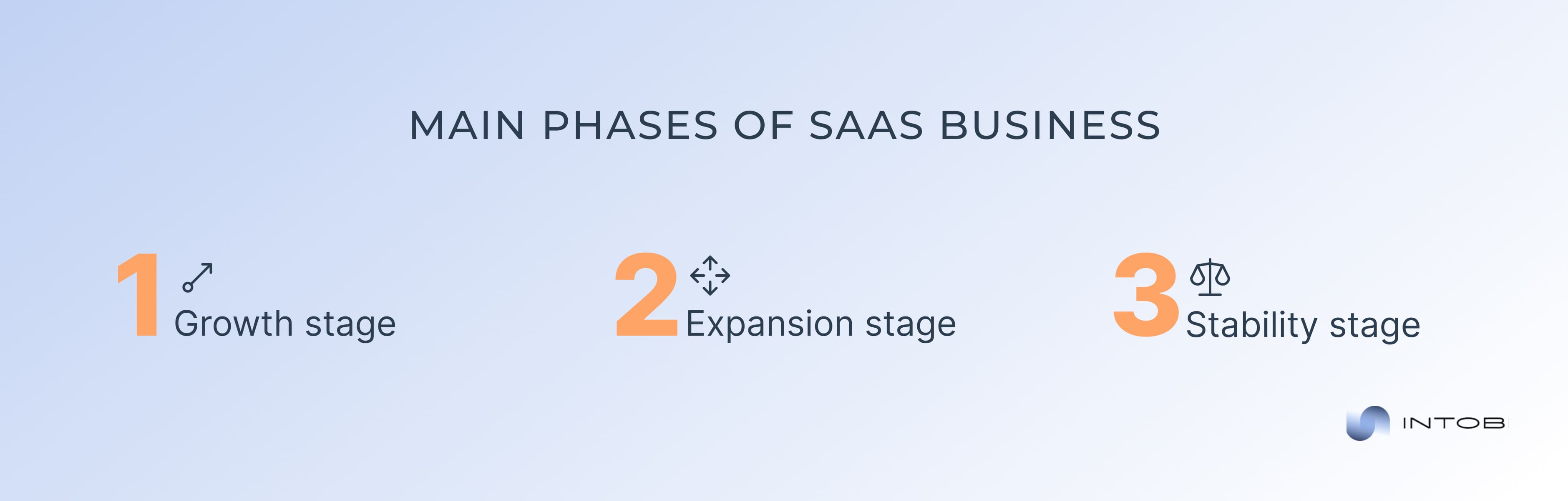
In general, businesses experience distinct phases characterized by unique challenges and opportunities. Understanding and effectively guiding these stages is vital for sustained success. Here, we explore the crucial stages of the SaaS business model: growth, expansion, and stability.

Fundamental steps of SaaS business model

1. Growth stage

The growth phase marks the initial wave of momentum, where startups strive to gain traction and establish a foothold in the market. During this stage, rapid customer acquisition and revenue growth are paramount. Key elements include:

Customer acquisition

At the heart of the growth stage lies the relentless pursuit of acquiring customers. Startups employ targeted marketing campaigns and referral programs and use social media platforms to expand their user base. By the way, we will discuss this in more detail in the next section.

Product development

Continuous enhancement of the SaaS product is essential to meet evolving customer needs and stay ahead of competitors. Feedback loops from early adopters play a crucial role in refining features and functionalities.

Scalability

Building scalable infrastructure is critical to accommodate increasing demand without compromising performance. Cloud-based solutions offer flexibility and scalability, enabling startups to scale their operations seamlessly.

Financial management

Efficient resource allocation is imperative during the growth stage. Startups must balance aggressive growth and fiscal responsibility to avoid burning through capital prematurely.

2. Expansion stage

As SaaS companies gain traction and solidify their position in the market, they enter the expansion phase. This stage is characterized by scaling operations, penetrating new markets, and diversifying product offerings. Key considerations include:

Market expansion

With a solid customer base established, SaaS companies focus on penetrating new markets. This may involve geographical expansion into international territories or targeting niche industry verticals.

Diversification

To mitigate risk and capitalize on emerging opportunities, diversification of product offerings is essential. SaaS companies may explore adjacent markets or introduce complementary services to address the evolving needs of their customer base.

Partnerships and alliances

Strategic partnerships with complementary businesses can accelerate growth and enhance market reach. Collaborating with industry leaders or integrating with popular platforms can provide access to new customers and drive revenue growth.

Operational efficiency

Streamlining operations becomes increasingly crucial during the expansion stage. Implementing scalable processes and investing in automation technologies can improve efficiency and reduce operational costs.

3. Stability stage

The stability phase represents a maturation stage where SaaS companies focus on sustaining growth, optimizing profitability, and fortifying their position in the market. Key components include:

Customer retention

Maintaining high customer satisfaction levels is vital for long-term success. SaaS companies invest in customer success initiatives, proactive support services, and product enhancements to foster loyalty and reduce churn.

Profitability

While growth remains a priority, achieving profitability becomes a primary objective during the stability stage. Optimizing pricing strategies, reducing customer acquisition costs, and maximizing customer lifetime value are crucial for sustainable profitability.

Continuous innovation

In fact, innovation remains central to staying competitive in the rapidly evolving SaaS landscape. SaaS companies must foster continuous innovation, encourage experimentation, and stay attuned to market trends and customer feedback.

Risk management

Reducing risks becomes increasingly crucial as SaaS companies mature. This includes addressing cybersecurity threats, regulatory compliance, and diversifying revenue streams to reduce dependency on any single source.

Thus, guiding the crucial stages of the SaaS business model requires a strategic approach, agility, and a relentless focus on customer value. SaaS companies can chart a path to sustainable growth and long-term success in the dynamic digital landscape by understanding the unique challenges and opportunities presented at each stage.

SaaS business model metrics

It is essential to understand that these SaaS business model metrics are navigational tools. They guide businesses through the complexities of customer acquisition, revenue generation, and retention.

Let’s delve into the significance of each metric and how they interplay within the SaaS business model.

Lifetime value (LTV)

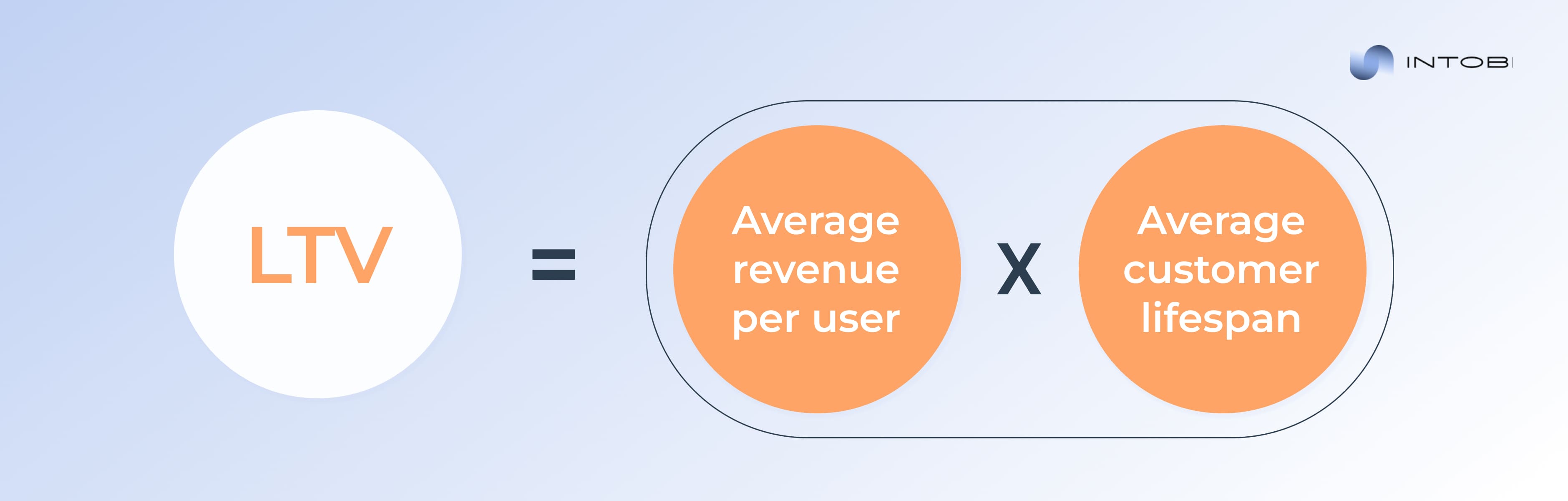
This metric represents the total revenue a customer is expected to generate throughout their entire relationship with a company. It is a crucial metric that quantifies the long-term value of acquiring a customer.

Calculating LTV involves forecasting customer revenue over time, factoring in churn rates, and upsell opportunities. A higher LTV indicates stronger customer loyalty and profitability, highlighting the importance of delivering ongoing value to customers to maximize their lifetime value.

How LTV metric works

Customer acquisition cost (CAC)

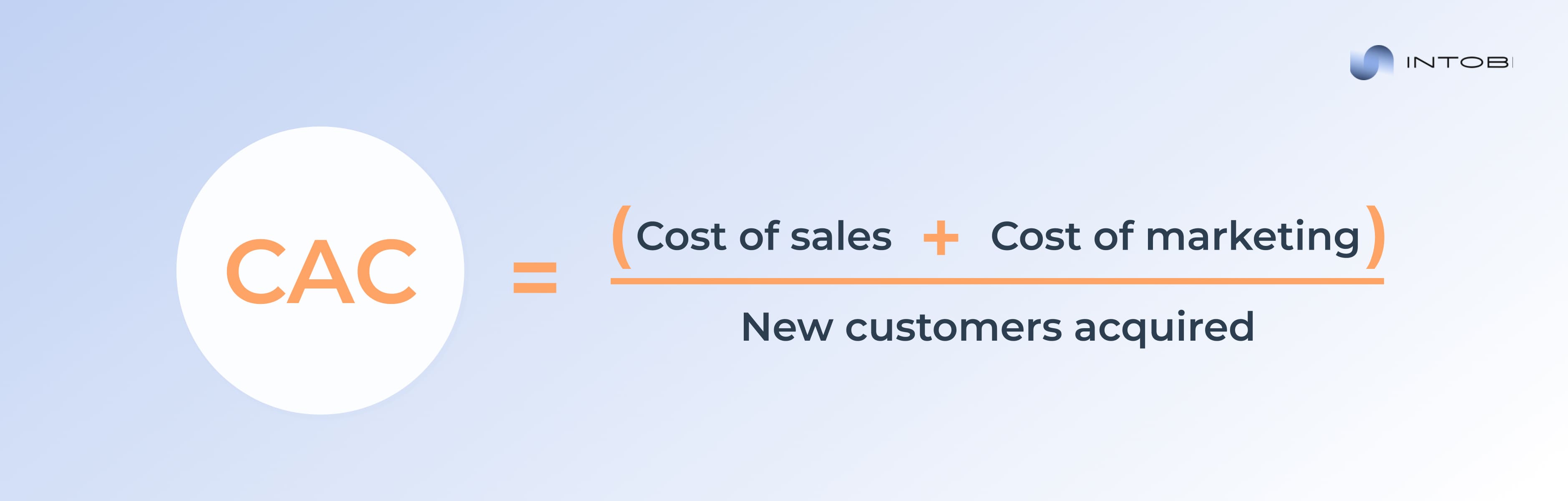
This metric measures the cost associated with acquiring a new customer. This includes marketing expenses, sales commissions, and other costs directly attributed to customer acquisition efforts.

Keeping CAC in check is essential for sustainable growth, as this excessively high metric can deteriorate profitability and hinder scalability. Efficiently managing CAC involves optimizing marketing channels, refining targeting strategies, and enhancing the sales process to acquire customers cost-effectively.

How CAC metric works

Monthly recurring revenue (MRR) and annual recurring revenue (ARR)

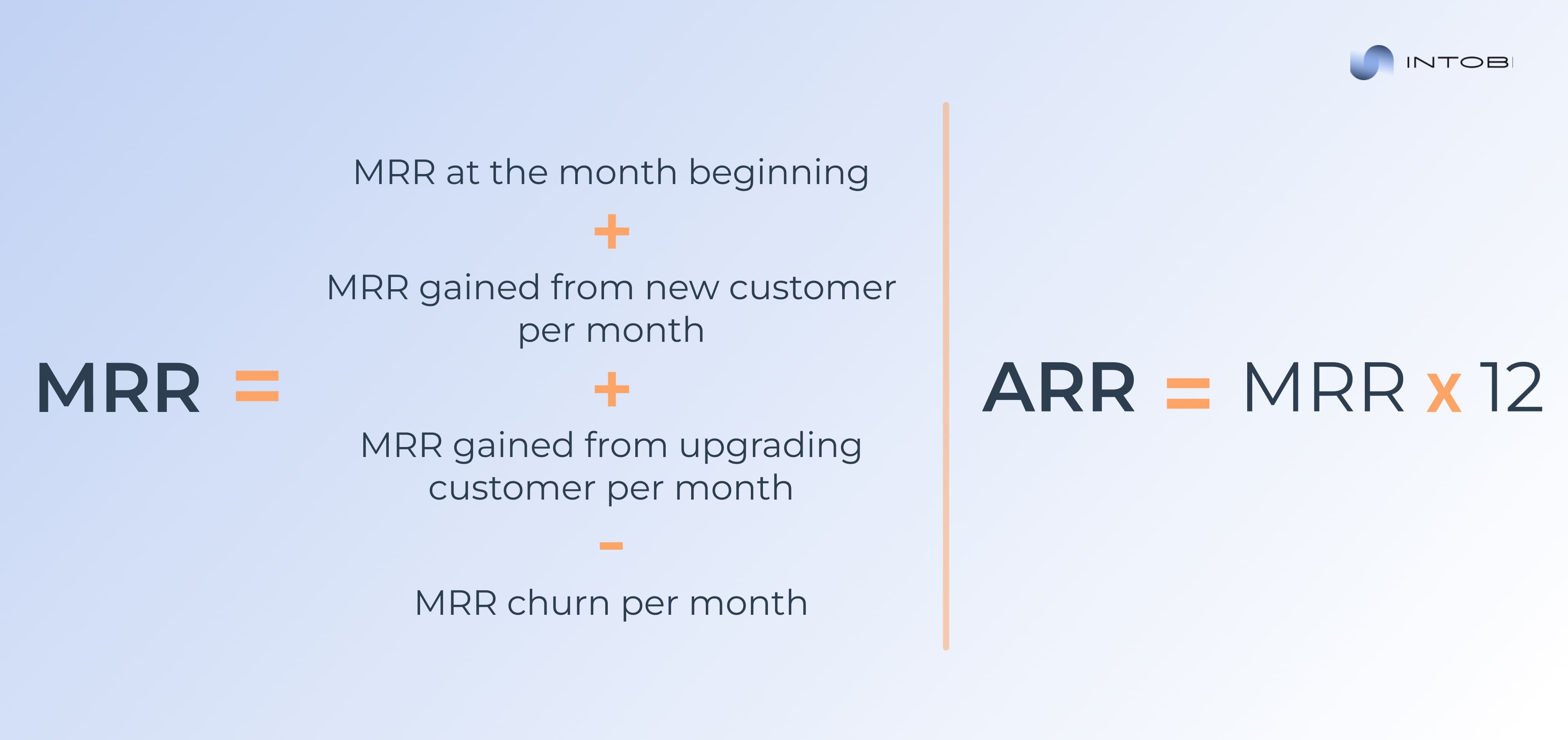
MRR and ARR are foundational metrics in the SaaS business model, representing the predictable revenue stream of subscription fees. MRR tracks the monthly revenue generated from subscription contracts, while ARR extrapolates this figure annually.

These metrics provide valuable insights into revenue stability and growth, enabling businesses to forecast cash flow, assess performance, and evaluate the impact of pricing changes or customer churn.

How MRR and ARR metric work

Churn rate

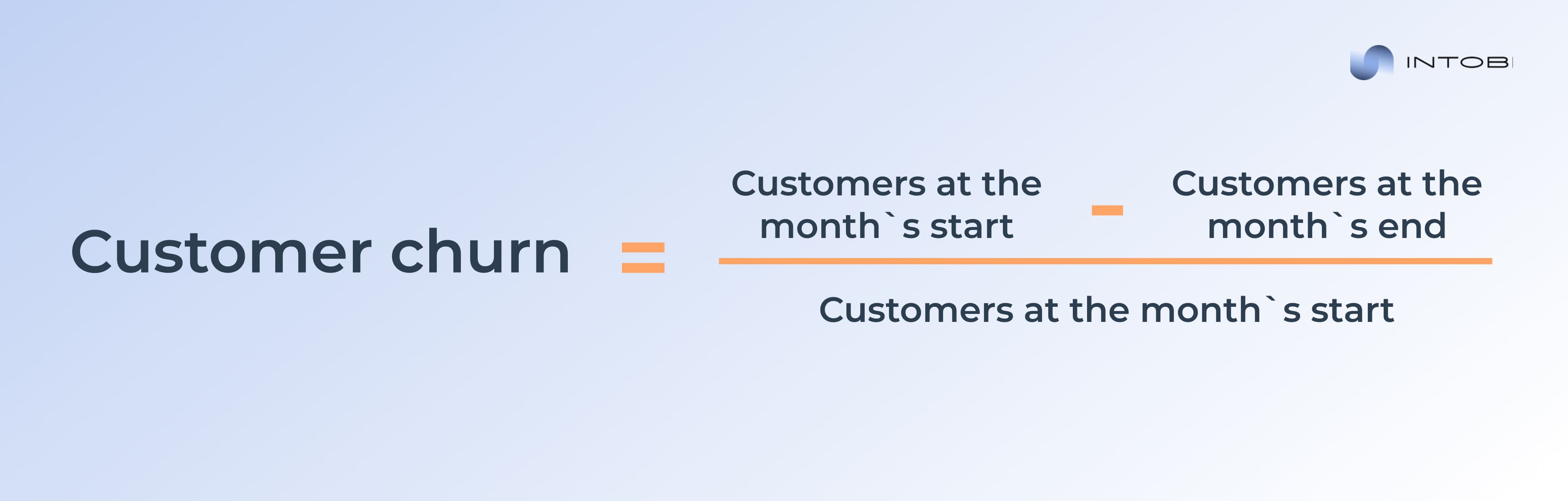
The churn rate measures the percentage of customers who discontinue their subscription within a given period. High churn can severely impact revenue and profitability, making it imperative for SaaS companies to address churn drivers and enhance customer retention efforts proactively. 

Analyzing churn patterns, identifying pain points, and implementing targeted retention strategies can help decrease churn and foster long-term customer relationships.

How customer churn metric works

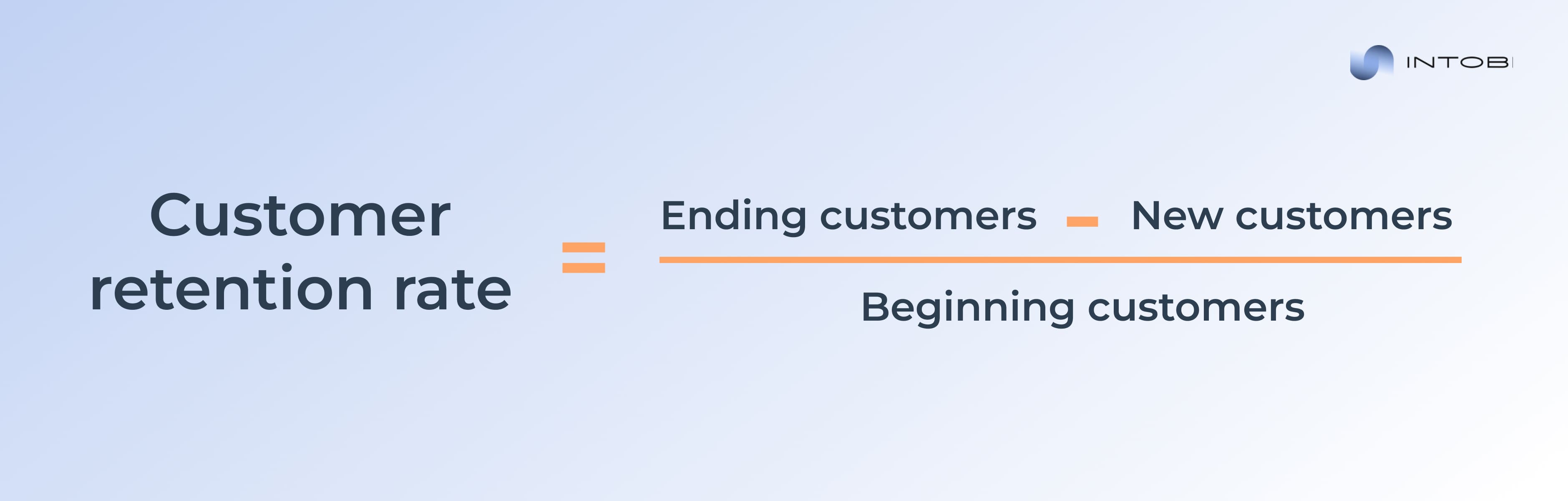
Customer retention rate (CRR)

This metric complements the churn rate by measuring the percentage of customers retained over a specific period. A high CRR indicates strong customer loyalty and satisfaction, reflecting positively on the product’s value proposition and customer experience.

Improving CRR involves fostering customer relationships, providing exceptional support, and continuously delivering value to customers to incentivize subscription renewals.

How CRR metric works

In summary, SaaS business model metrics drive strategic decision-making and foster sustainable growth. By closely monitoring these metrics, SaaS companies can gain actionable insights into their performance, optimize resource allocation, and develop lasting customer relationships.

Ready to move to the cloud?

Contact us

Top SaaS business model examples

Among the many SaaS businesses, some companies reshaped industries, redefined customer relationships, and set benchmarks for success. Let’s discover their unique business models, exploring how each has used innovation to carve its niche and thrive in the competitive SaaS landscape.

HubSpot

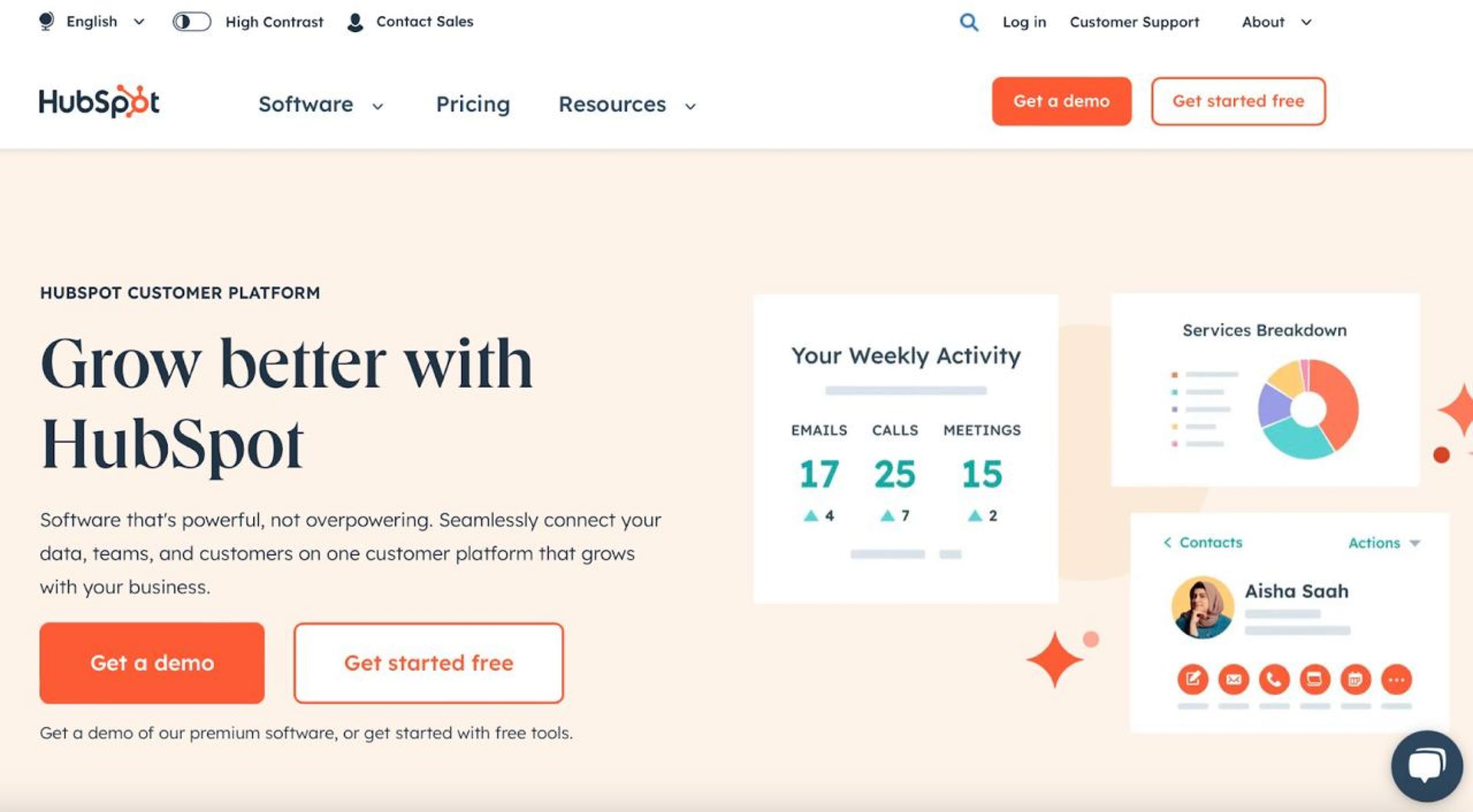
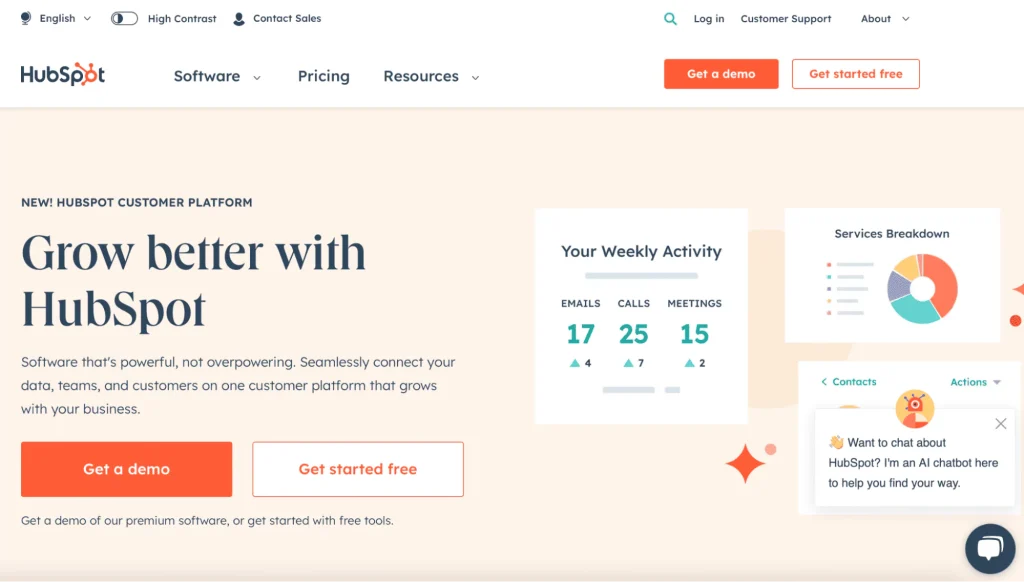
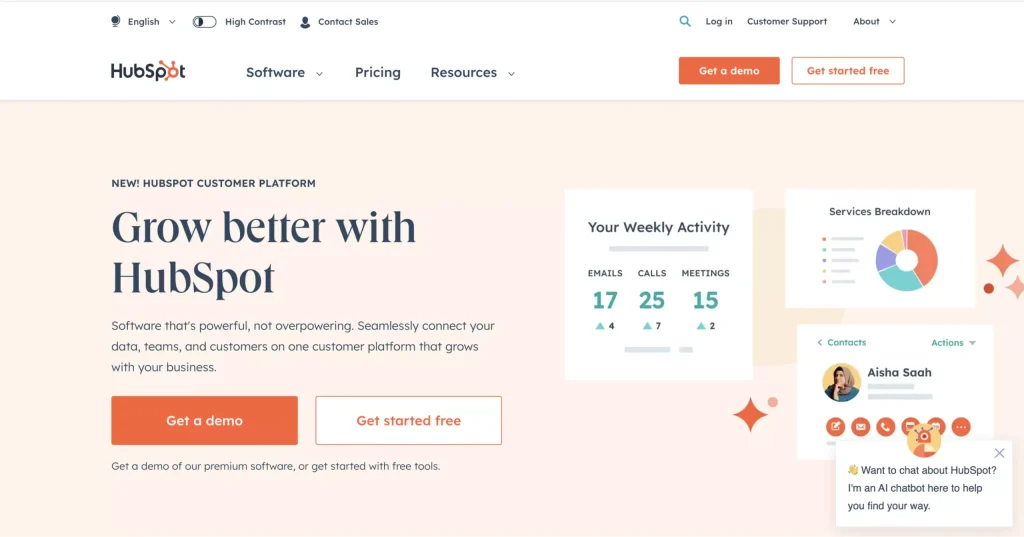
In fact, HubSpot’s prominence is synonymous with its pioneering role in inbound marketing. Built to empower businesses to attract, engage, and delight customers, HubSpot offers an integrated platform encompassing CRM (customer relationship management), marketing, sales, and customer service functionalities. Central to HubSpot’s business model is the “freemium” approach, enticing users with free access to essential tools while offering premium features and services for scalable growth.

HubSpot as a SaaS business model example

Key pillars of HubSpot’s success include:

  • Inbound methodology: HubSpot’s business model revolves around the inbound methodology, emphasizing content creation, SEO (search engine optimization), and personalized marketing strategies to attract and retain customers organically.
  • All-in-one platform: By consolidating essential marketing, sales, and service tools into a single platform, HubSpot streamlines workflows, enhances collaboration, and provides users with a comprehensive solution for their business needs.
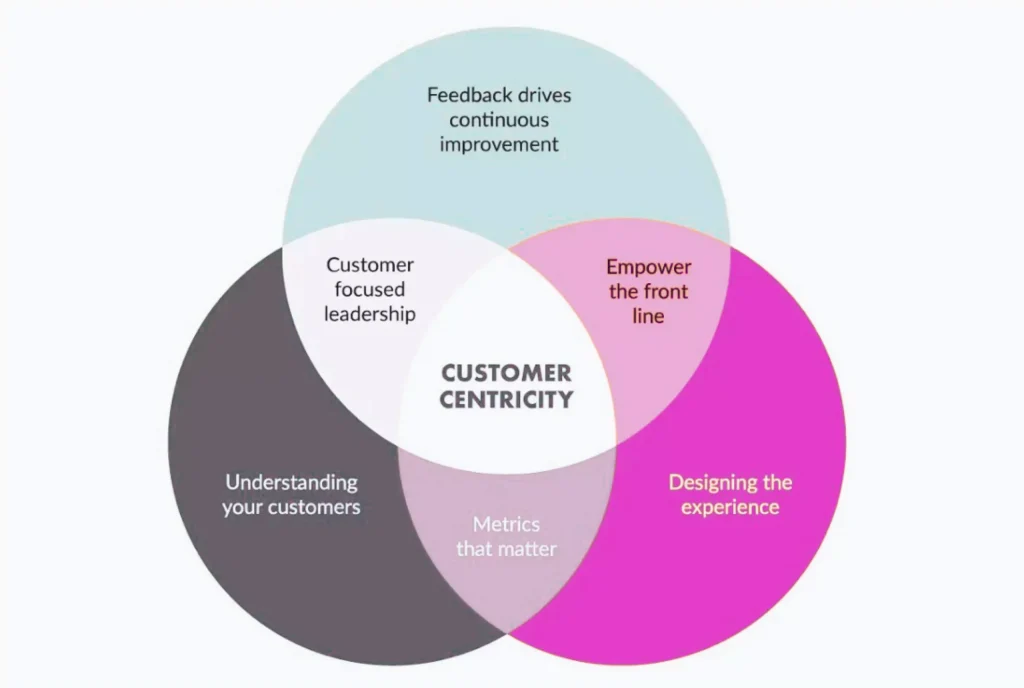
  • Customer-centric approach: This SaaS business model template prioritizes customer success through extensive educational resources, community engagement, and responsive support, fostering long-term relationships and advocacy.
  • Scalable pricing tiers: HubSpot offers tiered pricing plans tailored to businesses’ needs and growth stages, enabling seamless scalability and customization without overwhelming users with unnecessary features.

Salesforce

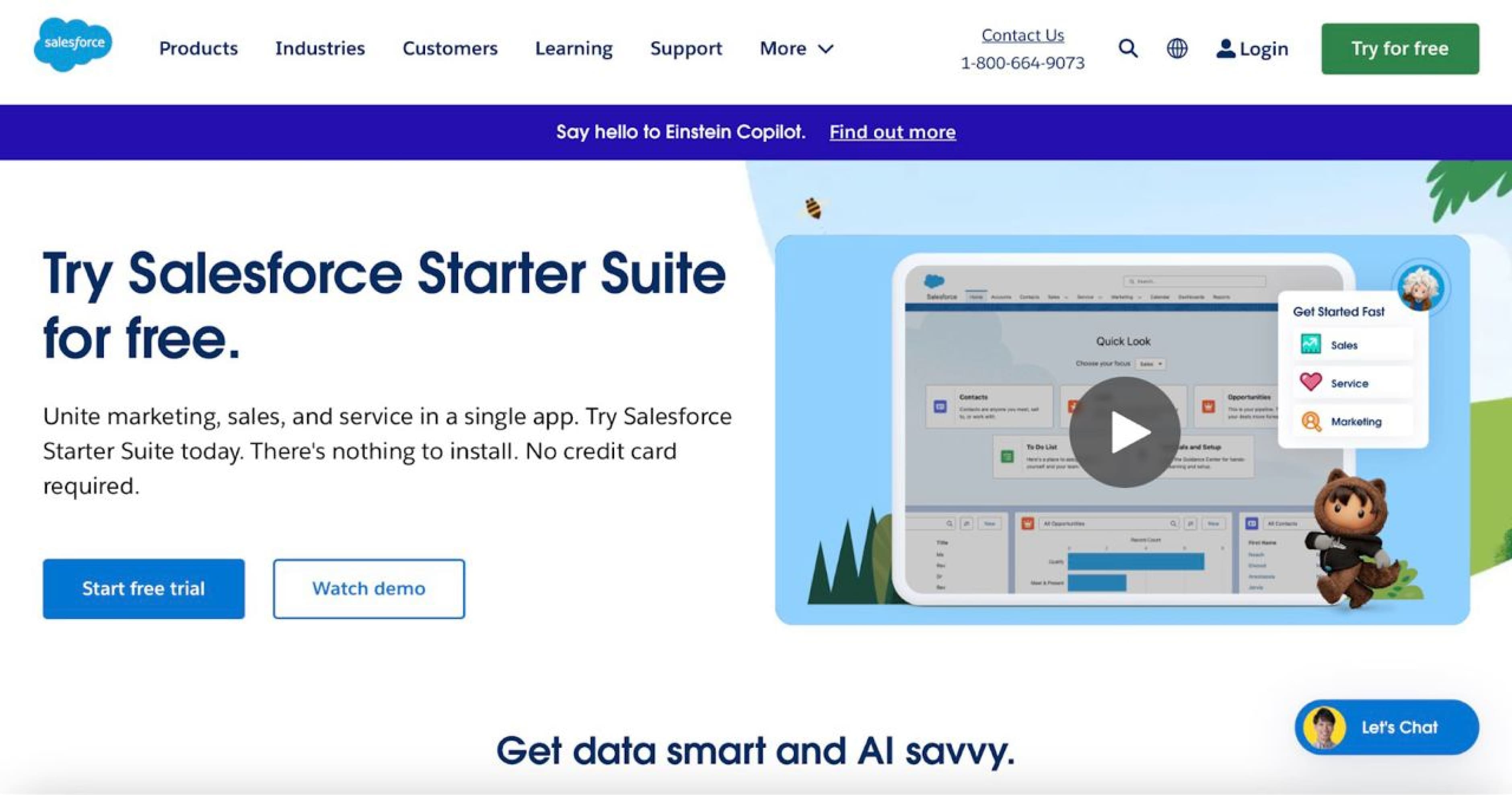
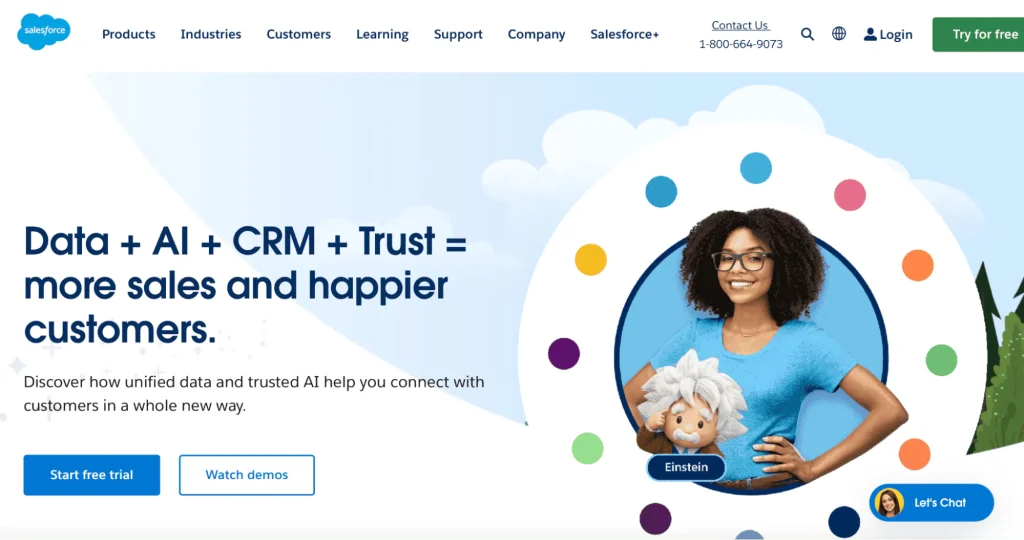
This platform is a testament to the transformative power of CRM solutions. Renowned for its cloud-based CRM platform, Salesforce has revolutionized how businesses manage and promote customer relationships, driving efficiency, agility, and growth. At the core of this SaaS business model example lies a determined focus on innovation, accessibility, and ecosystem expansion.

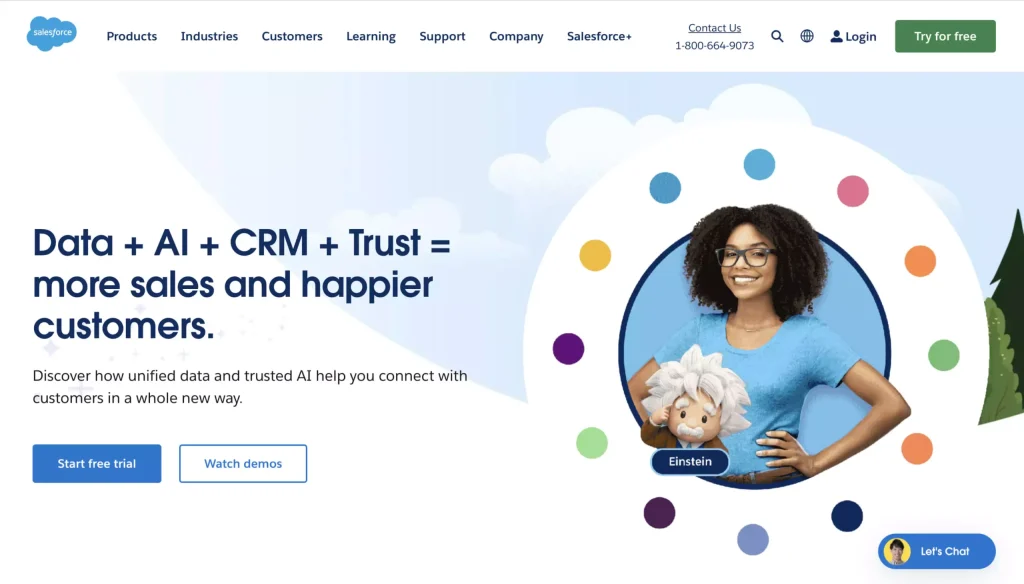
Salesforce as a SaaS business model example

Critical elements of Salesforce’s business model include:

  • Cloud-based infrastructure: Salesforce discovered the shift to cloud-based CRM solutions, delivering scalability, accessibility, and real-time insights to businesses of all sizes across diverse industries.
  • Platform as a service (PaaS): Salesforce’s platform-as-a-service model enables developers to build and deploy custom applications and integrations on top of its CRM platform, fostering innovation, customization, and extensibility.
  • Trailblazing ecosystem: Salesforce’s expansive ecosystem encompasses various partners, developers, and third-party applications, enriching its core offering and enhancing customer value through seamless integrations and extensions.
  • Subscription-based pricing: Salesforce adopts a subscription-based pricing model, offering flexible pricing tiers and add-on features to accommodate varying business needs and budgets while ensuring predictable revenue streams and scalability.

Viddyoze

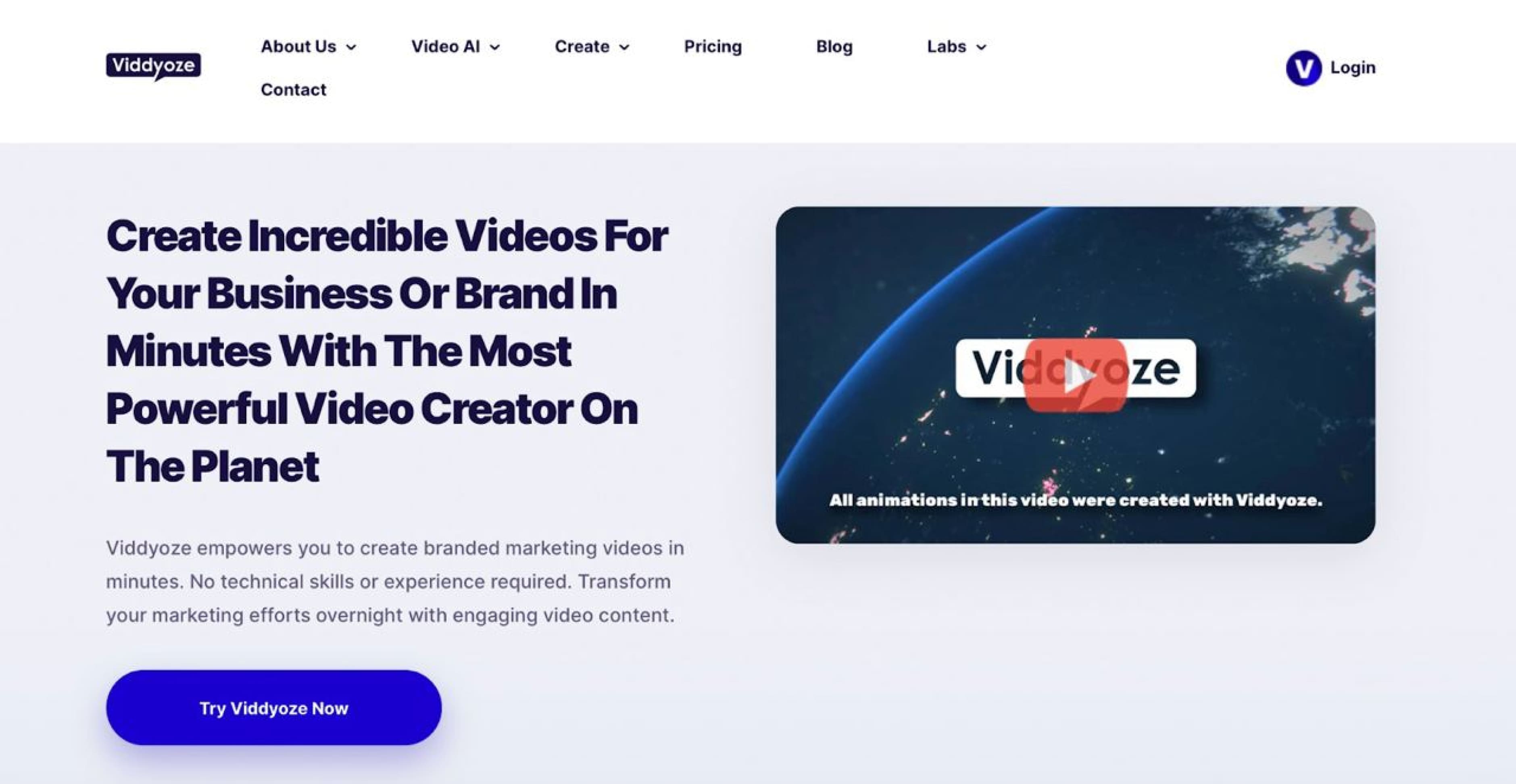
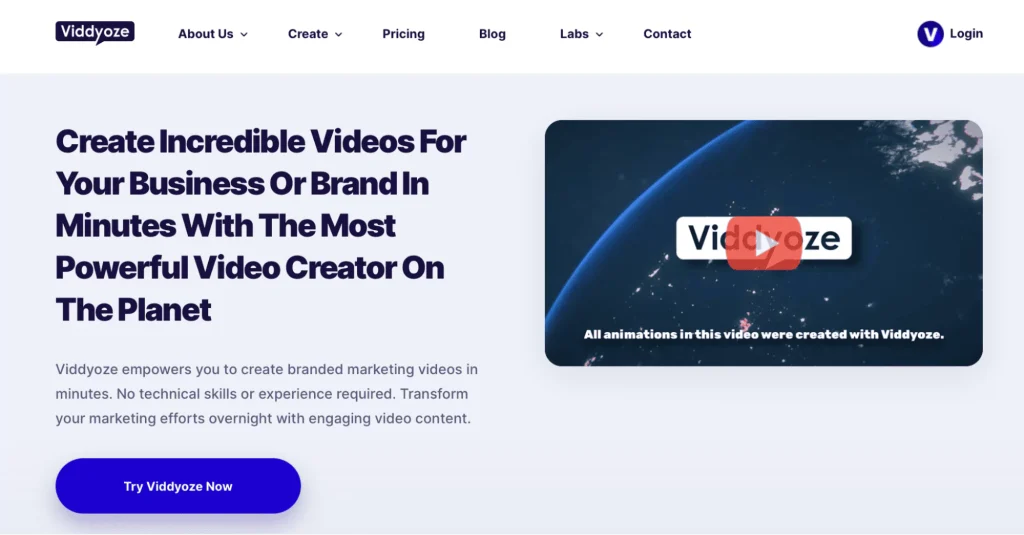
With our robust SaaS development services, our Intobi team developed Viddyoze, a SaaS web-based video editing software. This platform disrupts the conventional notions of video animation, democratizing access to professional-quality animations and motion graphics for businesses and content creators worldwide. Using cloud-based technology and intuitive design tools, this SaaS business model example empowers users to create stunning visual content that captivates audiences and elevates brand storytelling.

For companies building browser-based SaaS products, web development services can help turn product logic, subscriptions, and user workflows into a reliable web platform.

Viddyoze as a SaaS business model example

Essential aspects of Viddyoze’s business model include:

  • Cloud-based platform: Viddyoze’s cloud-based platform eliminates complex software installations and hardware requirements, enabling seamless access and collaboration from any device with an internet connection.
  • Template marketplace: This platform offers a vast library of customizable animation templates, ranging from logos and intros to transitions and outros, providing users with diverse creative assets to enhance their videos.
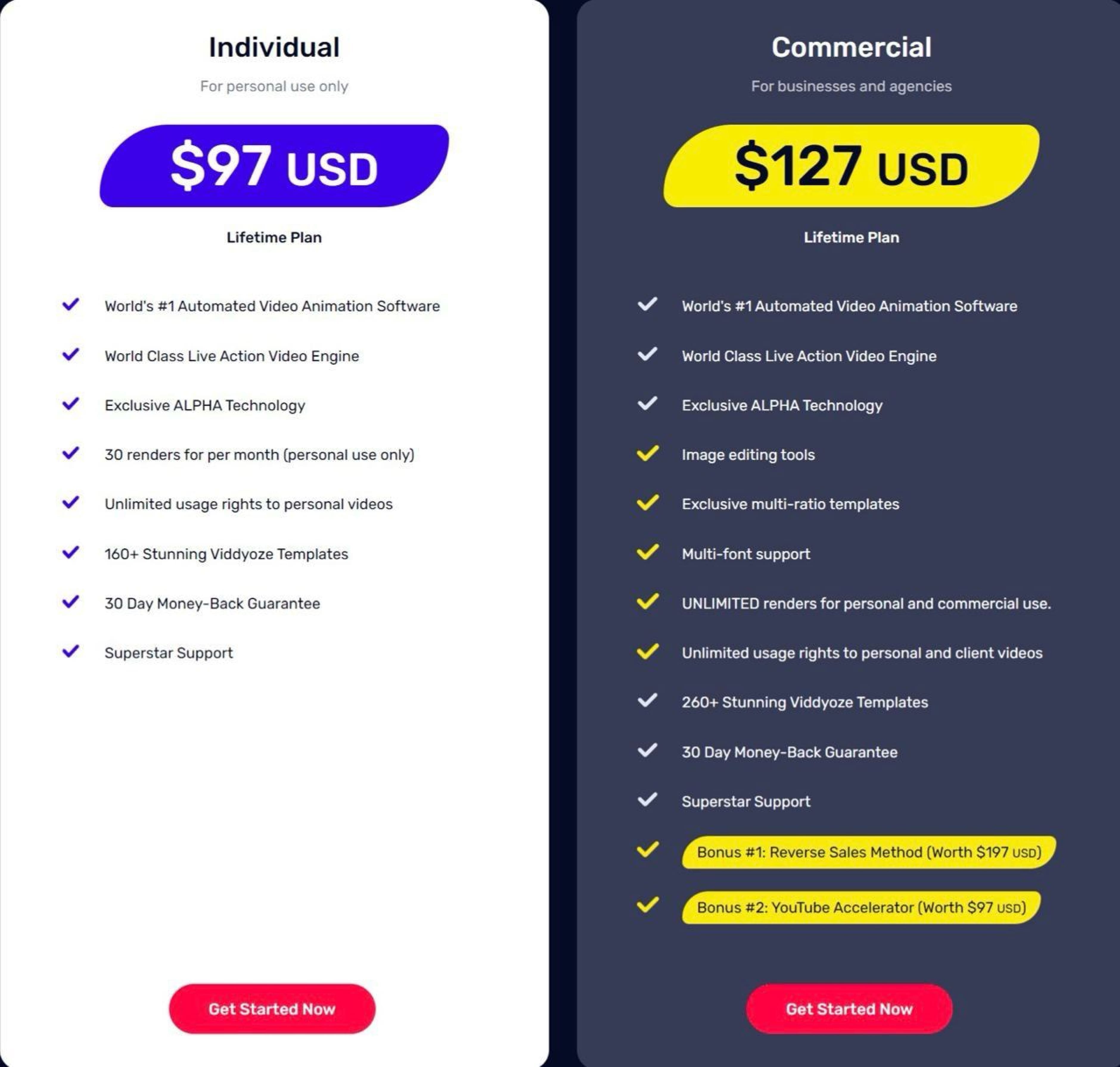
  • Subscription-based model: Viddyoze operates on a subscription-based model, offering tiered pricing plans with varying features and usage limits to accommodate individual creators, small businesses, and enterprise clients.
  • Community engagement: This platform fosters a vibrant community of users through forums, tutorials, and social media channels, facilitating knowledge sharing, feedback exchange, and collaboration among aspiring and seasoned animators.

Below, you can see the subscription-based model of the Viddyoze video editing platform.

Viddyoze pricing model template

Advanced tools for SaaS business model success

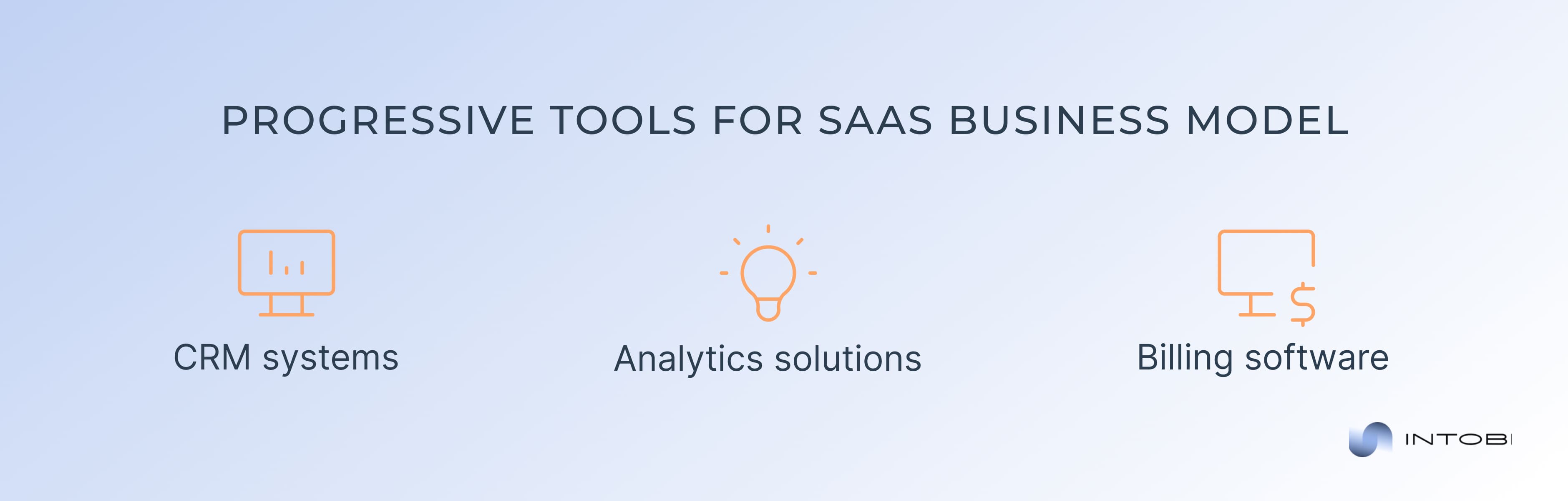
Success in SaaS development hinges on innovative ideas and the adept use of advanced tools tailored for seamless operations and sustained growth. Among the various essential tools, customer relationship management (CRM) systems, analytics solutions, and billing software support the structure of a thriving SaaS business.
Let’s analyze each of these tools and explore how they contribute to the success of the SaaS business model.

Examples of tools for SaaS business model

CRM systems

They are like nerve centers for SaaS businesses, facilitating and managing customer interactions, sales pipelines, and marketing campaigns. These systems empower SaaS companies to promote strong relationships with customers, enhance customer satisfaction, and drive sustainable growth.

CRM systems centralize customer data and interactions, providing invaluable insights into customer preferences, behaviors, and pain points. Using this data, SaaS businesses can personalize marketing strategies, tailor product offerings, and deliver exceptional customer experiences. CRM platforms also streamline sales processes, enabling sales teams to manage leads, track opportunities, and close deals effectively.

Moreover, CRM systems are crucial in customer retention and churn reduction. SaaS companies can strengthen customer loyalty and minimize attrition through proactive engagement, targeted communication, and timely support. Using advanced features such as predictive analytics and AI-driven recommendations, CRM systems empower SaaS businesses to anticipate customer needs and preemptively address issues, fostering long-term relationships and recurring revenue streams.

Analytics solutions

They are the analytical powerhouse driving informed decision-making and strategic planning within SaaS organizations. These solutions enable SaaS businesses to gain deep insights into user behavior, product performance, market trends, and competitive dynamics.

With robust analytics tools, SaaS companies can track key performance indicators (KPIs), monitor user engagement metrics, and measure the effectiveness of marketing campaigns with precision. By analyzing user data across various touchpoints, SaaS businesses can identify patterns, detect emerging trends, and seize opportunities for optimization and innovation.

Furthermore, advanced analytics solutions empower SaaS companies to conduct cohort analysis, segmentation, and predictive modeling, enabling them to understand user segmentation, forecast future performance, and refine product strategies accordingly. With data visualization techniques like dashboards and reports, analytics solutions facilitate clear communication and actionable insights, empowering stakeholders to make informed decisions and drive business growth.

Billing software

This software is key in streamlining revenue operations, optimizing subscription management, and ensuring financial sustainability for SaaS businesses. These platforms automate billing processes, invoice generation, and payment collection, reducing manual overhead and improving operational efficiency.

Billing software enables SaaS companies to satisfy diverse customer needs and maximize revenue potential by offering flexible pricing models, tiered subscription plans, and usage-based billing options. Additionally, these platforms facilitate subscription lifecycle management, from onboarding and upgrades to renewals and churn mitigation, ensuring seamless customer experiences throughout the journey.

Moreover, advanced billing software integrates seamlessly with CRM systems and analytics solutions, enabling comprehensive visibility into customer lifecycles, revenue attribution, and retention metrics. By employing real-time insights and automated workflows, SaaS businesses can optimize pricing strategies, identify upsell opportunities, and reduce revenue leakage, driving sustainable growth and profitability.

In general, CRM systems, analytics solutions, and billing software are essential tools for SaaS business model success. By using the full potential of these advanced tools, SaaS businesses can guide competitive landscapes, adapt to evolving market demands, and achieve long-term success in the digital economy.

Conclusion

The SaaS business model represents a fundamental shift in how software is accessed, utilized, and monetized. Its subscription-based approach empowers companies to streamline operations and drive innovation without the burden of significant investments. By eliminating the need for complex installations and constant updates, SaaS democratizes access to advanced technology, balancing the playing field for businesses of all sizes. 

As the digital economy continues evolving, SaaS stands at the forefront of software delivery, shaping how businesses operate and interact with technology. Using the SaaS business model isn’t just about adopting new software; it’s about assuming a philosophy of continuous improvement, innovation, and collaboration. By understanding and employing the potential of the SaaS business model, companies can unlock new opportunities for growth, efficiency, and success in the dynamic digital age.

Search for a reliable development team to transform your business with tailored SaaS solutions. Contact us today at Intobi to discuss how our expertise can drive your business success in the digital era!

FAQ

What is SaaS business model?

The SaaS (software as a service) business model involves delivering software applications over the Internet on a subscription basis. Instead of purchasing and installing software locally, users access applications online, typically paying a recurring fee for usage.

Why SaaS is the best business model?

SaaS is an ideal business model due to its scalability, accessibility, and cost-effectiveness. It allows businesses to access software without needing significant investments while allowing for easy updates and maintenance. The subscription-based revenue model provides predictable income streams.

What is a SaaS business model and how does it work?

A SaaS business model revolves around providing software apps to users via the Internet. The provider hosts and maintains the software, ensuring updates, security, and technical support. Users can access the software from any device online, making it highly convenient and accessible.

How to build a SaaS business model?

First, identify a niche market and understand its pain points. Based on competitor analysis, determine pricing strategies. Focus on providing excellent customer support and continuously iterate based on user feedback. Implement scalable marketing and sales strategies to attract and retain customers.

Mental Health App Development: Exploring Types and Process

TL;DR

Mental health apps help people build self-awareness, cope with stress, and connect with supportive communities. This article gives an overview of the mental health app market, the main types of apps, and 10 top app ideas such as Headspace, BetterHelp, and Calm. It also covers the benefits of mental health app development, five steps to build one, and the monetization strategies that work.

Make a summary of this article with AI:

Mental health is invisible but, at the same time, the main engine of a person, which allows one to live fully and function effectively in society. Taking care of yourself regularly can lead to discovering an inner source of strength that will help you get through difficult times. Therefore, one’s mental health is the same basic necessity of every person as worrying about one’s physical health. Mental and physical health are an inseparable whole.

Imagine having a helpful friend on your phone to support your mental well-being – that’s what mental health apps are all about. They are like digital buddies, giving us tools and advice to understand better and handle our emotions. These apps are changing the game, making it easier for everyone to focus on their mental health.

So, let’s explore the world of mental health app development and see how it makes it more straightforward for us to care for our minds and hearts.

Mental health app development: comprehensive market overview

Mental health app development involves creating mobile applications to support and improve mental well-being. These apps offer a range of tools and features aimed at helping users manage stress, anxiety, and other mental health concerns. They often provide resources such as guided meditation, mood tracking, and access to professional support, fostering a holistic approach to mental wellness.

Moreover, mental health apps make support and resources more accessible to a broad audience, allowing individuals to take control of their mental well-being from the comfort of their smartphones. These apps integrate diverse features like mood diaries, meditation exercises, cognitive behavioral therapy tools, and even virtual therapy sessions, catering to various needs and preferences.

Interesting

Mental health apps empower users by promoting self-awareness, offering coping mechanisms, and connecting them with communities with similar experiences.

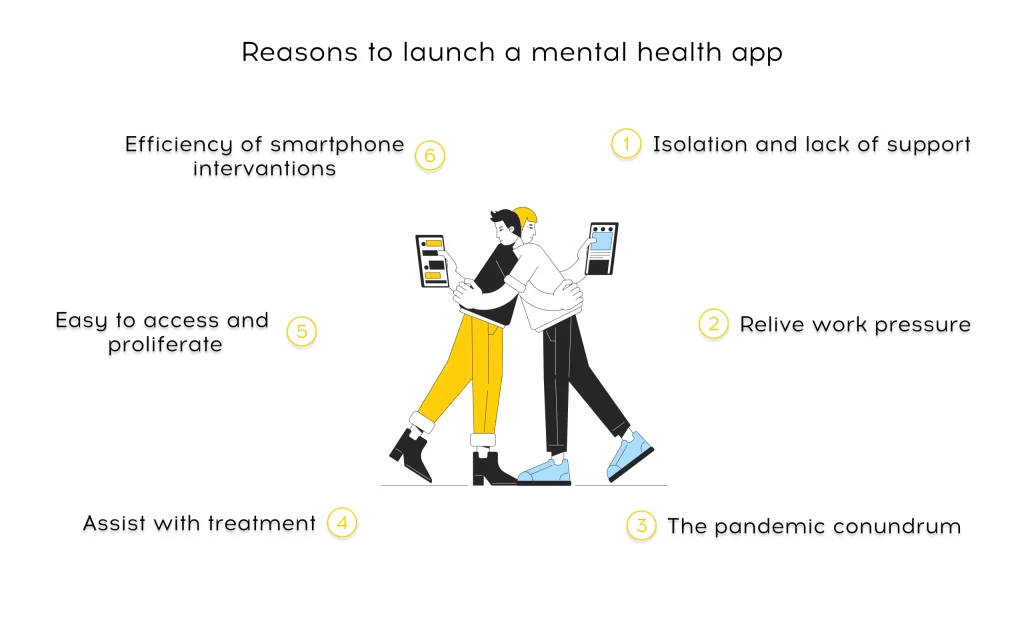
Motivations for introducing a mental health app

More money is becoming available to create different mental health apps, showing that the market for these apps is growing. Take the example of Calm, a meditation app. In 2018, they got $28 million, but by 2020, it went up a lot to $218 million. That’s a 52% increase from 2019 to 2020. This significant increase in funding means the market for these apps could get even more prominent from 2024 to 2030.

People expect it to keep growing at 15.2% every year from 2024 to 2030. More and more people are using mental health apps because they help with treatment and lifestyle. People are also becoming more aware of mental health as essential to staying healthy. This is making the market for these apps get bigger. The apps promote well-being, which is especially useful for people who work a lot. 

The demand for mental health apps has surged in recent years due to increasing awareness of mental health issues and the need for convenient, stigma-free solutions. Factors driving this demand include:

  • Pandemic impact: the COVID-19 pandemic heightened the importance of mental health, spurring a surge in demand for digital solutions as people sought ways to cope with stress, isolation, and uncertainty.
  • Stigma reduction: mental health apps contribute to breaking down societal stigmas surrounding mental health by providing discreet and personalized support.
  • Corporate wellness: companies are recognizing the importance of employee well-being, fueling the integration of mental health apps into corporate wellness programs.

On the other hand, people have been practicing meditation for a long time to feel better emotionally. It comes from various traditions and places around the world. Meditation helps with stress, and now there are apps to make it easier. These apps are becoming famous for assisting people to relax and be kinder to themselves. Experts think that by 2028, these apps will make over 2.6 billion U.S. dollars from people worldwide.

Various types of mental health app ideas

Mental health solutions include apps in several mental health niches. It is about online therapy sessions, relaxation, mood tracking, meditation, and more. Each mental health app is designed to satisfy individuals’ needs and challenges. Here’s a glimpse into the diverse world of mental health app ideas:

Mental disorder apps

These apps focus on specific mental disorders, offering resources and support tailored to conditions such as bipolar disorder, schizophrenia, or ADHD (attention deficit hyperactivity disorder). They provide coping strategies and psychoeducation and sometimes even connect users with online communities for shared experiences.

Examples: UCSF Prime, Talkspace, iMood Journal

Post-traumatic stress disorder (PTSD) apps

Tailored for those dealing with trauma, PTSD apps often incorporate tools like guided relaxation, breathing exercises, and cognitive behavioral therapy (CBT) techniques to assist users in managing and overcoming the effects of traumatic experiences.

Examples: PTSD Eraser, Breathe2Relax, PTSD Coach

Eating disorder apps

Specifically crafted for individuals guiding eating disorders like anorexia or bulimia, these apps often include meal tracking, nutritional guidance, and emotional support features to promote a healthier relationship with food.

Examples: Noom, Rise Up + Recover, Lifesum

Depression and anxiety apps

Addressing the widespread challenges of depression and anxiety, these apps provide mood tracking, journaling, and mindfulness exercises. Some even integrate CBT (cognitive behavioral therapy) principles to help users reframe negative thoughts and develop healthier coping mechanisms.

Examples: Calm, Happify, MoodTools

Meditation and self-improvement apps

Focused on promoting mental well-being through mindfulness and meditation, these apps guide users through relaxation techniques, breathing exercises, and meditation sessions. They aim to enhance overall mental resilience and foster a positive mindset.

Examples: Headspace, Simple Habit, Insight Timer

Stress and anxiety control apps

Geared towards daily stressors and anxiety management, these apps often include stress tracking, quick relaxation exercises, and personalized stress reduction plans to help users navigate life’s challenges more calmly.

Examples: Rootd, MindShift, Worry Watch

Mood and symptoms tracking apps

Providing a platform for users to log and monitor their moods, these apps enable individuals to identify patterns and triggers. This information can be valuable for users and mental health professionals in understanding and managing emotional well-being.

Examples: Daylio, eMoods, MindDoc

Teletherapy apps

In the digital age, teletherapy apps connect users with licensed therapists or counselors through video calls or messaging. This facilitates convenient and accessible mental health support, particularly for those facing barriers to in-person sessions.

Examples: BetterHelp, Amwell, Doctor On Demand
Thus, the diverse array of mental health app ideas reflects a commitment to providing personalized support and tools for individuals on their unique journeys toward mental well-being.

Interested in mental health solutions?

Let’s chat

Top 10 mental health app ideas

You need to understand your emotions and desires to feel good and enjoy life. The good news is that technology offers new ways to support our well-being, and mental health apps are gaining popularity. We have rounded up successful mental health app ideas to help you deal with anxiety, boost productivity, and manage your mental state.

Let’s explore some of the leading mental health apps available today:

Headspace

It is a meditation and mindfulness app that aims to make meditation simple and accessible. This app offers guided meditation sessions, sleep sounds, and mindful exercises. Whether you’re a beginner or an experienced meditator, Headspace provides various programs to promote relaxation and focus.

Headspace home page

BetterHelp

This is an online counseling platform connecting users with licensed therapists through text, chat, phone, or video calls. It provides a convenient and confidential way to access professional mental health support. BetterHelp covers a range of issues, including depression, anxiety, and relationship problems.

BetterHelp home page

Daylio

It is a mood-tracking and journaling app to help users understand their emotions and daily patterns. Users can log their moods, activities, and habits, and the app generates insights to identify potential triggers or contributors to emotional well-being.

Daylio home page

Calm

This comprehensive mental health app development solution offers guided meditations, sleep stories, and relaxation exercises. It is known for its soothing nature sounds and calming visuals. Calm also provides programs to help users build resilience, manage stress, and improve sleep.

Calm home page

Talkspace

This is an online therapy platform that connects users with licensed therapists for text, audio, or video counseling sessions. It provides a flexible and convenient way to access professional mental health support from the comfort of your own space.

Talkspace home page

Happify

It is designed to boost mood and well-being through science-backed activities and games. Happify incorporates positive psychology principles to help users reduce stress, build resilience, and foster a positive mindset.

Happify home page

Sanvello

This app combines therapy, mood tracking, and relaxation tools to support mental health. It offers guided journeys to help users with specific challenges, such as managing anxiety, improving sleep, and building self-esteem.

Sanvello home page

MindDoc

This is one of the mental health app development solutions that assists users in monitoring and managing their emotional well-being. It includes mood tracking, self-help exercises, and insights based on the user’s input. MindDoc is designed to support individuals dealing with mood disorders.

MindDoc home page

Woebot Health

It is an AI-powered chatbot that provides users with cognitive-behavioral therapy (CBT) techniques. This app engages in conversations, offers emotional support, and guides users through exercises to help them manage stress, anxiety, and other mental health challenges.

Woebot Health home page

Youper

It is an emotional health assistant that uses AI (artificial intelligence) to provide personalized conversations and interventions. Youper incorporates elements of CBT and other therapeutic approaches to help users better understand their emotions and develop coping strategies.

Youper home page

As technology advances, the landscape of mental health app development is evolving. These apps contribute to a growing movement toward making mental health resources more accessible and destigmatizing, seeking help for psychological well-being. However, individuals should always consult with qualified mental health professionals for personalized advice and treatment when necessary. Taking steps to prioritize mental health is a positive and proactive choice; these mental health app ideas can be valuable allies in that journey.

Crucial benefits of mental health app development

The rise of technology has paved the way for innovative solutions, and one such breakthrough is healthcare software development. The mental health apps cater to a broad audience, offering accessible and personalized tools to enhance mental well-being. Let’s explore the myriad advantages of mental health app development.

Accessibility:

  • Mental health apps provide instant support and resources at your fingertips.
  • Users can access these apps anytime, anywhere, breaking down barriers to seeking help.

Personalization:

  • Tailored content and features allow users to address specific concerns and preferences.
  • Personalized reminders and notifications encourage consistent engagement, fostering a sense of individualized care.

Self-help tools:

  • Interactive tools such as mood trackers, breathing exercises, and meditation guides empower users to manage their mental well-being actively.
  • These tools promote self-awareness and help users build healthy coping mechanisms.

Anonymity and privacy:

  • Users can explore and address mental health concerns with a sense of anonymity.
  • Privacy features ensure that sensitive information is securely handled, encouraging users to open up without fear of judgment.

Real-time support:

  • Many mental health apps offer real-time chat support or crisis helplines, providing immediate assistance during moments of distress.
  • Instant access to professional advice can be a lifeline for individuals in critical situations.

Community support:

  • In-app communities and forums foster a sense of belonging and understanding.
  • Users can share experiences, provide support, and connect with others facing similar challenges, reducing feelings of isolation.

Education and awareness:

  • Mental health apps often include educational resources to increase awareness and reduce stigma.
  • Informational content helps users better understand their mental health and encourages a proactive approach to well-being.

In general, the development of mental health apps has ushered in a new era of accessible and personalized support for individuals navigating the complexities of mental well-being. These apps provide practical tools for self-help and create a supportive virtual environment where users can connect, learn, and grow. As we continue to prioritize mental health on a global scale, the positive impact of mental health app development is evident in the lives it touches and the positive changes it brings to how we approach mental well-being.

Now, we can explore how to develop a mental health app.

5 steps on how to develop a mental health app

In recent years, mental health awareness has increased, prompting a growing demand for innovative solutions. One such solution is the development of mental health apps that provide support and resources to individuals seeking to enhance their well-being. This guide outlines the essential steps in creating a successful mental health app.

Guidelines for creating a mental health application

Research

Begin your mental health app development journey by conducting thorough research to understand the specific needs of your target audience. Consider the demographic, cultural, and psychological factors influencing their mental health requirements.

You can analyze existing mental health apps to identify market gaps and potential improvement areas. This analysis will help you understand what works well and what users find lacking in current solutions.

Also, collaborate with mental health professionals, psychologists, and psychiatrists to gain insights into the clinical aspects of mental health. Their expertise can guide the development of features that align with evidence-based therapeutic practices.

UI/UX design

It is a great idea to craft an intuitive and user-friendly interface that makes navigation seamless. Prioritize clarity and simplicity in mental health app design to ensure users can easily access the app’s features without feeling overwhelmed.

On the other hand, incorporate calming and aesthetically pleasing visuals that contribute to a positive user experience. Choose a color palette that aligns with mental health themes, avoiding overly stimulating or distracting elements.

Moreover, implement personalization options that allow users to tailor the app to their preferences. This may include customizable themes, notification settings, and content recommendations based on user behavior.

Also, ensure your mental health app design is inclusive by considering accessibility features. Accommodate users with various abilities, ensuring the app is usable and beneficial to a diverse audience.

Development

It is important to select a robust and scalable technology stack that aligns with the app’s goals. Consider security, data privacy, and integrating with other platforms or devices.

Prioritize core features such as mood tracking, journaling, and goal setting. Integrate evidence-based therapeutic techniques, such as cognitive-behavioral therapy (CBT), into the app’s functionalities to enhance effectiveness.

Also, implement stringent security measures to protect user data, adhering to industry standards and regulations. Encryption, secure authentication, and regular security audits are essential to maintaining user trust.

Moreover, clearly communicate your data privacy policies to users and ensure compliance with data protection laws. Transparency about user data collection, storage, and use is crucial for building trust.

Testing and feedback

You can conduct thorough beta testing with diverse users to identify bugs, glitches, or usability issues. Collect feedback on the overall user experience, feature effectiveness, and potential improvements.

On the other hand, establish a continuous feedback loop by encouraging users to provide insights and suggestions. Regularly update the app based on user feedback to demonstrate responsiveness to user needs.

Perform usability testing to assess how well users can navigate the app and accomplish specific tasks. Identify areas of improvement and make necessary adjustments to enhance overall usability.

Support

Provide reliable customer support to address user queries, concerns, and technical issues. A responsive support team contributes to user satisfaction and fosters trust in the app.

You can foster a sense of community among app users by incorporating features such as forums, support groups, or social networking. Building a supportive community enhances the app’s overall impact on users’ mental well-being.

Commit to regular updates to keep the app relevant and aligned with evolving mental health research. Stay informed about new therapeutic approaches and integrate them into the app’s features.

In conclusion, creating a mental health app requires a holistic approach, encompassing research, thoughtful UI/UX design, robust development, rigorous testing, and ongoing support. You can create a valuable tool that positively impacts users’ mental well-being by prioritizing user needs, adhering to ethical standards, and maintaining a commitment to continuous improvement. Remember, the journey doesn’t end with the app’s launch; it evolves as you adapt to user feedback and advancements in mental health research.

Searching for a reliable development partner?

Contact us

Monetization strategies for mental health app ideas

Where stress and anxiety are commonplace, mental health app ideas have become valuable tools for individuals seeking support and well-being. However, the development and maintenance of these apps require financial investment. Mental health app developers often employ various monetization strategies to sustain and enhance their offerings, each catering to different user preferences and needs.

Freemium: a gateway to wellness

One prevalent approach is the freemium model, a fusion of “free” and “premium.” Mental health apps adopting this strategy provide essential features for free, attracting users to explore the app’s functionality. Once users recognize the app’s value, they can upgrade to a premium version for enhanced features and a more comprehensive experience. This model ensures accessibility to a broader audience while offering a pathway for those seeking advanced features and a deeper engagement with mental well-being.

Subscriptions: a commitment to mental wellness

Subscriptions form another robust monetization avenue for mental health apps. Users pay a recurring fee to access premium content, exclusive features, and personalized services. This model fosters a sense of commitment and consistency, aligning with the long-term nature of mental health journeys. Subscriptions can be tiered, offering different levels of access based on user preferences, allowing individuals to choose the level of support that best fits their needs and budget.

Pay per download: a one-time investment in mental health

The pay-per-download strategy is a viable option for users who prefer a straightforward payment model. Individuals pay a one-time fee to download the mental health app, gaining full access to its features and resources. This model is detailed, offering a transparent transaction without ongoing financial commitments. Developers can enhance user satisfaction by ensuring the initial investment provides substantial value, encouraging positive reviews and word-of-mouth referrals.

In-app purchases: tailoring support to individual needs

In-app purchases add a layer of personalization to the monetization mix. While the core app may be free to download, users can choose to purchase additional content, features, or virtual goods within the app. For mental health apps, this could include guided meditation sessions, premium content from mental health professionals, or customization options for a more tailored experience. In-app purchases empower users to personalize their support journey, paying only for the most beneficial elements.

In conclusion, monetization strategies for mental health apps should align with the app’s purpose – to provide genuine support for users on their mental health journeys. The key is to create a sustainable model that ensures continued development and innovation while prioritizing user well-being. By fostering a harmonious relationship between user needs and financial sustainability, mental health app development can contribute meaningfully to the overall well-being of individuals worldwide.

Fundamental features for building a health app

Creating a health app requires thoughtful features to ensure patients and doctors have a seamless experience. Let’s explore critical functionalities for users on both sides of mental health app development.

Main features of mental health apps

Features for patients

In healthcare apps, features tailored for patients are pivotal in fostering a proactive and engaged approach to personal well-being. From the initial sign-up process to tools that facilitate continuous communication with healthcare providers, each feature is designed with the patient’s experience and empowerment in mind.

Sign up/sign in

Simple and secure registration process for patients to create accounts.

Registration process for patients

User profile

Personalized profiles allow users to manage their health information and preferences.

Self-monitoring

Tools for patients to track and manage their health metrics, fostering a proactive approach.

Live streaming

Capability for live video sessions, enabling virtual consultations with healthcare professionals.

Document sharing

Secure file sharing to exchange medical records, reports, and other relevant documents.

Messaging and chats

Real-time communication features allow patients to connect with healthcare providers conveniently.

Example of messaging with healthcare providers

Notifications and reminders

Customizable alerts to remind users of medication schedules, appointments, and other health-related activities.

Connect with your therapists

Direct channels for patients to engage with their therapists, fostering continuous support.

Features for doctors

For healthcare providers, the features integrated into the app play a vital role in streamlining processes and improving the overall efficiency of healthcare delivery. From advanced role systems to billing and appointment management, these features are designed to enhance the doctor’s ability to provide quality care.

Role system

Clearly defined roles and permissions to ensure secure and controlled access for healthcare professionals.

Appointment scheduling

Efficient tools for doctors to manage appointments, reducing scheduling conflicts.

Therapist dashboard

A comprehensive dashboard for therapists to access patient information, treatment plans, and communication history.

Example of dashboard for therapists

Billing plans and invoicing

Integrated billing features to streamline payment processes and manage invoicing for healthcare services.
In conclusion, robust mental health app development should cater to the diverse needs of both patients and doctors. The app can create a user-friendly and effective healthcare ecosystem by incorporating features like secure sign-up processes, self-monitoring tools, live streaming, and efficient appointment scheduling. These features enhance patient engagement and provide doctors with essential tools for seamless management and collaboration in the digital healthcare landscape.

Let's discuss

Contact Us

Cost of mental health app development

The mental health app development cost depends on features, design, security, ongoing support, and more. Balancing these elements is critical to creating a valuable and effective tool for users seeking support for mental well-being.

You need to figure out how much money and time different teams require. This helps you choose the right team for building your mental health app. You can pick from these options:

  • In-house;
  • Outsource;
  • Freelance.

We made a table using the cost rate of $50 per hour. It shows you how much time it takes to create a feature or complete tasks like figuring things out, designing, testing, or managing the project.

Cost of developing a mental health app
FeaturesTime, hoursCost ($50/h)
Design
UX Development42$2,100
UI Development56$2,800
Architecture
Project setup16$800
DB structure32$1,600
Integrations
Payment (Stripe or PayPal)32$1,600
Electronic health record integration64$3,200
Main functionality
Features for patients
Authorization and security72$3,600
User profile42$2,100
Homepage84$4,200
Self-monitoring32$1,600
Messaging and chats42$2,100
Audio and video calling48$2,400
Document sharing64$3,200
Emergency contact56$2,800
Notifications and reminders42$2,100
Prescription management42$2,100
Features for doctors
Profile system120$6,000
Appointment scheduling164$8,200
Dashboard with key metrics32$1,600
Billing plans and invoicing136$6,800
Non-development activity
Project management48$2,400
Quality assurance64$3,200
Code review48$2,400
Launching of app64$3,200
Total1378$68,900

It is crucial to understand that the costs can vary based on the complexity of your app, the features you include, and the development team you hire. Also, it is essential to plan carefully and be aware that ongoing expenses for maintenance and updates are part of the long-term commitment.

How to create a health app: Intobi’s vast expertise

Intobi is a skilled software development company with a wide range of know-how in delivering mental health app development services. Our expertise lies in creating applications that cater to the well-being of individuals’ mental health. By combining technology and empathy, Intobi designs user-friendly and compelling apps that aim to support and enhance mental wellness.

Our experienced team understands the sensitivity and importance of mental health, and our developers work collaboratively to bring innovative solutions to the forefront. Whether we are creating tools for mindfulness, mood tracking, or providing resources for mental health education, the Intobi team excels in developing applications that positively impact users’ mental well-being.

What sets us apart is our commitment to developing apps that are not only technically robust but also emotionally intelligent. We prioritize user experience (UX), ensuring our mental health apps are intuitive and accessible to a broad audience. With a focus on using technology to advance mental health, the Intobi team is dedicated to contributing meaningfully to the mental wellness field through our innovative software solutions.

Among all our remarkable projects, we also focused on building a health app. Let’s analyze it together.

MindTales

A mobile app that offers convenient access to online wellness support anytime and anywhere. MindTales delivers premium digital wellness courses and virtual counseling services.

Intobi's successful case study: MindTales

Our primary objective at MindTales was to enhance the well-being of its users. Through MindTales, users can access customized bite-sized activities and engage in online sessions with experienced counselors.

The Intobi team undertook a comprehensive design cycle, starting from the minimum viable product (MVP) and progressing to the launch of an enhanced product. Our approach revolves around placing the user at the center, ensuring an improved user experience, and ultimately augmenting the business value we provide.

MindTales is committed to delivering comprehensive digital wellness solutions through a meticulous scope of work that includes:

  1. UX research. We initiate our process with thorough user experience (UX) research. This involves understanding user needs, behaviors, and preferences to inform our design decisions. By gathering valuable insights, we lay the foundation for creating an effective and user-centric platform.
  2. Building a new UX strategy. MindTales focuses on crafting a robust UX strategy that aligns with improving user well-being. This strategy encompasses user journeys, information architecture, and feature prioritization to create a seamless and purposeful user experience.
  3. Wireframing. Before delving into the visual aspects, we develop detailed wireframes. These wireframes serve as a blueprint, outlining the structure and functionality of the platform. This step allows us to refine the user flow and interactions before moving forward in the design process.
  4. Visual design. Our commitment to aesthetics is reflected in the visual design phase. MindTales creates visually appealing interfaces that align with the brand identity and contribute to a positive and engaging user experience. The graphic design is carefully crafted to enhance the overall look and feel of the platform.
  5. Testing. MindTales places a significant emphasis on testing to ensure the efficacy of our digital wellness platform. We conduct usability testing and gather feedback to refine and optimize the user experience. This iterative approach allows us to address potential issues and enhance user satisfaction.

Thus, MindTales is an AI-enabled mental health platform providing patients with wellness activities and connecting them with mental health counselors. 

Conclusion

The world of mental health is witnessing a positive transformation through the development of mental health apps. These digital tools offer a convenient way to access support and empower individuals to take charge of their well-being. As we embrace the era of technology, the significance of mental health app development cannot be overstated.

These apps bridge the gap between mental health care and those in need, providing a lifeline for individuals facing various challenges. From stress management to mood tracking, these applications offer many features to promote mental well-being. The attractiveness lies in their accessibility, allowing users to seek help and guidance at their fingertips.

If you envision developing an outstanding app or software solution, let us be your partners in progress. Together, we can create solutions that meet today’s needs and shape a better tomorrow. Contact us to explore how our expertise can make your vision a reality.

FAQ

What is a mental health app?

A mental health app is a digital application designed to support and enhance mental well-being. These apps offer a range of features, including mood tracking, meditation exercises, therapy sessions, and educational resources to help users manage stress, anxiety, and other mental health concerns.

What types of mental health apps exist?

Some mental health apps focus on meditation and relaxation techniques, while others offer mood-tracking functionalities. Therapy apps connect users with licensed professionals, providing remote counseling sessions. Also, there are educational apps offering information on mental health topics.

Can I get a good profit from a mental health app?

The potential for profit in the mental health app market exists, given the growing mental health awareness and the increasing demand for accessible resources. Success depends on app quality, user experience (UX), effective marketing, and the ability to address specific user needs.

What niche is available for a mental health app?

The mental health app space offers various niches for exploration. Developers can consider niches such as stress management, sleep improvement, mindfulness for specific demographics, or apps tailored to address special mental health conditions.

How do you develop a mental health app?

Making a mental health app involves defining its purpose, targeting the audience, and collaborating with professionals for accuracy. Design user-friendly interfaces, engaging content, and interactive features. Ensure security and prioritize regular updates and user feedback for ongoing improvement.

Why must a mental health care app be compliant?

Mental health app development compliance is crucial to ensure user privacy and ethical standards. Adherence to regulations and guidelines, such as the Health Insurance Portability and Accountability Act (HIPAA), protects sensitive user data, maintaining confidentiality in therapy interactions.

How to Build a SaaS Product: A Comprehensive Beginner’s Guide

TL;DR

SaaS puts software on the Internet, making it flexible and easy to use for businesses and their customers. This beginner’s guide explains why building a SaaS product matters, its key benefits – from cost savings and free trials to security and global reach – and how SaaS compares with IaaS and PaaS. It then walks through 12 crucial steps to build a SaaS product from scratch.

Make a summary of this article with AI:

In today’s digital world, software as a service (SaaS) is a big deal! It’s like a superhero for businesses, changing how they operate and how people use technology. Instead of old-fashioned software, SaaS puts everything on the Internet, making it easy and flexible.

This switch from the old way to the new cloud-based style isn’t just a tech trend; it’s a game-changer for improving things in different areas. Businesses love it because SaaS is affordable and lets them do things more smartly. In simple words, SaaS is a program that runs on the provider’s server, and the user gets remote access to it for a fee.

In this article, we’ll discuss how to make a SaaS product, why it’s unique in today’s tech world, and why businesses value it. Also, we’ll spill the beans on how our company makes SaaS products. We’ll share our experiences and tips to help you if you’re thinking of making your cloud-based solution. Let’s explore the SaaS world together, where smart ideas meet real-life usefulness and discover the key behind making excellent software.

Get ready for a journey into the tech-savvy world of SaaS!

Significance of building a SaaS product

The SaaS model, short for software as a service in cloud computing, involves delivering ready-made software through a subscription-based online connection. This approach allows users to access the required software on any device with an internet connection and a web browser.

Simply put, opting for SaaS products presents a valuable opportunity to cut down on expensive hardware costs since data and applications are stored in remote data centers. Consequently, users of SaaS are spared from dealing with issues related to maintenance, compliance, and security.

Contemporary SaaS technology comes in a diverse range of options. It facilitates the development of platforms capable of linking applications, integrating Internet of Things (IoT) solutions, and analyzing big data. IoT and big data are recognized as prominent trends in technology, making the knowledge of constructing a SaaS product a highly worthwhile investment.

Basics of SaaS

Technically, a client can access a SaaS product in one of three ways:

  1. Through a private cloud, when cloud software is built on infrastructure that exists exclusively for use by one organization;
  2. Through a public cloud, which is cloud services offered and usually hosted by a third-party provider;
  3. Through a hybrid cloud that exists in an organization that uses both public and private cloud systems in its IT infrastructure.

SaaS products range from video streaming services to IT business analytics tools. Popular SaaS products include Google Workspace, Microsoft 365, HubSpot, Trello, Netflix, Zoom, Slack, Adobe Creative Cloud, and more.

Let’s consider unique features of SaaS that help businesses to thrive.

Fundamental features of the SaaS product:

  • You do not need a separate workplace because you can use the service remotely – through a browser or mobile application. In addition, other users can use the same account at the same time as you.
  • Since the service provider is responsible for creating, operating, and updating the program, you get a ready-to-use solution and do not deal with its technical side.
  • SaaS systems are usually cross-platform and cross-browser. You can launch such a cloud service from almost any device or browser, often with a minimum Internet connection speed.
  • System updates of the Saas are performed centrally on the provider’s side. You do not need to pay extra for them, as this service is initially included in the payment for using the platform.

Essential benefits of building SaaS products for your business 

Building SaaS products brings many advantages beyond the traditional software development model. These key benefits guide in a new era of efficiency, collaboration, and innovation for businesses of all sizes. Let’s explore why building SaaS applications is a game-changer!

Saves money

Because SaaS allows multiple people to work simultaneously at any time and from any location, you don’t need to install software on local computers. You will also save on wages because you do not need a programmer who will adapt and update the service. We remind you that the provider is responsible for SaaS maintenance, and this service is already included in the monthly package.

Free trials

SaaS allows providers to offer free trials of their software (7, 14, or 30 days). During this period, you can try the program for free to see if you want to register and pay for the subscription. This service allows you to minimize risk and maximize return on investment, and SaaS businesses can attract more potential customers and expand their customer base.

Convenient payment

You only pay for the SaaS product when you use it. Nowadays, companies provide various payment plans depending on the customers’ financial capabilities. You decide to continue paying for the SaaS services or cancel the subscription, pay extra for the advanced functionality of the programs, or use only the basic one.

Comfort in use

Working with SaaS products is easy and convenient because you need to connect to the Internet and log in to access modern, functional programs. It saves you time and effort and does not require special IT knowledge.

Systematic updates

Software updates are the responsibility of the vendor. Some of them release new versions of their products every week or every few months to keep the product useful for current user needs. You can easily update to the latest versions with the click of a button, gaining access to bug fixes and new features as they become available.

Enhanced security

SaaS providers prioritize data security through advanced encryption techniques. This ensures the confidentiality and integrity of user data, safeguarding against potential security threats. Moreover, SaaS platforms undergo regular security audits and adhere to industry compliance standards. This commitment to robust security measures instills confidence in users regarding protecting sensitive information.

Global reach

SaaS eliminates geographic limitations, allowing businesses to operate on a global scale. Users worldwide can collaborate seamlessly, promoting a more interconnected and competitive business landscape. SaaS products often offer localization options, allowing businesses to customize the software to meet diverse international markets’ specific needs and preferences.

User-friendly experience

SaaS providers prioritize user experience by designing intuitive and user-friendly interfaces. This emphasis on usability ensures that individuals can easily guide and employ the software regardless of their technical expertise. Many SaaS providers offer training resources and customer support to assist users in maximizing the benefits of the software. This commitment to user education contributes to a positive and empowering user experience.
Before moving on to the guide on building a SaaS product, let’s look at the different cloud computing models for a better understanding of the SaaS base.

Want to optimize your SaaS for growth?

Contact us

Best cloud computing models: IaaS vs. PaaS vs. SaaS

First, cloud computing has changed how businesses and people handle data, providing services like servers, storage, and software over the Internet. There are three main models: infrastructure as a service (IaaS), platform as a service (PaaS), and software as a service (SaaS). Let’s check them!

IaaS (infrastructure as a service)

In fact, IaaS is like a virtual toolbox on the Internet. Users can rent virtual machines, storage, and networking as needed. Examples include Amazon Web Services (AWS), Microsoft Azure, and Google Cloud Platform. IaaS helps save costs and allows businesses to adjust their resources quickly based on their needs, leaving the complicated management to the service provider.

IaaS basics

PaaS (platform as a service)

PaaS is a platform for making and managing applications without dealing with the technical stuff underneath. Examples are Heroku, Google App Engine, and Microsoft Azure App Services. PaaS speeds up development and reduces the time it takes to get a product to market. Also, developers can focus on their work while the platform provider handles maintenance.

PaaS basics

SaaS (software as a service)

SaaS delivers software over the Internet on a subscription basis. Users can apply the software through a web browser without installing anything locally. Examples are Salesforce, Google Workspace, and Dropbox.

Interesting

SaaS is cost-effective, automatically updates, and works on any device with an internet connection.

SaaS basics

As a result, IaaS, PaaS, and SaaS each offer unique benefits, giving organizations the freedom to choose the model that suits their needs in the ever-changing world of cloud computing.

Below is a comparison table of IaaS, PaaS, and SaaS cloud computing models.

CriteriaIaaSPaaSSaaS
ManagementUser manages apps, data, runtimeUser manages apps and data; platform provider manages runtimePlatform provider manages apps, data, runtime
FlexibilityHighModerateLow
ScalabilityHighModerateLow
Development speedSlower due to infrastructure managementFaster due to pre-built platform componentsFastest due to ready-to-use applications
ExamplesAWS, Azure, Google CloudHeroku, Google App EngineSalesforce, Google Workspace

Finally, we reached the basis of our article – a detailed guide on how to build a SaaS product. Let’s delve into it in more detail!

12 crucial development steps to building a SaaS product from scratch

Creating a SaaS product requires a detailed approach and strategic planning. From ideation to launch, each step plays a crucial role in the success of your SaaS product. This guide provides a thorough roadmap for building a SaaS product, ensuring that your development journey is smooth and results in a product that meets market needs.

Let’s analyze each development step separately to realize how to build a SaaS product.

Step 1: Searching ideas for SaaS product innovation

The core of any successful SaaS product is a unique and valuable idea. Start by diving deep into your target audience and identifying pain points waiting to be addressed. Also, conduct thorough market research, employ surveys, and analyze competitors to pinpoint opportunities and validate the demand for your solution.

The SaaS industry is rife with stories of innovative ideas turning into successful ventures. For example, consider how Dropbox identified the need for seamless file synchronization and sharing, revolutionizing cloud storage.

Dropbox example

Step 2: Unveiling your marketing niche

The next stage of building SaaS products is analyzing the market. To carve out your marketing niche, pose vital questions such as:

  1. Who is your target audience?

If you’re developing a project management tool, your target audience might include small to medium-sized businesses looking for efficient collaboration solutions.

  1. What specific problems are you solving?

For example, Trello addressed the need for simplified project management by offering a visual and intuitive platform that allows teams to collaborate seamlessly.

  1. How does your solution differ from existing ones?

For instance, Slack differentiated itself by providing a communication platform that seamlessly integrates with other tools, streamlining workplace communication.

  1. What is your unique value proposition?

In turn, Zoom disrupted the video conferencing space by offering a user-friendly platform with high-quality video, setting itself apart from traditional conferencing solutions.

Answers to these questions will guide your marketing strategy and help you define a unique space for your SaaS product in the competitive landscape.

Understanding your target audience is crucial. Consider HubSpot, a marketing automation platform that caters to businesses of all sizes. By offering a free CRM (customer relationship management) alongside premium marketing tools, HubSpot addressed the needs of startups and small businesses, creating a niche in the market that contributed to its widespread adoption.

HubSpot example

Step 3: Creating your strategic business plan

Next, before building a SaaS product, you can make a comprehensive business plan as a roadmap for your SaaS product. So, include details such as:

  1. Goals: define clear and achievable goals for your product.
  2. Target market: clearly outline your target market and audience.
  3. Revenue model: specify how your SaaS product will generate revenue (subscription, freemium, etc.).
  4. Growth strategies: identify strategies for scaling and expanding your user base.
  5. Financial projections: provide realistic financial projections for your SaaS product.
  6. Timeline: establish a timeline for development, marketing, and launch.

A vivid example of a strategic business plan is that of Salesforce. In its early days, Salesforce disrupted the CRM market by introducing a cloud-based solution. Their strategic plan focused on scalability, customization, and addressing the pain points of traditional CRM systems, leading to their eventual dominance in the industry.

Salesforce example

Step 4: Determining your SaaS business needs

To build a SaaS product, it is also critical to identify the necessary resources for your SaaS business.

  • Personnel:
    Assess the skills and expertise required for your development, marketing, and support teams.
  • Technology:
    Choose appropriate technologies that align with your product requirements.
  • Infrastructure:
    Ensure scalability to accommodate future growth and changing user demands.

Consider Netflix, which continuously invests in robust infrastructure to handle the demands of its ever-growing user base, ensuring a seamless streaming experience. By anticipating the need for scalable infrastructure, Netflix has maintained a competitive edge in the streaming industry.

Netflix example

Step 5: Selecting the cutting-edge SaaS tech stack

Obviously, when you build a SaaS product, you must choose a tech stack tailored to your SaaS product requirements:

  1. Frontend technologies: JavaScript frameworks – React, Angular, or Vue.js.
  2. Backend technologies: Ruby on Rails, Node.js, or Django.
  3. Database: PostgreSQL, MySQL, or NoSQL.
  4. SaaS hosting provider: Amazon (AWS), Google, Microsoft, or Heroku.

For SaaS teams that need scalable hosting, secure deployment, and reliable performance, cloud app development can help build cloud-based products ready for long-term growth.

Consider the case of Shopify, an ecommerce SaaS platform. Shopify’s tech stack includes Ruby on Rails for the backend, React for the frontend, and MySQL for the database. This carefully selected tech stack has contributed to Shopify’s success in providing a scalable and customizable ecommerce solution.

Shopify example

Step 6: Forming your dream SaaS development team

Turning your vision of a successful SaaS-based product into reality requires assembling a dedicated team comprising the following key roles:

  • Business analyst
  • Designer
  • Software developers
  • Quality assurance engineer
  • Project manager

Now that you have your plan, it’s time to bring your SaaS development team together. Here are three options of choosing a team to build a SaaS product:

In-house team

Having an in-house team means you have direct control over the development process. Communication is seamless, and collaboration is often more straightforward. This option is ideal for projects requiring constant adjustments and close monitoring.

Freelancers

They offer flexibility and specialized skills. If your project requires a specific expertise for a limited time, hiring freelancers can be a cost-effective solution. It allows you to tap into a global pool of talent without the commitment of a full-time team.

Custom software development company

Engaging a custom software development company brings comprehensive expertise. These companies often have experienced professionals in various domains, ensuring a well-rounded approach to your SaaS product. It’s an excellent choice for those seeking end-to-end solutions.

The success of Atlassian’s suite of SaaS products, including Jira and Confluence, is attributed to its in-house development team. This team has allowed Atlassian direct control over the development process, fostering collaboration and ensuring a cohesive product ecosystem.

Atlassian example

Step 7: Bringing your vision to life with MVP development

What else needs to be done before starting to build a SaaS product? Develop a minimum viable product (MVP) to test your concept and gather user feedback. Focus on core features to validate product-market fit before investing in full development. An MVP is a valuable tool for understanding your product’s viability in the market. This approach validated the company concept and created a foundation for continuous improvement and expansion.

Consider the example of Airbnb, which started by renting out air mattresses in a spare room – a minimalist approach that eventually evolved into a global platform for booking unique accommodations. Airbnb’s MVP allowed them to test their concept, receive user feedback, and refine their platform based on real-world usage.

Airbnb example

Step 8: Developing the full SaaS product

Once the minimum viable product has been validated and you’ve received positive signals from your users, it’s time to transition from the foundational stage to creating the complete SaaS product. The phase of building a SaaS product involves expanding the existing features and delving into the intricacies of user experience (UX), making refinements based on user feedback and technological advancements.

An exemplary illustration of this developmental evolution is Google Workspace (formerly G Suite). Initially, G Suite began as a collection of standalone applications such as Gmail, Google Docs, and Google Sheets. Over time, Google strategically transformed this assortment into a comprehensive suite of collaborative tools, showcasing the power of continuous development.

Drawing inspiration from Google’s approach, it’s imperative to maintain agility in your development process. Agility means more than speed; it’s about adaptability and responsiveness to changing dynamics.

Google Workspace example

Step 9: Making an intuitive and appealing UI/UX design

To build a SaaS product better, invest in a user-friendly design to enhance the overall experience. Consider factors like intuitive navigation, responsiveness, and visually appealing interfaces. The importance of innovation extends to productivity tools as well.

Take the case of Asana, a project management SaaS product. Asana’s clean and visually appealing UI enhances collaboration and task management, making it a preferred choice for teams worldwide.

Asana example

Step 10: Testing your SaaS product for quality assurance

Building a SaaS product requires a commitment to quality assurance, and understanding effective testing strategies is integral to the process. Thoroughly test your product to identify and rectify any bugs or issues. Perform usability testing to ensure a seamless experience for end-users. Testing is an ongoing process. Even after the initial launch, it’s crucial to implement thorough testing procedures.

To maintain a reliable and user-friendly platform, Facebook employs a robust testing process, including user feedback loops and extensive testing environments.

Facebook example

Step 11: Ensuring a smooth SaaS product launch

In fact, building a SaaS product involves not only the development and testing phases but also strategic planning to ensure a successful introduction to the market. Plan a well-coordinated launch strategy that includes marketing, public relations (PR), and customer onboarding. Employ early user feedback to make final improvements before the official launch.

Slack’s launch strategy was rooted in addressing the communication challenges faced by teams. The platform strategically positioned itself as an alternative to traditional email, offering a more dynamic and efficient way for teams to collaborate. Slack’s initial success was fueled by a freemium model, allowing teams to experience the platform’s value before committing to a subscription.

Taking inspiration from Slack’s approach, consider implementing a freemium model or a limited free trial as part of your launch strategy. This approach enables potential users to explore the essential features of your product, fostering engagement and paving the way for a smoother conversion process.

Slack example

Step 12: Adopting an iterative approach to enhance your SaaS product

If you’re interested in discovering more about building a SaaS product, understanding the importance of post-launch iteration is fundamental to long-term product success. Gather user feedback, monitor performance metrics, and implement updates to stay ahead in the competitive landscape. Google continuously updates its products based on user feedback, ensuring a dynamic and evolving user experience.

Iterative development is a cornerstone of success. Look at the continuous evolution of Microsoft’s Office 365. Regular updates and feature enhancements have kept the suite relevant, providing users with new tools and capabilities while adapting to changing workplace dynamics.

Microsoft Office 365 example

Thus, building SaaS products is an all-around journey that demands careful consideration at every stage. In fact, each step contributes to the overall SaaS product success. By following this comprehensive guide, you provide yourself with the knowledge and strategies needed to guide the complexities of SaaS product development.

Need custom features for your SaaS?

Let’s chat

Costs to build a SaaS product

Building a SaaS product involves various expenses, and the overall cost can vary significantly based on complexity, features, and development resources. There are key cost factors when you decide to build a SaaS product:

  • Development team: hiring skilled developers, designers, and project managers contributes significantly to the overall cost.
  • Features and functionality: the complexity and number of features impact costs. Advanced functionalities, integrations, and customization options can increase expenses.
  • Infrastructure: costs associated with hosting, servers, and data storage are essential considerations.
  • Testing and quality assurance: ensuring a robust and bug-free product requires investment in thorough testing.
  • Security: implementing robust security measures to protect user data adds to development costs.
  • Marketing and launch: promoting your SaaS product before and after launch is crucial for success.

Below, we have prepared an approximate cost table for building SaaS applications for your potential business. 

Cost categoryWhat’s included?Estimated range
DesignStunning visuals, user-friendly interface, and brand aesthetic tailored to captivate users.$6,000 – $10,000
ArchitectureRobust and scalable foundation, ensuring seamless performance and future scalability.$8,000 – $12,000
IntegrationsSeamless connections to third-party services, amplifying the functionality and user experience.$7,000 – $11,000
Main functionalityCore features that define your product’s uniqueness and value proposition. Tailored to meet user needs.$8,000 – $12,000
Non-dev activityRigorous testing, quality assurance, and project management to ensure a smooth development journey.For free
Total estimated costInvesting in excellence: Creating an outstanding SaaS experience with innovation and reliability.$29,000 – $45,000

Remember that these are rough estimates, and the actual costs can vary based on your specific requirements and the market rates for development services in your region.

Exclusive insights on how to build a SaaS product – Intobi’s expertise

Businesses increasingly use SaaS solutions in the dynamic digital transformation landscape to streamline operations and enhance user experiences. Intobi, an innovative technology company, stands at the forefront of SaaS development, employing its profound expertise to shape cutting-edge solutions for diverse industries.

Below is a video of the Intobi development approach.

Intobi brings extensive experience and a multidisciplinary approach to building SaaS products. The company understands that each business has unique needs and, as such, tailors its solutions to address specific challenges and opportunities. With a keen eye on industry trends and emerging technologies, Intobi consistently pushes the boundaries of what’s possible in the realm of SaaS.

The journey from concept to a fully functional SaaS product involves detailed planning and execution. Intobi’s development process is marked by a strategic sequence of steps that ensures a robust and scalable end product.

There are the primary steps to building a SaaS product by our specialists:

Specification

Intobi begins by delving into the client’s business goals and operational nuances. This comprehensive understanding forms the foundation for the subsequent development phases.

UI/UX design

With insights, Intobi’s expert team architects a scalable and user-friendly design. This phase prioritizes an intuitive user interface (UI) and seamless functionality, laying the groundwork for an exceptional SaaS experience.

Development

Intobi’s technical prowess shines in the coding and integration phase. Using state-of-the-art technologies, the team meticulously creates the software, ensuring compatibility, scalability, and security are ingrained in every line of code.

Quality assurance

Rigorous testing protocols are employed to identify and rectify potential issues. Intobi is committed to delivering products that not only meet but exceed client expectations, and this phase is crucial in achieving that goal.

Deployment and maintenance

The final product is deployed with precision, and ongoing maintenance ensures that the SaaS solution continues to evolve alongside the client’s needs and technological advancements.

Intobi continues to drive the evolution of SaaS solutions, empowering businesses to thrive in the digital era. Let’s check out one of our exciting projects.

Viddyoze: case study

In general, Viddyoze is a super easy-to-use SaaS video editing tool. Anyone can make awesome professional animations in just a few clicks, even if you’re not tech-savvy. 

Moreover, Viddyoze is like magic for small businesses. This tool helps them increase visitors, leads, and sales by effortlessly creating powerful marketing videos.

Our project goals:

  • All-in-one solution: Viddyoze wanted to make the life of video editors simpler. They shouldn’t need different tools for video editing. Viddyoze aims to be the only tool you need for creating everything from start to finish.
  • Focus on your goals: Viddyoze understood that everyone has different objectives. So, we made a tool that concentrates on what you want to achieve without unnecessary extras. It’s straightforward and gets straight to the point.
  • Save time and effort: Viddyoze made video creation a breeze. Creators don’t have to start from scratch every time. We added features that let you automate video creation and plan when you want them to go live. It’s all about making things quick and easy.

Below, you can see what Viddyoze looks like.

Viddyoze SaaS editing tool

Bottom line

In the dynamic landscape of SaaS product development, success hinges on a detailed journey from ideation to launch. Each step – from conceptualizing the idea to embracing iterative enhancements – plays a vital role in developing a product that resonates with users and stands out in a competitive market. Drawing inspiration from industry trailblazers like Google Workspace, Spotify, Zoom, and more, the key lies in continuous adaptation, user-centric design, and strategic launches.

Now, you have discovered how to build a SaaS product. As you launch your SaaS experience, remember that building a successful product is not just a process; it’s a commitment to understanding user needs, staying agile, and fostering innovation. By adopting best industry practices and learning from vivid examples, your SaaS product has the potential to thrive and redefine user experiences.

Ready to transform your idea into a successful SaaS product? Explore the possibilities with Intobi, a leading development company committed to making visions a reality. Let’s build something extraordinary together!
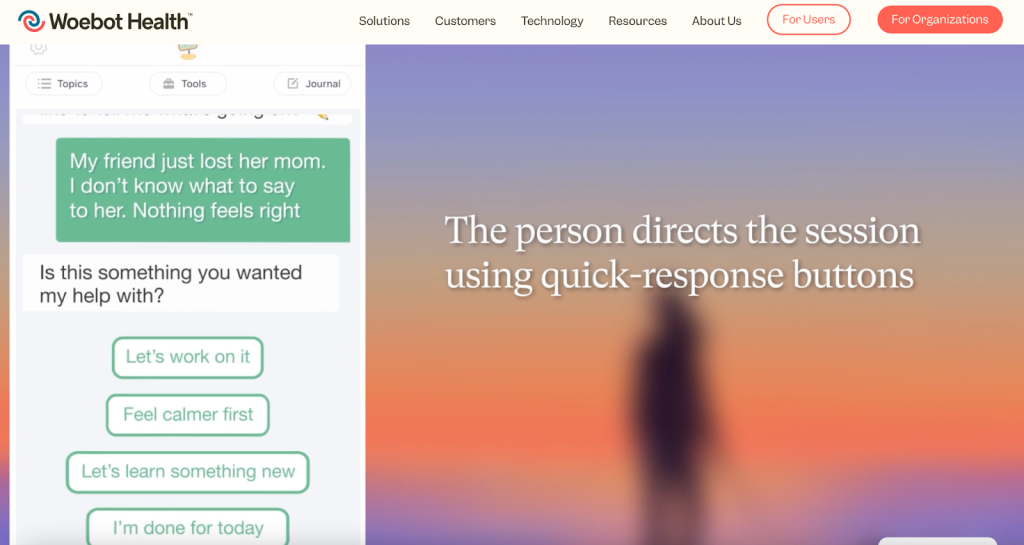
Feel free to contact us!

FAQ

How to build a SaaS product without coding?

Building a SaaS product without coding involves using no-code and low-code platforms that empower individuals to create sophisticated software solutions. Combining pre-built components and logic allows you to create a functional SaaS product without writing complex code.

How much does it cost to build a SaaS product?

The cost of building SaaS products can vary widely, including development, design, testing, marketing, and other associated costs. Remember that your SaaS solution complexity, the core features, and the development team’s hourly rates will influence the final price.

How do you build a SaaS product from scratch?

Building a SaaS product from scratch involves a systematic approach: idea and market research, defining your MVP, design and prototyping, development, testing, launch, iterating, and scaling. Also, engaging a skilled development team and staying agile are critical to SaaS development success.

What expertise do you need to build a SaaS product?

Creating a SaaS product requires a complete approach – understanding the industry, defining the problem, and having UI/UX design expertise. Based on your tech stack, proficiency in languages like Python or JavaScript is crucial. A digital marketing scope is vital for a thriving SaaS product launch.

SaaS Marketing: Innovative Strategies and Success Stories

TL;DR

SaaS marketing has one core task: constantly proving to customers that the product is worth the monthly payment. This guide explains what SaaS marketing is, how it differs from traditional marketing, and its essential components. It also covers the best channels – content, email, paid ads, social media, and influencers – common challenges, the five stages of the SaaS marketing funnel, and how to build a successful strategy.

Make a summary of this article with AI:

Software as a service (SaaS) marketing is a way of transferring software licenses and selling products using cloud applications. This marketing model has its characteristics – the task of the SaaS company is to constantly prove to its customers that their product is worth the monthly payment. To achieve this, developers improve the user experience daily and expand the software tools.

SaaS marketing is a popular niche in which thousands of companies and firms operate. With the help of SaaS marketing, startups grow into corporations. This is only possible with a good strategy and the proper marketing channels. Marketers must keep abreast of all changes in this niche – the company’s performance and chances of success depend on many factors.

In this article, we will analyze the strategies that move SaaS startup marketing forward, explore the essential elements, and draw inspiration from real-world examples that have successfully guided this complex landscape. Our experts will provide insights that empower businesses to thrive in the present and future-proof their offerings in a rapidly evolving digital ecosystem. Whether you’re a SaaS provider or a curious observer, this exploration of SaaS marketing promises to dispel the difficulties and light the path to sustained success.

Shall we begin?

SaaS marketing meaning: essence and impact

What is SaaS? Software as a service is a software delivery method through which specialists gain access to selected software via subscription. Payment may also be charged for a certain number of transactions.

SaaS architecture

The main advantage of SaaS is that the client receives a working application with full service. To do this, the provider or company provides access to the software using a browser – without downloading the program. This guarantees the user timely updates and bug fixes – the application is located in the cloud.

This approach to software distribution has many advantages and disadvantages. The benefits include convenience, compatibility with operating systems (Windows, macOS, or Linux), the ability to work with the team on the same plane (some apps and programs support shared access), and update and correction (users do not need to wait for downloading a new version or installing an update). 

Users consider the main drawback of SaaS to be that the Internet is required to work with the software. The development of wireless technologies makes this weakness less critical. Some SaaS applications work offline, providing basic tools and capabilities.

What is SaaS marketing? To understand what SaaS marketing is, you need to refer to the definition of the term SaaS. With SaaS, consumers access programs from cloud storage via a browser. The principle is simple: you can use the applications you need without downloading for a monthly payment. In turn, SaaS marketing is one of the methods by which a company promotes its software. In other words, SaaS marketing adapts standard communications for promoting and selling cloud software.
The SaaS market is set to keep growing as more organizations globally use SaaS solutions for different business tasks. This includes customer resource management (CRM), enterprise resource planning (ERP), web hosting, and e-commerce.

Let’s focus more on the main advantages of SaaS marketing ideas.

Crucial benefits of SaaS startup marketing

In the rapidly evolving landscape of digital business solutions, SaaS marketing emerges as a powerhouse, offering many advantages that redefine how companies connect with their audience. Let’s delve into the specific benefits that make software as a service marketing a game-changer in the tech-driven marketplace.

  • Scalability. SaaS marketing enables businesses to scale effortlessly, adjusting resources and services based on evolving needs. This flexibility ensures that companies can seamlessly adapt to growth without the limitation of extensive infrastructure upgrades.
  • Cost-efficiency. With subscription-based models, SaaS marketing minimizes upfront costs, allowing businesses to allocate resources strategically. Moreover, this pay-as-you-go approach ensures a cost-efficient entry point for startups and a sustainable model for established enterprises.
  • Global accessibility. Cloud-based SaaS applications break down geographical barriers. So, users can access services from anywhere, fostering worldwide reach and collaboration, a crucial element in the interconnected world of modern business.
  • Continuous updates. SaaS marketing thrives on endless improvement. Regular updates and enhancements ensure that users benefit from the latest features and security measures without the hassle of manual installations, keeping businesses at the forefront of innovation.
  • Data-driven insights. Harnessing the power of data, SaaS marketing provides actionable insights. Analytics tools embedded within SaaS applications empower businesses to make informed decisions, refine strategies, and optimize their marketing efforts.

In conclusion, SaaS marketing is more than a strategy; it catalyzes efficiency, innovation, and strategic growth. Its advantages extend beyond conventional marketing approaches, offering a dynamic toolkit for businesses to thrive in the digital age.

By the way, it is crucial to understand how SaaS marketing differs from traditional marketing. Do you know the main differences? In any case, let’s remind ourselves.

Primary differences between SaaS marketing and traditional marketing

Understanding the distinctions between SaaS and traditional marketing is pivotal for businesses aiming to guide the digital age effectively. Let’s explore the fundamental differences that set these two approaches apart and redefine the strategies employed in the contemporary business arena.

The primary difference lies in the agility and adaptability inherent in SaaS marketing, emphasizing ongoing relationships and iterative improvements. Traditional marketing, while effective in its own right, often revolves around singular transactions. Acknowledging these distinctions allows businesses to tailor their marketing strategies to align with the dynamics of the digital era, ensuring relevance and resonance with the ever-evolving consumer landscape.

Below, you can see the detailed comparison table.

AspectSaaS marketingTraditional marketing
Delivery modelCloud-based, subscription servicesTangible products, one-time services
Revenue modelRecurring subscriptionsOne-time sales, periodic transactions
Customer focusContinuous relationship-buildingTransaction-focused
AdaptabilityAgile and iterativeOften slower to adapt to changing trends
MetricsMonthly recurring revenue (MRR), Customer Lifetime Value, and moreSales volume, Customer Acquisition Cost (CAC), and more
Product updatesContinuous, seamless updates and feature enhancementsPeriodic releases, may involve more substantial upgrade processes
Global accessibilityBorderless reach, accessible from anywhereGeographically constrained, may require local adaptations
Risk managementLower risk due to the subscription model and recurring revenueHigher risk associated with reliance on periodic sales
User feedbackContinuous feedback loop, agile response to user inputFeedback gathered at intervals, potentially slower adjustments
Innovation cycleRapid innovation, quick response to market changesSlower innovation cycle, may take time to adopt new trends

Understanding the nuanced differences between SaaS marketing and traditional marketing goes beyond the surface, providing businesses with the insights needed to tailor their strategies to the demands of the contemporary landscape. As we navigate this expansive spectrum, recognizing the strengths and limitations of each approach becomes instrumental in preparing marketing strategies that resonate and endure in the dynamic business ecosystem.

Need to strengthen your SaaS brand?

Contact us

Essential components of marketing SaaS products

A dynamic interplay of strategies and components sets the stage for success in the digital age. Unlike traditional marketing approaches, SaaS marketing ideas succeed in unique features that harmonize to drive user acquisition, retention, and overall business growth. Now, let’s check the main components that form the backbone of a robust SaaS marketing strategy.

In-depth understanding of the target audience

Successful SaaS startup marketing begins with a profound understanding of the target audience. This involves identifying the demographic details and delving into the pain points, challenges, and aspirations of potential users.

Interesting

The more intimately a marketing strategy aligns with the audience’s needs, the more likely it is to resonate and drive conversions.

Content-centric approach

Content is king in the realm of SaaS marketing. From informative blog posts and engaging videos to whitepapers and case studies, content bridges the solution and the user. A robust content strategy educates the audience and establishes the SaaS brand as an authority in the industry, fostering trust and credibility.

User-centric onboarding

The onboarding process is a critical touchpoint for SaaS users. A seamless, user-centric onboarding experience ensures that users can quickly understand and harness the value of the software. This includes intuitive tutorials, interactive guides, and responsive customer support to address any queries or challenges users may encounter.

For SaaS companies that want to improve onboarding and self-service support, customer portal development can help create a centralized space for guides, resources, and customer communication.

Below is an example of a customer-centric strategy for your SaaS business.

SaaS customer-centric strategy

Data-driven decision-making

SaaS marketing thrives on data analytics. Employing user data allows marketers to make informed decisions, optimize strategies, and personalize user experiences. This data-driven approach extends beyond acquisition to contain user engagement, retention, and continuous marketing strategy improvement.

Customer retention strategies

Retaining customers is as crucial as acquiring them. SaaS marketing involves implementing targeted retention strategies, such as ongoing communication, feature updates, and loyalty programs. By emphasizing the long-term relationship, SaaS companies can reduce churn and maximize the lifetime value of each customer.
As a result, the success of SaaS startup marketing lies in producing these critical components. From understanding the audience and delivering captivating content to ensuring a seamless user onboarding experience and гіштп data for continuous improvement, each component plays a pivotal role in creating a holistic and effective SaaS marketing strategy. By adopting these elements, businesses can guide the dynamic digital landscape with agility, resilience, and a boosted potential for sustained success.

Let's discuss

Contact Us

Optimal channels for SaaS startup marketing success

Where innovation and adaptability reign supreme, choosing the proper marketing channels is vital for sustained success. SaaS marketing isn’t a one-size-fits-all trial, and the strategic selection of channels can make all the difference. So, we’ll delve into the top marketing channels that define the landscape of SaaS marketing, each playing a unique role in driving brand visibility, user engagement, and business growth.

SaaS content marketing

It is well-known that SaaS content marketing is the cornerstone of SaaS marketing, and an effective content marketing strategy contains various elements:

SEO (search engine optimization)

Optimizing content for search engines ensures that your SaaS solution is discoverable. Companies like HubSpot exemplify this approach, consistently producing SEO-optimized content that positions them as thought leaders in the inbound marketing space.

HubSpot main page

Blogging

Regular, informative blog posts enhance SEO and establish your brand’s authority. Buffer’s insightful blog covers all aspects of social media and digital marketing and is a prime example of how blogging can drive engagement.

Buffer main page

E-books and webinars

Offering in-depth resources such as e-books and hosting webinars can position your SaaS company as an industry expert. Salesforce, through its comprehensive library of e-books and webinars, educates users on CRM (сustomer relationship management) best practices and industry trends.

Salesforce main page

SaaS email marketing

In fact, SaaS email marketing remains a powerful tool for nurturing leads and retaining customers in the SaaS sphere:

Drip campaigns

These campaigns, like those employed by Mailchimp, guide users through a personalized journey, providing valuable information and encouraging them toward conversion.

Mailchimp main page

Product updates and newsletters

Companies like Slack utilize email newsletters to inform users about product updates, industry news, and best practices, fostering ongoing engagement.

Slack main page

SaaS paid advertising marketing

Paid advertising allows SaaS companies to target specific audiences and drive quick results:

Google Ads

Utilizing Google Ads, companies like Dropbox can ensure their solutions appear prominently when users search for cloud storage or collaboration tools.

Dropbox main page

Social media advertising

Platforms like LinkedIn and Facebook enable targeted advertising. Monday.com, a project management SaaS, effectively utilizes LinkedIn ads to reach professionals seeking streamlined project collaboration.

Monday.com main page

SaaS social media marketing

Social media is a dynamic space for SaaS marketing ideas, providing opportunities for brand building and user interaction:

Engaging content on Twitter

Zendesk utilizes Twitter to share company updates and engage with users by providing customer support and participating in relevant conversations.

Zendesk main page

Visual storytelling on Instagram

Canva, a graphic design SaaS, uses Instagram to showcase user-generated content, share design inspiration, and highlight the people behind the platform.

Canva main page

SaaS influencer marketing

Partnering with influencers in the industry can amplify your SaaS brand’s reach and credibility:

Partnerships with industry experts

Referbi, a robust referral program powered by Intobi company, frequently collaborates with industry experts and thought leaders to host webinars and share insights. By tapping into the influence of these experts, Referbi enhances its brand authority and credibility within the referral marketing landscape. This strategic collaboration provides valuable content to users and positions Referbi as a trusted source in the industry, driving awareness and fostering a sense of reliability among its audience.

Our big challenge was making a super practical tool for businesses to get more customers and keep them returning. Of course, we wanted our solution to be better than what others had. So, we used our skills to make excellent affiliate referral software and a fantastic app for iOS and Android. This tool helps businesses get more customers and make people love their brand.

A robust referral program powered by Intobi

User advocacy programs

Zoom has implemented a user advocacy program through its “Zoom Champions” initiative. It is a community-driven program where enthusiastic users, often called Zoom Champions, voluntarily advocate for the platform. These advocates share their positive experiences with Zoom, provide tips and best practices, and actively engage with other users in forums and social media.

Zoom Champions initiative

A strategic combination of these channels can create a synergistic effect, boosting the impact of your marketing efforts. In fact, each channel contributes uniquely to the holistic success of a SaaS marketing strategy. By understanding the nuances of these channels and tailoring your approach to your target audience, your SaaS company can confidently steer the complexities of the digital era and drive sustained growth.

Ready to scale your SaaS product?

Contact us

Common SaaS startup marketing challenges

While the appeal of disrupting industries is vital, startups often find themselves grappling with unique obstacles in the competitive digital landscape. It is essential to explore some of the critical challenges that SaaS startups commonly face as they strive to make their mark.

  • Visibility and awareness: Gaining visibility in an area of digital offerings is a significant hurdle. Establishing brand awareness requires strategic efforts to cut through the noise and reach the target audience effectively.
  • Customer trust: Building trust in a new SaaS product demands overcoming skepticism. Convincing potential users about the reliability and security of the solution becomes a crucial challenge.
  • Limited resources: Startups often operate on tight budgets, limiting the resources available for marketing endeavors. Allocating funds judiciously while maximizing impact becomes a delicate balancing act.
  • Competition with established brands: Competing with established players in the SaaS arena poses a considerable challenge. Startups must find unique selling propositions and differentiation strategies to stand out.
  • User onboarding and retention: Once acquired, retaining users is a persistent challenge. Compelling onboarding experiences and continuous value delivery are critical for keeping users engaged and satisfied.
  • Adapting to market dynamics: The rapid evolution of market trends and user preferences requires skillful adaptation. Startups must stay agile to adjust strategies in response to changing dynamics.
  • Navigating regulatory compliance: Addressing legal and regulatory aspects, especially in industries with strict requirements, adds complexity. So, it is crucial to ensure compliance while maintaining agility.

In the complex landscape of SaaS startup marketing, overcoming these challenges is necessary and a testament to resilience and strategic insight. By recognizing and addressing these limitations head-on, startups can chart a course for success in a digital ecosystem that rewards innovation, persistence, and adaptability.

The SaaS marketing funnel: 5 fundamental stages

Comprehending the sophistication of the marketing funnel is crucial for guiding potential customers from discovery to long-term loyalty. Then, let’s check the five main stages of the SaaS marketing funnel, each playing a pivotal role in driving user acquisition and retention.

Stages of SaaS marketing funnel

Awareness

The journey begins with creating awareness. At this stage, the goal is to inform potential users of your SaaS solution. Strategies include content marketing, social media campaigns, and search engine optimization. Compelling content and targeted advertisements help launch a wide net and introduce your brand to a broader audience.

Interest

Once awareness is established, the focus shifts to generating interest. Engaging content, informative blog posts, and compelling visuals come into play. At this stage, the goal is to spark interest and encourage potential users to learn more about your SaaS offering. Webinars, demo videos, and interactive content can effectively pique interest.

Consideration

As users express interest, they move into the consideration stage. Here, providing in-depth information, case studies, and comparison guides helps them evaluate your solution against competitors. Free trials or limited-access versions can also facilitate hands-on exploration, allowing users to assess the value and fit of your SaaS product.

Purchase

The decision to purchase is a critical transition. Clear calls-to-action (CTAs), transparent pricing, and streamlined purchase processes are essential. Building trust through testimonials and guaranteeing a smooth onboarding experience enhances the possibility of conversion at this stage.

Retention

Post-purchase, the focus moves to retention. Keeping users engaged with regular updates, exclusive features, and excellent customer support is crucial. Loyalty programs, educational resources, and ongoing communication contribute to building long-term relationships with users.

Each stage in the SaaS marketing funnel is a stepping stone toward fostering a robust and lasting relationship with users. A well-crafted SaaS marketing strategy that aligns with each stage ensures a comprehensive approach to user acquisition and retention in the competitive SaaS landscape.

Building a successful SaaS marketing strategy

A well-crafted SaaS marketing strategy is not just a roadmap; the compass drives a product toward success. This comprehensive guide is designed to explore the essential steps in creating a robust SaaS product marketing strategy. From solving your audience’s complications to fine-tuning specific tactics for ongoing success, each factor contributes to a holistic approach aimed at attracting customers and fostering long-term relationships.

1. Unveiling your audience: understanding customer personas

It’s crucial to chart your course by understanding who your customers indeed are. Demographics merely scratch the surface; delve deeper into their business backgrounds, values, and goals. Identify their influences and the sources they rely on for information, and empathize with their motivations and challenges.
Constructing detailed customer personas is not a formality; it’s the bedrock of a successful SaaS marketing strategy. This knowledge goes beyond targeting; it enhances your ability to resonate with your audience, forging a connection beyond a transactional level.

SaaS marketing customer personas

Understanding the nuanced layers of your audience allows you to tailor your messaging and communication channels accordingly. For instance, a SaaS product catering to tech-savvy millennials may leverage social media platforms, while a B2B (business-to-business) solution may find more traction through industry-focused publications and conferences.

2. Crafting your identity: define positioning and messaging

With a crystal-clear understanding of your audience, the next step is to define the identity of your SaaS product. What sets your solution apart in a saturated marketplace? This is more than a tagline; it’s about preparing a unique value proposition that captures attention and resonates with your target personas on a profound level. Your messaging should transcend the features of your product, delving into the intrinsic benefits customers will derive. 

Moreover, your positioning should not exist in isolation. It should align strategically with the needs and desires of your identified customer personas. This alignment forms the basis for a compelling brand story that communicates value and forges an emotional connection with your audience. In a world inundated with choices, this emotional resonance can transform a product into a brand, fostering loyalty and advocacy.

3. Navigating the marketing channels: choose wisely

The vast and varied SaaS startup marketing landscape offers many channels to explore. The options can be overwhelming, from social media and content marketing to email campaigns and influencer partnerships. The key here is not to be present everywhere but to be present where it matters.

The choice of SaaS marketing channels should align with the preferences and behaviors of your identified customer personas. A B2B SaaS solution might find LinkedIn more effective than Instagram, while a B2C (business-to-consumer) product might thrive on visually-driven platforms. However, the emphasis should always be on quality over quantity. It’s not about being universal; it’s about being impactful. Combining multiple channels can amplify your reach, but each channel should be carefully chosen based on its ability to contribute to your overarching strategy.

4. Metrics that matter: setting SaaS marketing models

To calculate the success of your SaaS product marketing strategy, it’s essential to establish meaningful metrics aligned with your business goals. Customer acquisition cost (CAC), customer lifetime value (CLV), conversion rates, and churn rates are just a few key performance indicators (KPIs) that provide insights into the effectiveness of your campaigns.

Moreover, these metrics shouldn’t be static. As your SaaS product evolves and as market dynamics shift, the relevance of specific metrics may change. Regularly reassess and refine these benchmarks to align with your business objectives. This adaptability is critical to staying agile in a landscape that evolves at the speed of technology.

5. Tactical tricks: selecting specific SaaS marketing tactics

Armed with a deep understanding of your audience, a compelling identity, and chosen channels, it’s time to deploy particular marketing tactics. Content marketing, SEO optimization, paid advertising, webinars, email campaigns, and influencer collaborations are just a few of the diverse tactics at your disposal.

The key here is to adopt a variety of approaches. Tailor your tactics based on the preferences of your audience and the nature of your SaaS solution. A B2B product may benefit more from thought leadership webinars and whitepapers, while a B2C solution might succeed in engaging social media campaigns. The goal is to create a well-rounded mix of tactics that ensures a comprehensive and engaging marketing strategy.

6. The ongoing evolution: measure and improve for SaaS startup marketing success

The SaaS industry is dynamic and ever-evolving, so your marketing strategy should be, too. Once your strategy is in motion, the work is far from over. Implement robust analytics tools to measure the performance of your campaigns continuously. Analyze user behavior, track conversion paths, and gather customer feedback. Use these insights to refine your approach, optimize underperforming elements, and capitalize on successful strategies.

A flexible philosophy that welcomes change and adaptation is crucial for sustained marketing success. The ability to shift based on emerging trends, customer feedback, and performance metrics ensures that your SaaS marketing strategy remains relevant and ahead of the curve.

In the highly competitive realm of SaaS, a successful marketing strategy is an ongoing, dynamic process. It begins with a deep understanding of your audience, extends to compelling brand identity, explores diverse marketing channels, sets meaningful metrics, deploys targeted tactics, and constantly evolves through measurement and improvement. In a world where innovation is the heartbeat of progress, your marketing strategy should be the rhythm that keeps your SaaS product in sync with the market’s pulse.

Let's discuss

Contact Us

Practical techniques for marketing SaaS companies

Strategic marketing is the core to success in the rapidly evolving realm of software as a service. SaaS companies, faced with a dynamic and competitive landscape, require targeted approaches to attract and retain customers. Here, we will analyze the top marketing techniques explicitly tailored for SaaS companies.

Free trials and freemium models

Offering free trials or freemium versions of your SaaS product is a powerful strategy. This allows potential customers to experience the value firsthand, breaking down entry barriers and fostering user adoption. The “try before you buy” approach often leads to conversions as users recognize the benefits of upgrading to premium plans, making this a cornerstone for SaaS startup marketing success.

Example of SaaS free trial length

Referral programs

Harness the power of satisfied customers by implementing referral programs. Encourage existing users to advocate for your SaaS solution by offering encouragements such as discounts or additional features. Word-of-mouth remains a powerful marketing tool, and referral programs leverage the trust established by your satisfied customer base.

Referral program by LiveChat

Tailored experiences for new clients

Personalization is critical in the SaaS landscape. Tailor the onboarding experience for new clients, guiding them through the features and benefits most relevant to their needs. A personalized onboarding journey enhances user satisfaction and increases the chance of long-term engagement.

Success stories and case studies

Highlighting success stories and case studies featuring satisfied customers proves your SaaS solution’s effectiveness. Real-world examples of positive impacts on businesses build trust and credibility, influencing potential customers in their decision-making process.

Community building

Foster a sense of community around your SaaS product by creating forums, social media groups, or dedicated spaces on your website. Facilitate discussions, knowledge-sharing, and user interaction. A vibrant community enhances user engagement and serves as a valuable source of feedback and testimonials.

Continuous analytics and optimization

Implement continuous analytics and optimization to refine your marketing strategies. Regularly analyze vital metrics such as conversion rates and user engagement. Use these insights to optimize campaigns, ensuring your marketing efforts align with evolving customer behaviors and industry trends.

Celebrate success with your customers

Acknowledge and celebrate the successes of your customers. Recognize landmarks, share customer achievements on social platforms, and create a positive feedback loop. By celebrating the achievements of your customers, you foster a sense of loyalty and showcase real-world examples of how your SaaS solution contributes to business growth.

Asana's task completion celebration

Gamification strategies

Infuse elements of gamification into your SaaS platform to enhance user engagement. Incorporate challenges, rewards, and interactive features that make the user experience enjoyable and compelling. Gamification encourages active participation and fosters a sense of achievement, turning users into enthusiastic advocates for your product.

Thus, successful marketing is a dynamic combination of innovative strategies and customer-centric approaches. With marketing techniques, SaaS companies can attract new clients and promote lasting relationships, ensuring sustained growth and relevance in an ever-evolving market.

Search for effective SaaS marketing tactics?

Let’s chat

Cutting-edge software for SaaS marketing

Every type of marketing is complete with tools. Professionals need programs and services to achieve results. SaaS startup marketing also has such advanced tools. In this article, we already remembered a little about them, especially HubSpot, Google Ads, and Canva. Now, let’s discuss other equally progressive SaaS marketing tools.

Plerdy

It helps track, analyze, and convert website visitors into buyers. Heat maps help understand how users behave on a website to improve UX. SEO-checker – daily collection of the most essential SEO data from website pages. Event and Goal Tracking is one of Plerdy’s tools to track specific user actions on a website. Plerdy has over 100 features and reports for online marketers and businesses.

Plerdy main page

Hootsuite

You can get more done on social media in less time. Save time by scheduling posts across all your social networks in just a few clicks. Automatically organize your content and view messages in a simple calendar view. Access your images directly from your Hootsuite dashboard to make it easy to post regularly.

Hootsuite main page

BuzzSumo

Today, thousands of businesses use BuzzSumo to create great content, monitor their brand and industry, and discover growth opportunities. Build your brand and sell online, all in one place. This marketing and sales tool works to help you run your business.

BuzzSumo main page

Semrush

Harness the power of Semrush for comprehensive online marketing success. From SEO and content marketing to PPC (pay-per-click) and social media marketing, Semrush provides a unified platform to achieve measurable results. Gain insights, conduct competitor research, and optimize your strategies seamlessly.

Semrush main page

Ahrefs

Boost your SEO competition with Ahrefs – a versatile toolkit designed for everyone. You don’t have to be an SEO expert to rank higher and drive more traffic. Ahrefs empowers users with a universal set of tools, simplifying SEO tasks and enabling effective strategies for increased visibility and improved online performance.

Ahrefs main page

Google Analytics

It is a web analytics service offered by Google that tracks and reports website traffic. Google Analytics provides an SDK (software development kit) to collect usage data from iOS and Android apps, known as Google Analytics for Mobile Apps. Browsers, browser extensions, firewalls, and other means may block Google Analytics.

Google Analytics interface

Google Search Console

You can increase your site’s ranking in Google Search Search Console. Tools and reports allow you to measure your site’s Google ranking and clicks, correct errors, and rank high in search results.

Google Search Console interface

With the help of these tools, SaaS niche marketers achieve their goals and get good results. That’s why they are so popular.

A guide to effectively measuring marketing SaaS performance

Success is not just about attracting users but also about understanding their journey and optimizing strategies accordingly. Key metrics play a pivotal role in evaluating the effectiveness of SaaS startup marketing efforts. Let’s explore ten crucial metrics that form the foundation for measuring marketing SaaS performance.

  • Monthly Recurring Revenue (MRR)

It represents the predictable monthly revenue generated from subscription-based services, providing a baseline for assessing financial health.

Formula: MRR = Average Revenue Per User (ARPU) × Total Number of Users

  • Customer Acquisition Cost (CAC)

This is the cost incurred to acquire a new customer, containing marketing and sales expenses. It ensures a balance between spending and revenue.

Formula: CAC = Total Marketing and Sales Costs / Number of New Customers Acquired

  • Lifetime Value (LTV)

It estimates the total revenue a customer is expected to generate throughout their relationship with the SaaS product, emphasizing long-term value.

Formula: LTV = Average Revenue Per User (ARPU) × Average Customer Lifespan

  • Churn Rate

Churn Rate measures customer attrition, reflecting the percentage of customers lost over a specific period. A high churn rate signals potential issues with user retention.

Formula: Churn Rate = Number of Customers Lost / Total Customers at the Start of the Period

  • Net Promoter Score (NPS)

This assesses customer satisfaction and loyalty by calculating the possibility of customers recommending the SaaS product. It categorizes users as promoters, passives, or detractors.

Formula: NPS = Percentage of Promoters – Percentage of Detractors

  • Lead-to-Customer Conversion Rate

This metric evaluates the efficiency of converting leads into paying customers, providing insights into the effectiveness of the sales funnel.

Formula: Lead-to-Customer Conversion Rate = (Number of Customers Acquired / Number of Leads) × 100

  • User Engagement Metrics

So, metrics like active users, session duration, and feature utilization offer insights into how users interact with the SaaS product, indicating the product’s overall appeal and utility.

  • Retention Rate

Retention Rate measures the percentage of customers retained over a specific period, indicating the platform’s ability to retain and satisfy its user base.

Formula: Retention Rate = ((Number of Customers at the End of a Period – New Customers) / Number of Customers at the Start of the Period) × 100

  • Funnel Metrics

Funnel metrics analyze conversion rates at each stage of the marketing funnel, identifying areas for improvement in the user journey from awareness to conversion.

  • Return on Ad Spend (ROAS)

It evaluates the effectiveness of advertising efforts by measuring revenue generated against ad spending. It indicates the profitability of advertising campaigns.

Formula: ROAS = (Revenue Generated from Ads / Cost of Ads) × 100

These ten metrics, with their clear definitions and formulas, provide a comprehensive view of SaaS marketing performance. Thus, with these marketing metrics, SaaS businesses can refine strategies, enhance customer experiences, and ensure sustainable growth in the competitive digital landscape. 

Bottom line

Guiding the complex realm of SaaS startup marketing requires a thorough understanding of strategies, elements, and techniques that resonate with today’s digital landscape. In conclusion, SaaS marketing strategy is a dynamic interplay of innovation and adaptability. So, by assuming the right features, using proven tactics, and drawing inspiration from successful examples, SaaS businesses can carve a distinctive niche in the market. 

As the digital landscape evolves, staying ahead demands a holistic approach that integrates creativity, data-driven insights, and a deep understanding of user needs. You can see the limitless possibilities with Intobi, a leading software development company committed to transforming your SaaS aspirations into reality. So, elevate your digital presence, captivate your audience, and thrive in the ever-evolving world of SaaS with our specialists. Contact us today to launch your journey to digital success!

FAQ

What aspect of marketing SaaS products do you enjoy the most?

You can find the dynamic nature of SaaS marketing exhilarating. The continuous evolution of technology and user needs can challenge you to stay innovative. Crafting strategies that showcase not just the features but also the transformative impact of SaaS solutions is particularly fulfilling.

What is SaaS marketing?

SaaS marketing is the specialized area of promoting software as a service (SaaS) products. It involves creating/executing strategies for cloud-based software solutions to attract and retain customers. SaaS marketing focuses on highlighting the value and efficiency that these services bring to users.

What does SaaS stand for in marketing?

In marketing, SaaS stands for software as a service. This model delivers software apps over the Internet, eliminating the need for users to install, maintain, and update the software locally. SaaS is a popular choice for businesses seeking scalable and cost-effective solutions.

How much do SaaS companies spend on marketing?

The marketing budget for SaaS companies varies widely based on factors like company size, target market, and growth stage. SaaS companies allocate around 10-20% of their revenue to marketing. However, newer entrants might invest a higher percentage to build brand awareness and acquire customers.

What is B2B SaaS marketing?

B2B (business-to-business) SaaS marketing refers to the marketing strategies and tactics specifically designed to target other businesses as customers for software as a service products. It involves understanding the unique challenges and needs of businesses and crafting marketing campaigns.

How to measure SaaS content marketing?

Measuring the effectiveness of SaaS content marketing involves assessing various metrics. Beyond the standard metrics like website traffic and engagement, focus on tracking conversion rates, customer acquisition costs, customer lifetime value, and monitor how content contributes to the sales funnel.